The Keppel brand is closely tied to Singapore’s corporate landscape.
With several publicly listed companies sporting this brand name, investors have to decide which one to pick.
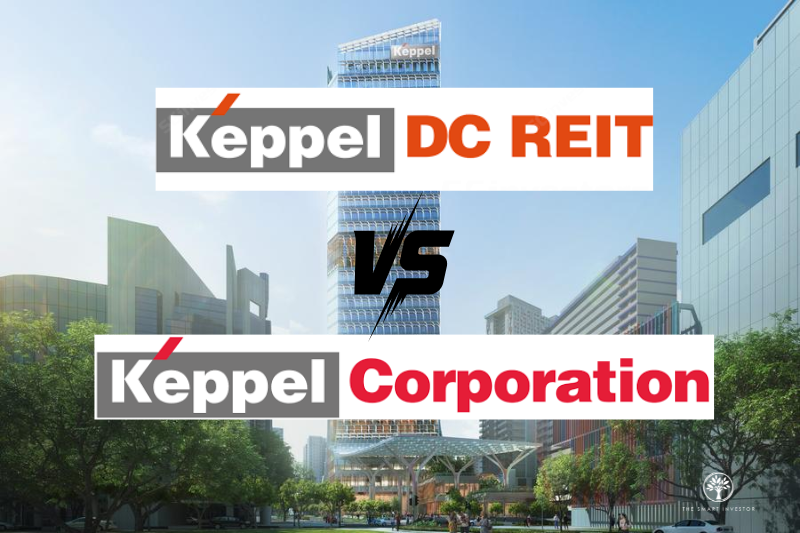
For instance, deciding between Keppel DC REIT (SGX: AJBU) and Keppel Limited (SGX: BN4), isn’t as straightforward as it looks.
One offers pure-play data centres exposure while the other is a massive conglomerate.
The hard part is choosing which fits your portfolio better: a specialised data centre REIT or a diversified giant.
Let’s examine the key differences and see which name is a better fit for your portfolio.
Business Overview: Two Very Different Models
Keppel DC REIT is a data centre REIT with exposure spanning the Asia-Pacific region and Europe.
As of 31 December 2025, the REIT has S$6.3b in assets under management (AUM), with 25 data centres across 10 countries.
Being a REIT, Keppel DC REIT’s main focus revolves around ensuring the occupancy rate across its portfolio is high, preferably with tenants committed to long leases.
These factors will allow the data centre operator to collect steady rental income, which it can redistribute to its unit holders.
For investors considering a position in Keppel DC REIT, your investment thesis should be income-focused with the potential for steady capital appreciation.
But make no mistake, income should be your core focus here.
Keppel Corporation (SGX: BN4)
If you’re looking for a diverse business, Keppel might be the pick for you.
This vast conglomerate has operations encompassing asset management, infrastructure, data centres and connectivity, while also providing essential utilities such as energy.
Keppel is both a utility provider and a leader in infrastructure and asset management.
The company keeps the lights on through energy sales, charging fees to manage assets for investors, and providing the main tools, such as data centres and connectivity, that companies need to function.
Unlike its REIT counterpart, which relies solely on rental income, Keppel’s diversified business across asset management, urban development, and its foray into the renewables business makes it a more compelling growth play.
Income versus Diversity: What Are You Buying?
Keppel DC REIT solidifies its status as an income play with its consistent distributions.
To put this into perspective, the REIT has averaged a distribution yield of 4.6% over the past decade.
With a track record of paying distributions since 2015, this REIT is certainly appealing to income-focused and retired investors seeking a stable income.
That said, this yield is sensitive to interest rates — if rates inch up, its yield could come under pressure, and vice versa.
On the other hand, Keppel has a lower dividend yield.
However, the conglomerate compensates with higher capital growth potential, as it continues its transition to an asset-light business model (focusing on earning fees rather than owning physical assets).
Coupled with secular growth trends, including the green energy transition, and data centre and connectivity expansion, its growth potential looks promising.
A possible headwind to Keppel is that its earnings could be more cyclical compared to its REIT counterpart.
Financial and Valuation Comparison
Keppel DC REIT currently sports a share price of S$2.23 per share, with a market cap of S$5.44 billion.
Keppel DC REIT currently offers a last 12-month (LTM) yield of 4.7%.
The REIT’s 2025 distribution is roughly 10% higher than its 2024 payout.
This increase in payout has been supported by a steady climb in revenue and net property income (NPI).
The data centre operator’s balance sheet remains manageable, with leverage at a comfortable 35.8% as of 31 December 2025.
Meanwhile, Keppel is hitting new highs; at a share price of S$10.95, the stock has nearly doubled from its 52-week low of S$5.61, bringing its market cap to nearly S$20 billion.
The conglomerate offers a trailing LTM yield of 3.1%.
Management is committed to increasing its dividends, funded by its asset divestments and increased business profits moving forward.
Like the REIT, Keppel’s revenue and profit have been on a steady upward climb.
Net debt to earnings before interest, taxes, depreciation, and amortisation (EBITDA) stands at 5.5x as of 30 June 2025, down from 5.9x in December 2024.
Risk Profiles: What Could Go Wrong?
The risks facing Keppel DC REIT include higher interest rates, which could pressure yields.
The REIT also faces concentration and competition risk as well, given its portfolio of data centres.
Meanwhile, Keppel faces cyclical risks given its exposure to infrastructure and renewable energy.
Delayed project timelines could also result in earnings volatility.
Get Smart: Which Keppel Stock Fits Your Portfolio?
If you’re looking for a stock that provides consistent income with an exposure to data centres and lower volatility, Keppel DC REIT might be for you.
If you’re someone looking for business diversity, Keppel might be for you.
Or you can always own both for the best of both worlds, diversifying across income and growth.
In all, there’s no such thing as a perfect “Keppel stock”.
For income investors, Keppel DC REIT seems to be a better fit, while investors seeking more growth can consider Keppel.
Imagine receiving steady rent increases for more than two decades. It sounds unusual, but one healthcare REIT already has rental escalations locked in until around 2042. Income visibility like this is hard to find today. We break down how this REIT built such dependable cash flow in our FREE dividend report and how it could strengthen a retirement portfolio. Get the free report here.
Follow us on Facebook, Instagram and Telegram for the latest investing news and analyses!
Disclosure: Wilson.H does not own shares in any of the companies mentioned.