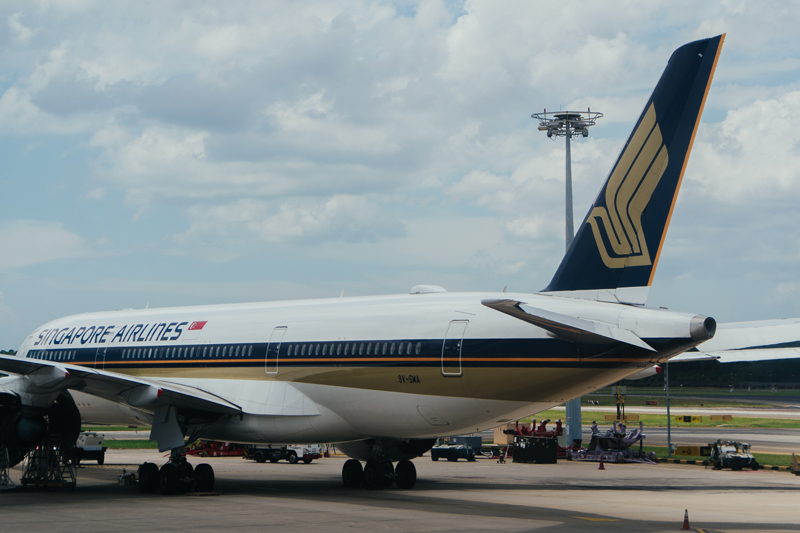
Those who invested in Singapore Airlines Limited (SGX: C6L), or SIA, have seen better days.
While the broader market enjoyed gains in late 2025, SIA’s share price remained stubbornly flat-to-down, struggling to break past the S$6.50 resistance level.
This might be surprising, given that passenger numbers, cargo volumes and revenues have all been ticking higher.
In this article, we take a look under the hood of SIA’s latest earnings to examine how the airline is doing, and if you should consider adding this blue chip to your portfolio.
Revenue Growth Masks a Sharp Profit Decline
For the six months ended 30 September 2025 (1HFY2025/2026), the airline’s turnover inched up slightly 1.9% year on year (YoY) to S$9.7 billion.
Profitability, however, plunged 67.9% YoY to S$238.5 million.
This slump is mainly attributed to the share of losses from associated companies.
In other words, revenue growth was hiding the slump in SIA’s decline in profitability.
Free cash flow (FCF) also slumped significantly to S$817.6 million from S$1.17 billion in 1HFY2024/2025, pointing to softer operating leverage.
Air India Losses Take Centre Stage
The biggest hit to profitability for this half came from the losses experienced by its 25.1% stake in Air India, following the Vistara integration.
Air India is struggling in a highly competitive Indian aviation industry, posting a net loss of US$1.15 billion for its fiscal year 2025 (FY2025).
To make things worse, Air India is facing a crisis of public trust following a fatal aeroplane crash in June.
In late October, Air India also requested a large cash injection from its shareholders (including SIA).
This staggering net loss has flowed through, via equity accounting from December 2024 onwards, directly to SIA’s profit and loss statement through the line item “share of losses of associated companies”.
Singapore Airlines disclosed a negative contribution of S$375.4 million for this metric in its 1HFY2025/2026 results.
Owing to its substantial stake and following the Vistara integration, this marks a structural change in SIA’s earnings profile compared to prior years.
Management is committed to its Air India stake as they believe in the Indian air travel growth market potential.
However, given rising competition and unique operating challenges, it does not seem that Air India is likely to report net profits any time soon.
The key takeaway is that the fortunes of Air India are now highly linked to SIA’s earnings moving forward.
Passenger Demand Remains Strong, But Yields Are Under Pressure
On the bright side, SIA’s core operating metrics remain encouraging.
Singapore Airlines’ passenger numbers rose 6.2% YoY to 13.7 million, with load factor improving one percentage point YoY to 86.7%.
Across the entire SIA Group (including Scoot), passenger traffic grew 8.0% YoY to 20.8 million, with a group load factor of 87.7%.
These metrics suggest robust travel demand across both brands.
However, passenger yields weakened 2.9% YoY to S$0.099 per passenger-kilometre for the Group, reflecting increased competition.
SIA’s passenger yields specifically declined 1.8% YoY to S$0.11 per km.
Similarly, cargo revenue softened to S$1.07 billion, down 2.8% YoY, with yields declining 4.1% to S$0.347 per tonne-km.
These numbers highlight that volume growth alone for both passengers and cargo may be insufficient in an increasingly competitive environment.
Revenue growth depends on the Group’s ability to maintain or improve yields alongside capacity expansion.
A Strong Balance Sheet Still Provides Cushion
Singapore Airlines continues to have a decent capital structure, with substantial cash and equivalents amounting to S$8.5 billion as of 30 September 2025.
Borrowings remain elevated at S$7.8 billion, but debt-to-equity remains healthy at 0.70 times.
This balance sheet strength remains a core strength for SIA, giving the airline a nice buffer against weaker operating profits.
Dividends Reflect a More Cautious Phase
SIA paid an interim dividend of S$0.05 per share, representing a 50% decline compared to the interim dividends paid over the past three fiscal half-years (S$0.1 per share).
However, this decline in interim dividend is partially compensated by an interim special dividend of S$0.03 per share.
This decline in total dividend (S$0.08 per share vs S$0.10 YoY) may reflect management’s cautious approach amidst an uncertain operating environment.
The YoY decline in FCF also contributed to the lower dividend paid thus far; less FCF means SIA would have to draw down on its cash balance to support its previous year’s dividend payout.
SIA’s lower dividend payout demonstrates management prudence, rather than business distress.
What Could Influence the Next Leg for the Share Price
Singapore Airlines could see a share price rally if there is more clarity surrounding Air India’s earnings pathway.
SIA’s ability to strengthen its passenger and cargo yields could lead to greater profitability.
The airline faces a few big hurdles: more expensive fuel, rising borrowing costs, and global instability.
While the industry is highly competitive, management believes SIA has what it takes to navigate this uncertain environment.
Singapore Airlines’ equity story depends more on earnings improvement, rather than the continued recovery in air travel.
What This Means for Investors
Putting the pieces together, SIA’s latest results highlight the difference between a steady recovery in air travel and its financial performance.
While demand remains resilient, profitability is significantly challenged by Air India’s losses and weaker yields.
Investors thinking of purchasing SIA shares at this moment should focus on its ability to execute, manage costs, and the Air India progression story.
Get Smart: Recovery Is No Longer the Only Story
SIA’s share price story is no longer solely reliant on air-travel recovery; its ability to rally depends on SIA’s efficiency in generating net profits from robust travel demand.
Moving forward, more critically, Air India (for better or worse) would play a contributing factor to SIA’s profitability.
This new 10-minute read could change how you invest this year. Inside:
5 SG dividend-paying blue chips that have quietly powered through past downturns, and could reward you handsomely in the next.
Grab the free report now. It might be the most profitable thing you read today.
Disclosure: Wilson.H does not own shares in any of the companies mentioned.