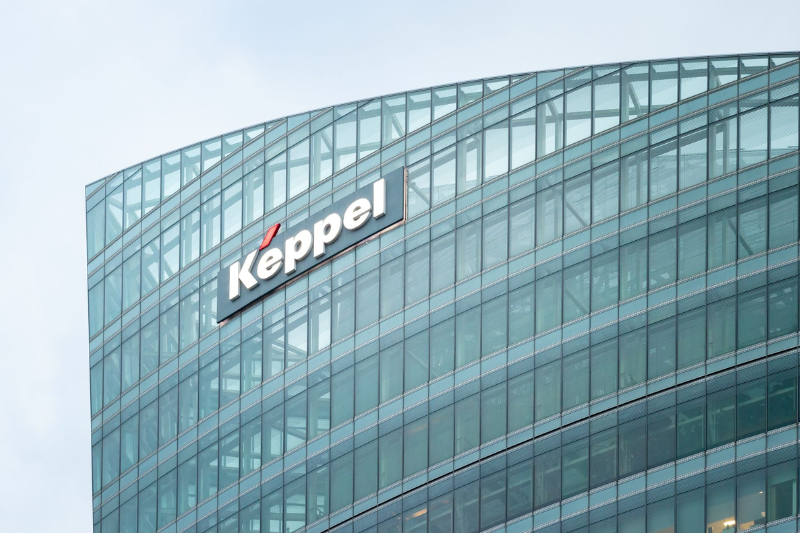
In 2015, Donald Trump was viewed as a longshot candidate for president, a non-profit called OpenAI had just been founded, and Keppel Corporation (SGX: BN4) was a conglomerate that derived 60% of its revenue from the offshore and marine (O&M) business, with the remainder from the property, infrastructure, and investment segments.
This meant that its share price was highly correlated to the price of oil, which was experiencing a significant downturn at the time.
Much has changed since then.
For one, Keppel Corp is a very different animal from what it was a decade ago.
It now calls itself a “global asset manager and operator”, having divested most of its O&M business.
In the first half of 2025, the rump of these assets accounted for just 7.7% of overall revenue.
Back in 2015, few would have predicted a two, non-consecutive term, Trump Presidency, or that OpenAI would sport a US$500 billion valuation.
Similarly, someone who invested, say $10,000 in Keppel shares 10 years ago would not have known the direction the company would take.
But if they had the discipline to hold on through the decade, what would that $10,000 be worth today?
Capital appreciation plus dividends
Keppel’s share price closed at $4.32 on 13 November 2015.
A $10,000 investment then would have bought around 2,315 shares.
Over the following 10 years, the company faced a prolonged downturn in its O&M business, resulting in a significant restructuring.
As a result of these efforts, its share price as of 13 November 2025 was $10.20, 136% higher than a decade ago.
This works out to a compound annual growth rate (CAGR) of about 9.0%.
However, shareholders in Keppel would have benefited from more than just capital gains.
The company has consistently paid twice-yearly dividends to shareholders since 2015, although the amount has fluctuated as it underwent restructuring and events such as the Covid-19 pandemic.
Since the lows of the pandemic in 2020, however, dividend payments have steadily increased.
An investor in Keppel over the last decade has pocketed a total of $2.73 in dividend payments for every share they own.
This works out to a total of $6,320 for the investor who had purchased $10,000 in shares back in November 2015.
Based on a purchase price of $4.32, and assuming a payout of $0.34 in 2015, Keppel shares yielded a chunky 7.9%.
However, the high yield was really a sign that the dividend was unsustainable, as demonstrated by the falling per-share distributions in the following years.
Today, assuming a payout of the same $0.34, the shares yield just 3.3%, compared to the Straits Times Index (SGX: ^STI)’s average dividend of around 3.87% (as of 13 November), using SPDR’s Straits Times Index ETF (SGX: ES3) as a proxy.
However, unlike in the past, when Keppel’s income was tied to the boom and bust of the oil cycle, Keppel now expects its earnings profile to become more stable and recurring, which should result in more consistent and steadily growing dividends to investors.
But wait … there’s more!
Typically, a shareholders’ total return would comprise the share’s capital gains and dividend payouts.
However, Keppel shareholders enjoyed another source of returns: distributions of units in Keppel REIT (SGX: K71U) and shares in Sembcorp Marine, resulting from Keppel’s restructuring (which involved merging its O&M business with Sembcorp Marine’s).
Keppel shareholders received one unit of Keppel REIT for every five Keppel shares they held, and 19.1 SembCorp Marine shares for every Keppel share.
SembCorp Marine was subsequently renamed Seatrium (SGX: 5E2), and underwent a 20:1 share consolidation.
| Received | Price (as at 13 Nov 25) | Value (as at 13 Nov 25) | |
| Keppel REIT shares | 463 units | $1.06 | $491 |
| Seatrium shares | 44,216 SembCorp Marine shares, subsequently 2,210 after Seatrium’s 20:1 share consolidation | $2.18 | $4,818 |
| Total | $5,309 | ||
Putting it all together, if you had invested $10,000 in Keppel a decade ago, this is what your holdings would look like today.
| Value of 2,315 Keppel shares @$10.20 per share | $23,613 |
| Amount of dividends received | $6,320 |
| Value of Keppel REIT units and Seatrium shares | $5,309 |
| Total | $35,242 |
This works out to a total return of around 252%, and a CAGR of 13.4%.
For comparison, a shareholder who invested in the SPDR Straits Times Index ETF over the 10-year period ending 31 October 2025 would have generated a CAGR of 7.9%, net of fees and assuming all dividends were reinvested.
Why Keppel Delivered These Returns
Much of the uptick around Keppel’s share price only happened in the last few years.
In early 2021, Keppel announced the first part of a restructuring, which involved exiting the offshore rig building business, and then merging its O&M business with Sembcorp Marine the following year.
In 2023, it announced that it would transform into an asset manager, operating alongside companies like Brookfield and Macquarie Group, targeting $200 billion in assets under management (AUM) by the end of 2030.
To that end, it has been involved in much deal-making, including acquiring European asset manager Aermont Capital in November 2023, and divesting its stake in telco M1 for $1 billion earlier this year.
Share price aside, how do old and new Keppel compare in terms of their financials?
In the first half of 2015, Keppel generated $5.4 billion in revenue, and 757 million in net profit.
For the same period this year, its revenue was $3.1 billion, with net profit of $373 million.
This is to be expected, given that Keppel gave up its biggest business as part of the restructuring, but is also an interesting lesson that sometimes, markets look beyond the immediate financials and at the future trajectory of the business.
For Keppel, this involves growing its AUM and asset management fees, riding the increasing demand for digital infrastructure, and focusing on delivering total shareholder returns.
Get Smart: riding out the short-term
Keppel’s journey over the past decade contains many lessons for investors: the importance of having a long-term outlook, how dividends can reward patience, and how a company that is undergoing restructuring can deliver strong returns.
The last point requires management that is focused not on empire-building but on doing the right thing by shareholders, even if this means downsizing and divesting businesses.
If you want to retire with a constant stream of dividends, these 5 stocks might be all you need. We’ve found 5 SG stocks that have kept paying (and growing) through inflation, rate hikes, and recessions. See what they are with our latest free report for SGX dividend investors. Click here to get instant access.
Follow us on Facebook, Instagram and Telegram for the latest investing news and analyses!
Disclosure: Silas owns shares in Keppel.