Manulife US REIT (SGX: BTOU), or MUST, is caught in a bind.
Back in July, the US office REIT reported that the valuation of its property portfolio had declined by 14.6% to US$1.63 billion.
As a result of this fall, aggregate leverage shot up to around 57% while a financial covenant with its lenders was breached.
MUST also ended up halting distributions when it reported its first half of 2023 (1H 2023) earnings back in August 2023 as it worked with its lenders to address this breach.
Just last week, the manager of MUST released a comprehensive recapitalisation plan to revitalise the REIT and help it get back on its feet.
Should unitholders support or reject this plan?
Details of the plan
The recapitalisation plan involves two key components – revitalise and reinforce.
For the revitalise portion, a total of US$285 million will be raised to pay off each lender.
MUST will divest its Park Place property to its sponsor, Manulife Financial, at US$98.7 million, which is the higher of the two independent valuations sought.
At the same time, the REIT will obtain a six-year unsecured sponsor-lender loan of US$137 million at an interest rate of 7.25%.
Finally, MUST needs to tap on US$50 million of its cash balance to fulfil this portion of the deal.
Meanwhile, the “reinforce” section seeks to reposition MUST’s portfolio and strengthen its balance sheet.
The office REIT will sell assets to raise US$328.7 million with properties prioritised according to their total return potential and capital expenditure (capex) requirements.
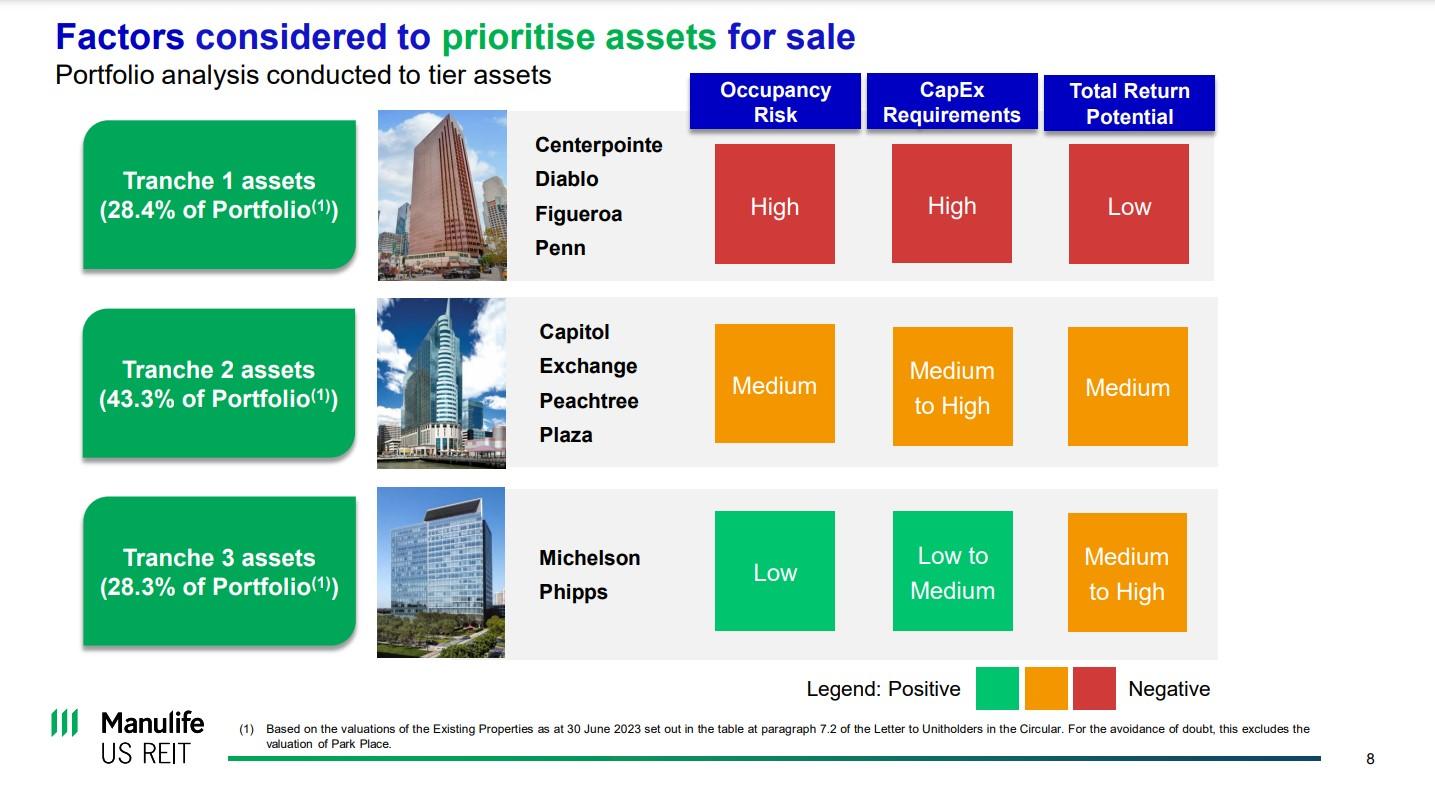
Source: Manulife US REIT Presentation Slides
The slide above shows how MUST’s portfolio will be divided into three tranches to determine which assets to sell off first.
The priority is to divest the Tranche 1 assets that make up 28.4% of the portfolio as they have high occupancy risk with lower total return potential.
As such, half-yearly distributions will remain suspended until the end of 2025 but may resume if certain conditions are met.
With the “reinforce” segment, the manager intends to repay maturing debt, fund future capex, and optimise the portfolio to enable the REIT to grow again.
Other options were considered
This plan was proposed after the manager considered numerous options for the REIT.
The problem is that the US office sector continues to face headwinds with post-COVID remote work patterns negatively impacting leasing demand.
The NCREIF Office Index has declined by 21.1% year-to-date, showcasing the challenging conditions within the sector.
Coupled with the high interest rate environment and MUST’s high aggregate leverage, this means that debt financing options are severely limited.
The REIT had considered the gradual disposal of its properties to raise cash but with buyers having limited access to credit, this was not a good option.
An equity fundraising exercise was also out of the question as MUST’s unit price had declined to an all-time low with banks unable to underwrite any preferential offer as the sponsor’s unitholding is mandated to be capped at 9.8%.
Mergers also come with heightened risk in the current environment while new loans and credit facilities were not available.
In light of the above, the manager of MUST has come up with a recapitalisation plan which it believes will help to cure the breach and put the REIT back on track for growth.
Benefits of the transaction
Assuming the recapitalisation plan is approved, MUST’s lenders will initiate a waiver of past and existing breaches and allow a temporary relaxation of financial covenants till 31 December 2025.
The lenders need to do so as MUST’s unencumbered gearing ratio will touch 80% after the recapitalisation plan while its interest coverage ratio will be reduced from the current two times to just 1.5 times.
MUST has around 19 months to effect the asset dispositions and the lenders have agreed to extend the loan maturities of all facilities by one year.
Assuming the recapitalisation plan goes through, the sponsor-lender loan is taken up and the tranche 1 assets are disposed of, MUST’s aggregate leverage is projected to fall to 49.4%.
This will bring the gearing level a whisker under the maximum 50% limit as mandated by Singapore’s central bank but also allow the REIT to have breathing room and a longer runway to withstand the US office sector headwinds.
Get Smart: An all-or-nothing decision
An extraordinary meeting (EGM) will be convened by MUST on 14 December to vote on three resolutions.
These three resolutions involve the “revitalise” transactions mentioned above along with the approval for the disposition mandate to accelerate the sale of the tranche 1 properties to raise more cash.
The manager has communicated that these three resolutions are inter-conditional, meaning that if any of them are not approved, then all three cannot go ahead.
Given the lack of alternatives for unitholders as mentioned above, it seems voting for these resolutions would be in their best interests.
Should the US office sector conditions improve or the REIT enjoys a favourable outcome for its dispositions, there is a possibility that distributions may be resumed before the end of 2025.
Boost your portfolio’s returns with 5 SGX stocks that promise both stability and steady growth. We bring you the names of these rock-solid stocks, including why they could drive massive dividends over the next few years. If you’re looking to invest for retirement, this guide is a must-read. Click HERE to download now.
Follow us on Facebook and Telegram for the latest investing news and analyses!
Disclosure: Royston Yang does not own shares in any of the companies mentioned.