Executive Summary
- Atlassian’s first quarter of the financial year ended 30 June 2027 (1Q’FY27) didn’t look like a slowdown. Revenue grew 23.7% year on year to US$1.77 billion, with Cloud revenue up 30.5% to US$1.3 billion. Free cash flow jumped 304% to US$462.6 million, a 26% margin.
- AI agents did not take work away from Atlassian’s human users. After adopting the MCP server, users created 50% more in Jira and 75% more in Confluence, on average. More agents means more work to coordinate, and Atlassian is where that coordination happens.
- Atlassian still gets paid for AI through bundles, not meters. More than 3,000 customers have upgraded to the Teamwork Collection, up 7x year on year. Meanwhile, GAAP gross margin rose to 85.2%, from 82% a year ago.
- The slowdown is real, but much of it comes from the comparisons and the accounting. Management expects Cloud revenue growth of about 27% in 2Q’FY27 and about 26% for the full year. Atlassian is lapping its DX acquisition and paying back FY26’s Data Center sugar rush.
- One question went unanswered: how much of Data Center will still be running after its March 2029 retirement. If a meaningful chunk of customers stays put for longer, the 1.75x spending uplift from moving to Cloud arrives later than we would like.
- Investors will be paying less for a business that, on the evidence, got better this quarter. At US$139.58, Atlassian trades at around 21.5 times trailing free cash flow, down from around 33 times in August 2026. That month, Cannon-Brookes announced plans to buy up to US$250 million of Atlassian shares.
Share price as of 24 November 2026 (Singapore time, morning)
When we last wrote about Atlassian in August 2026, the big question was whether AI agents would replace the humans who pay for its seats.
Our answer: the agents showed up, and the humans stayed.
Three months on, the market has found a new worry.
The trigger?
Management expects Cloud growth to slow over the rest of the year.
We’ll get to that.
But as always, we would rather start with the business than the share price.
A Quarter That Didn’t Look Like a Slowdown
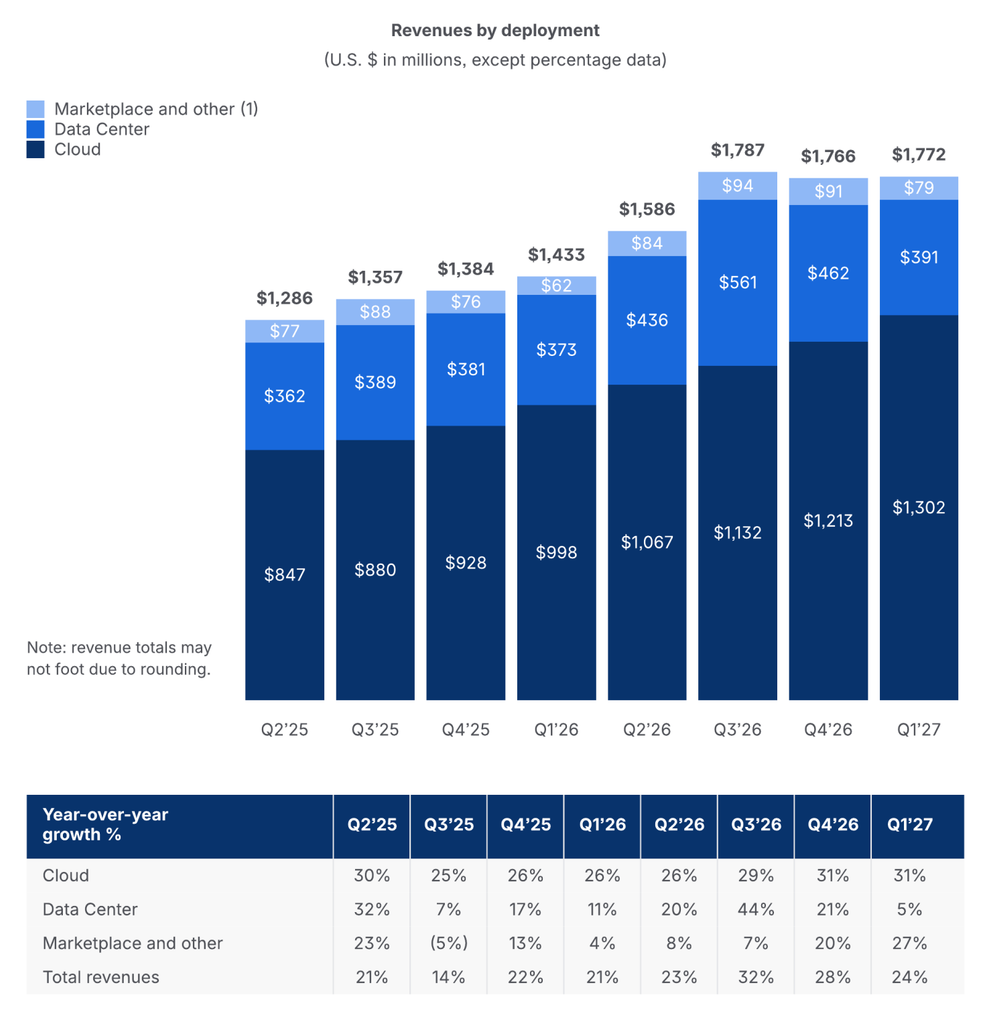
For the first quarter of the financial year ending 30 June 2027 (1Q’FY27), Atlassian’s revenue grew 23.7% year on year to US$1.77 billion.
Once again, Cloud did the heavy lifting.
Cloud revenue rose 30.5% to US$1.3 billion, or 73.5% of the quarter’s revenue.
Subscription ARR — the annualised value of Atlassian’s active subscriptions, and the measure management wants us to watch — grew 22.5% to US$6.81 billion.
Remaining performance obligations (RPO), or contracted revenue not yet recognised, rose 44.4% to US$4.7 billion.
The slice due over the next 12 months, known as current RPO, grew 28%.
In other words, customers are signing up for longer, and for more.
The cash followed.
Free cash flow jumped 304% to US$462.6 million, a 26% margin.
The Humans Didn’t Just Stay. They Did More.
In August 2026, we described Atlassian’s Model Context Protocol (MCP) server as a side door.
It is how an AI agent working elsewhere, in a coding tool or a chat window, reaches into a company’s Jira and Confluence.
Traffic through that door has exploded.
More than two million people now use the MCP server each month, up 8x since March 2026.
MCP calls top 15 million a day, up 15x over the same period.
The bear case says this is where the trouble starts: if agents do the work, who needs the seats?
This quarter, Atlassian answered with behavioural data.
First, 98% of MCP users were also active on the Atlassian platform in the same month.
Second, after adopting the MCP server, users created 50% more in Jira and 75% more in Confluence, on average.
That’s worth pausing on.
The agents did not take work away from the humans.
They handed them more of it to track.
But here’s a question from the bear case: if agents write the code, doesn’t the need for human coordination — Jira’s reason to exist — shrink?
Co-founder and CEO Mike Cannon-Brookes was direct in his response (bolded for emphasis):
“I’d have to say we disagree on this question personally.
There’s no doubt the amount of work happening is going to go up, precipitously so.
The coordination tax of that then becomes even more so.”
Add finance, marketing and HR staff now writing code with AI, and the job of connecting technology teams with business teams only gets bigger.
Translation: more agents means more work to coordinate, and Atlassian is where that coordination happens.
Bundles First, Meters Later
So how does Atlassian get paid for all this activity?
In August 2026, we said the answer was bundles, not meters.
That still holds.
More than 3,000 customers have upgraded to the Teamwork Collection, which packages Jira, Confluence, Loom, and Rovo together.
That is up 7x year on year, and more than triple the 1,000 customers we cited in February 2026.
The pull is AI.
The Teamwork Collection carries 10x the Rovo credits, and customers moving up the editions, from Standard to Premium to Enterprise, get 2 to 3x more credits at each step.
The behaviour that follows is what we like.
Teamwork Collection customers complete 35% more work items per Jira user than those using Jira alone, run twice as many agents, and grow their Jira and Confluence footprints faster.
Meanwhile, the Service Collection, Atlassian’s bundle for support teams, passed 70,000 customers, with ARR still growing north of 30%.
Seat growth from customers switching over from competitors rose more than 40%.
What about meters?
Usage-based pricing starts in early December 2026.
But management called it “not a near-term revenue driver” and is not counting on any meaningful contribution in FY27.
The same goes for the Agentic Multiplayer Protocol (AMP), which lets humans and agents work side by side with clear identities and an audit trail.
It is built into the platform, not sold separately.
We like management’s restraint.
Customers get generous AI allowances, and Atlassian gets paid when they upgrade.
Now for the part that surprised us.
AI costs money to run, so you might expect margins to suffer.
Instead, Atlassian’s GAAP gross margin rose to 85.2%, from 82% a year ago.
Management credited ongoing optimisation of its cloud infrastructure and its AI Gateway, which sends each AI task to the best-fit model for quality and cost.
To be fair, management still guides for a full-year gross margin of 84.5% as Rovo usage ramps up.
We’ll be watching that gap.
Engineers, Not Salespeople
One more thing caught our eye.
Atlassian is expanding its forward deployed engineer (FDE) programme, which places engineers at customer sites to speed up AI adoption.
An analyst compared its move to one at ServiceNow (NYSE: NOW), another of our holdings.
Cannon-Brookes drew a sharp line.
Atlassian’s FDEs, he said, are “fully qualified AI and ML engineers” writing production code on site, not rebadged customer success staff.
Atlassian is not building a consulting arm.
It wants customers running more of their work on the platform, and its own engineers learning faster from what customers need.
If that sounds familiar, it should.
As we shared in August 2026, Atlassian spent most of its life spending more on product than on marketing, and let the software sell itself.
Sending engineers instead of salespeople is the same instinct, updated for the AI era.
So Why Did the Shares Fall?
Now for the part the market focused on.
For 2Q’FY27, management expects Cloud revenue growth of about 27%, down from 30.5% in 1Q’FY27.
For the full year, it now expects Cloud growth of about 26%, total revenue growth of about 13.75%, and Subscription ARR growth of 18.5%.
The obvious question: why the slowdown?
CFO James Chuong gave two reasons.
First, Atlassian starts lapping its DX acquisition in 2Q’FY27, so acquired growth drops out of the comparison.
Second, the second half faces tougher comparisons after growth accelerated in the second half of FY26.
Fair enough.
Then there’s Data Center.
In August 2026, we called FY26 a sugar rush: customers bought ahead of Data Center’s March 2029 retirement, and under the accounting rules, Atlassian booked more of that revenue upfront.
This year, Atlassian pays it back.
Management also expects total revenue growth to re-accelerate in FY28, once the Data Center accounting effects wash out.
One more callback.
In August 2026, we flagged a minor caveat: the number of customers paying more than US$10,000 a year in Cloud grew around 10%, far slower than Cloud revenue.
This quarter, that number rose 12.9% to 59,877, adding 2,543 customers, the biggest quarterly increase in the letter’s two-year chart.
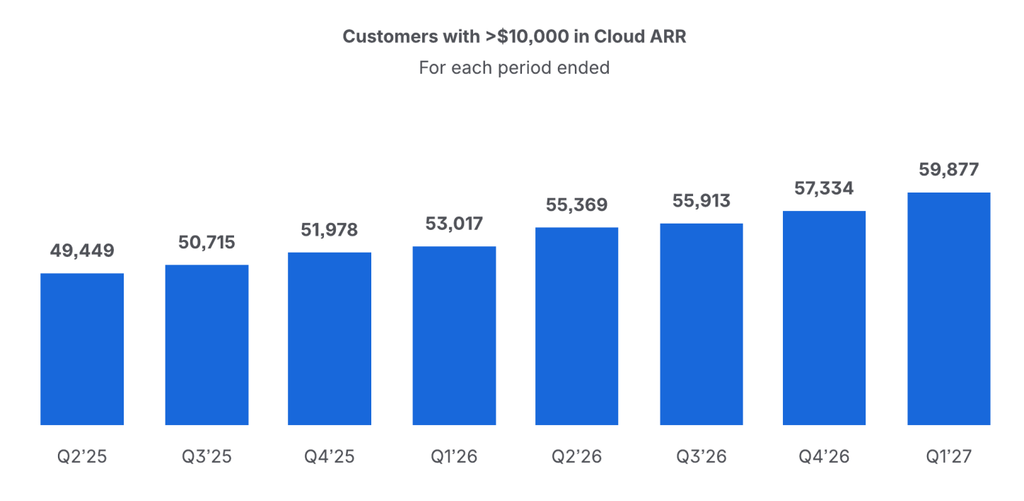
That is still well short of Cloud’s 30.5% growth, so existing customers spending more remains the main engine.
But the gap narrowed.
Translation: the slowdown is real, but much of it comes from the comparisons and the accounting, not from customers walking away.
The Question Nobody Answered
That said, one thing left us wanting more.
Data Center is set to be retired in March 2029, and management expects Data Center revenue to fall about 16% this year.
What management didn’t say is how much of Data Center will still be running after that deadline.
That matters.
Customers who move to Cloud increase their spending 1.75x after three years, according to management.
If a meaningful chunk of customers stays put for longer, that uplift arrives later than we would like.
Valuation
In August 2026, at US$171.33, Atlassian traded at around 33 times trailing free cash flow.
Today, at US$139.58, it trades at around 21.5 times.
That is above the 16.5 times we wrote about in February 2026, but well under the 10-year average of roughly 60 times.
Notably, Atlassian is shifting employee pay from shares towards cash to cut stock-based compensation.
Management expects this to trim FY27’s non-GAAP operating margin by about three percentage points, and it should weigh on free cash flow too.
We welcome that trade.
Stock-based compensation fell to 20.1% of revenue this quarter, from 24.5% a year ago.
And with buybacks, the weighted average diluted share count fell 2.3% year on year, so each share owns a bigger slice of the business.
Finally, skin in the game.
In August 2026, Cannon-Brookes announced plans to buy up to US$250 million of Atlassian shares on the open market.
And for good reason.
At around 21.5 times trailing free cash flow, investors will be paying less for a business that, on the evidence, got better this quarter.
Disclosure: Chin Hui Leong owns shares of Atlassian and ServiceNow.