It’s official.
The Straits Times Index (SGX: ^STI) is in a correction.
Last Friday (6 November 2026), the index closed at 5,180, almost 11 per cent below its record close of 5,802 in early September 2026.
Just two months ago, the STI was setting records.
Today, the mood has turned.
If you feel uneasy, you are not alone.
In times like these, it’s easy to lose sight of what matters and what doesn’t.
With that in mind, here are eight dos and don’ts for my fellow investors.
1. Do know the odds of a correction …
A fall of 10 per cent or more is not unusual.
It is the norm.
Historically, the STI has fallen by 10 per cent or more in around eight out of every 10 years.
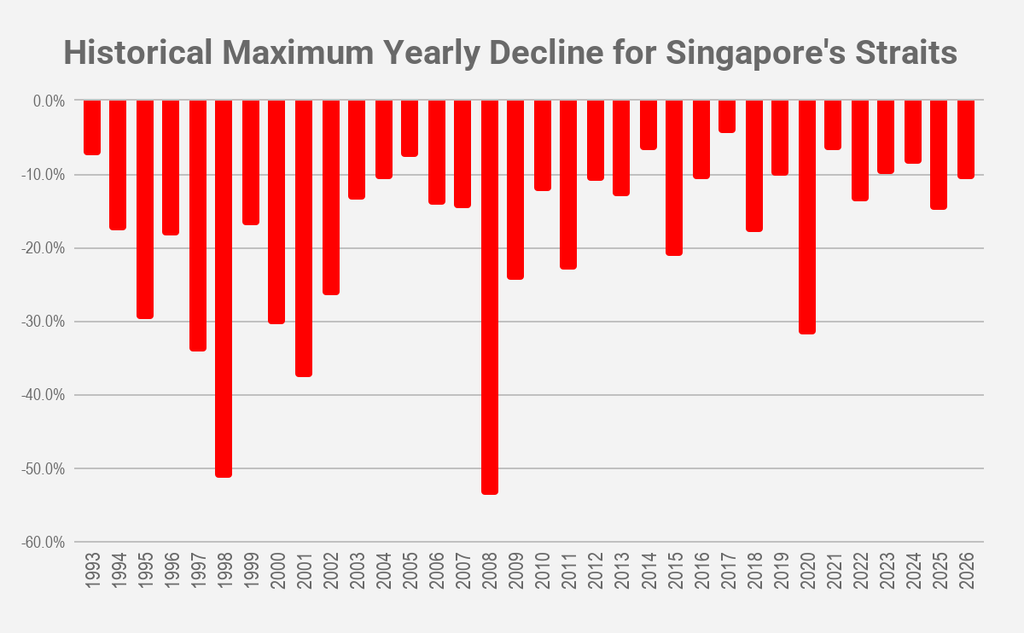
Source: S&P Global Market Intelligence, Yahoo Finance, WSJ, author’s calculation
Said another way, a year without a correction is the exception, not the rule.
Knowing the odds won’t make a fall painless.
But it should make it less of a surprise.
2. … but don’t mistake odds for timing
Here’s the catch: knowing a market correction will occur tells you nothing about when it will happen.
Legendary fund manager Peter Lynch once observed that far more money has been lost by investors preparing for corrections than in the corrections themselves.
Imagine you sold your shares when the STI hit a record high of around 3,900 on 10 February 2025 — its first in 17 years — convinced that a fall was overdue.
You would still be behind today.
Even after an 11 per cent drop, the index is still well above 3,900 — and that’s before counting dividends.
There’s a deeper emotional flaw to consider.
If fear of a 10 per cent drop makes you sell, that same fear will make it hard to buy back when the drop arrives.
More often than not, the investor who sells early ends up waiting for a lower price — and never acts on it.
3. Do keep an even keel …
Investing in a falling market is not just about which shares to buy, or at what price.
You may land a great bargain.
But if you lack the stomach to hold, you will be prone to selling at the wrong time.
As Lynch put it, it’s not brains that will help you beat the stock market, it’s your stomach.
Start with the basics.
Keep cash for emergencies.
Only invest money you won’t need for the next five years.
If daily price swings are costing you sleep, consider paring back to a level where you feel comfortable.
Here’s a thought: when investing, don’t optimise for performance. Optimise for a calm mind.
A calm mind makes better decisions.
And better decisions lead to better performance.
4. … but don’t beat yourself up for not selling
Looking back, September 2026’s peak seems obvious.
It wasn’t at the time.
Nobel laureate Daniel Kahneman called this hindsight bias: once we know how events unfolded, we convince ourselves we saw it coming.
Documenting your investment moves will help.
As humans, we tend to misremember our past experiences, especially when they involve major events.
On this note, the past six years have been full of challenging episodes that can distort our memories and directly impact the lessons we learn.
Therein lies the issue.
If you remember the wrong things, you will draw the wrong conclusions.
Even worse, you will be applying these wrong lessons in the future over and over again.
5. Don’t watch the scoreboard …
Warren Buffett once said that games are won by players who focus on the playing field, not by those whose eyes are glued to the scoreboard.
In a correction, the scoreboard — in this case, falling stock prices — is hard to ignore.
Every red number feels like a verdict on your investments.
But a falling share price only tells you how other investors feel.
It says little about how the business is doing.
Here’s a simple fix: remove the daily price-change column from your portfolio tracker.
6. … but do watch the business
A share price is made of two things: the business, and the mood of the market.
In a correction, the market’s mood does all the moving.
Prices swing on headlines and fear.
In contrast, business developments move at a slower pace.
They show up in what a company actually earns, quarter after quarter, year after year.
Lynch saw the same pattern.
Measured in months, he said, there is little link between a company’s results and its share price.
Measured over many years, the link is close to perfect.
So when the results come in, ask one question: is the business still growing?
One quarter shouldn’t change your mind.
A trend over several quarters might.
If the business keeps growing, a lower share price is not a threat.
It may well be a gift.
7. Do have a shopping list …
A correction is a good time to list the businesses you want to own for years, not months.
Keep in mind: you should buy because you want to own the business, not because the share price is lower.
Then decide how you will put your money to work.
Here’s a rule of thumb: take at least half as long to invest your money as it took you to save it.
If you took four years to save S$10,000, there is nothing wrong with taking two years to invest it.
8. … but don’t wait for the perfect price
In March 2020, Citibank’s research team downgraded DBS Group (SGX: D05) to “sell”, saying the shares were worth just S$17.50 — or S$15.90 after adjusting for DBS’s 2024 bonus issue.
I bought shares at S$18.40, above Citi’s target.
Today, DBS trades at just under S$70. My shares are up about 280 per cent, before dividends.
The lesson? You don’t need to get the perfect price.
Waiting for a “cheap” price comes with a catch.
Over the past 20 years, DBS has traded at one times book value only three times: during the Global Financial Crisis in 2008, the oil price crash in 2014, and the pandemic in 2020.
Each time, something had to go badly wrong first.
Get Smart: The opportunity you only see in hindsight
After almost two decades of investing, here’s what I’ve learnt: every past market decline looks like an opportunity.
Every future decline looks like a risk.
Looking back, buying DBS at S$18.40 in March 2020 seems like an easy call.
It wasn’t.
Four months later, the Monetary Authority of Singapore asked the local banks to cap their dividends at 60 per cent of the previous year’s level.
Vaccines were still just a hope.
Today’s correction will likely be no different.
A few years from now, it may look like an obvious opportunity.
Right now, it feels like a risk.
That’s why the dos and don’ts matter.
Know the odds, keep your calm, watch the business, and buy what you want to own, a little at a time.
As Charlie Munger, Buffett’s long-time business partner, said, the big money is not in the buying or selling, but in the waiting.
How do rich Singaporeans invest when volatility hits?
They turn to companies with cash, history, and discipline. This free report highlights 5 blue chips that deserve your attention. Get your copy here and see who made the list.
Follow us on Facebook, Instagram, Telegram and YouTube for the latest investing news and analyses!
Disclosure: Chin Hui Leong owns shares of DBS Group.