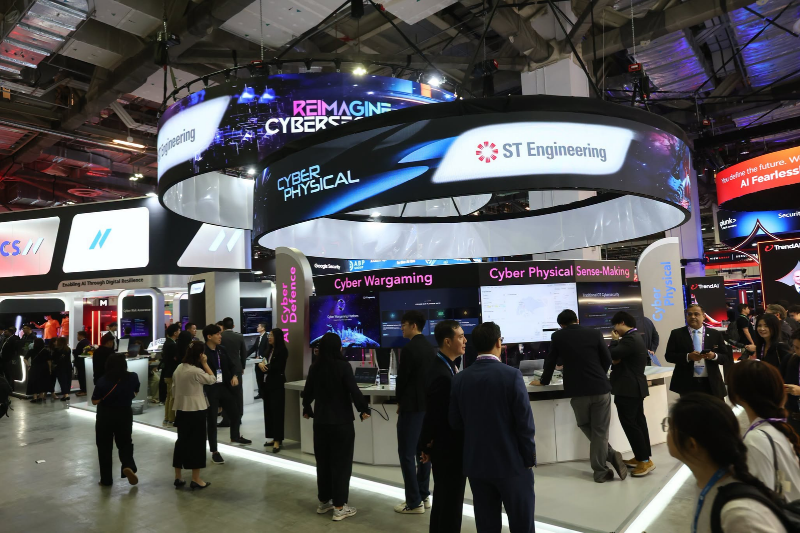
Singapore Technologies Engineering (SGX: S63), or ST Engineering, has rallied strongly over the past few years.
Rising defence budgets and the steady commercial aerospace sector explain much of the share price gain.
But after a staggering run like this, how much of the future is already reflected in the share price?
In this article, we evaluate whether today’s valuation is justified by the business, or if you can afford to wait for better opportunities.
ST Engineering: More Than Just a Defence Stock
ST Engineering has a nicely diversified business across three main segments: Commercial Aerospace (CA), Defence & Public Security (DPS), and Urban Solutions & Satcom (USS).
Its CA segment provides aftermarket maintenance, repair, and operations (MRO) services for, as you might guess, commercial aircrafts.
As Singapore’s prime defence major, ST Engineering also provides defence equipment, military systems and security solutions for governments and armed forces worldwide through its DPS segment.
Finally, USS covers smart city systems, transport technology and satellite communications.
Overall, these businesses provide different economic exposures and ensure ST Engineering does not solely rely on a particular industry.
Much of the work also runs on long contracts with governments and airlines, which make future revenue more predictable compared to other companies.
Why Is Driving ST Engineering’s Growth?
Defence spending is the headline driver.
Global military spending has risen over recent years, as countries increasingly look to upgrade their defence capabilities given the conflicts in Russia/Ukraine and the Middle East.
This trend, unlikely to slow anytime soon, plays into ST Engineering’s DPS segment, which has benefitted from more contracts for defence and military solutions.
Aircraft maintenance is the quieter one.
Like defence, global spending on MRO activities has picked up as global aircraft fleets age and require more maintenance and upkeep work.
This dual engine has resulted in a steadily increasing order book for ST Engineering.
As of 30 June 2026 (1H2026), the order book hit a record S$35.7 billion, up 14% from a year earlier, with S$5.7 billion due to be delivered in the rest of 2026.
Given the group’s FY2025 (ending 31 December 2025) total revenue of S$12.35 billion, the current order book provides close to three years of revenue visibility.
That said, a big order doesn’t automatically guarantee big profits.
Execution risk still matters, and higher costs could whittle down the margins of each contract, ultimately resulting in lower profits.
Are ST Engineering’s Earnings Keeping Up with Its Share Price?
So far, yes.
In 1H2026, revenue rose 11% to S$6.6 billion and net profit climbed 27% to S$512 million, so earnings are growing faster than sales.
CA led the way, with operating profit up 29%. DPS grew 10%, and USS almost quadrupled its operating profit (albeit from a low base) after cost cuts.
Cash is coming in too.
Operating cash flow rose 26% to S$960 million, and free cash flow improved to S$591.6 million from S$591.6 million from S$484.6 million.
Meanwhile, debt looks manageable.
Borrowings were S$4.7 billion against S$255.3 million of cash and cash equivalents as of 30 June 2026, with the group steadily deleveraging across the past year.
Is ST Engineering’s Current Valuation Justified?
This is where it gets harder.
As at 12 November 2026, ST Engineering trades at trailing and forward price-to-earnings (P/E) ratios of 57.1x and 26.1x, respectively.
Against their historical averages, these earnings ratios seem stretched.
The market is clearly paying up for defence exposure and earnings visibility.
If profit growth slows, the multiple could shrink, with the share price going nowhere even while the underlying business keeps doing well.
ST Engineering’s new dividend policy dictates a base dividend of S$0.18 per share for 2026 plus about a third of any rise in underlying profit per share.
Interim payments of S$0.04 and S$0.05 have been made so far.
Free cash flow of S$591.6 million in 1H2026 comfortably covered the S$468.2 million paid out in dividends during the half.
But at S$9.74 (as at 12 November 2026), the trailing yield is roughly 2.5%, which does not scream attractive to income investors.
What Could Drive ST Engineering’s Next Phase of Growth?
More defence contracts from an international pipeline, additional aircraft maintenance capacity and increasing profit contribution from USS could help.
Continued conversion of order backlogs to underlying profits and cash flows, alongside any improvements in operating margins, will be beneficial for ST Engineering as well.
The key risks for the group include delays or cost overruns on big projects, weaker margins and slower contract wins.
Already, new orders in 1H2026 were S$7.6 billion, down from S$9.1 billion a year earlier.
Get Smart: A Strong Business, but Is the Price Right?
Undoubtedly, ST Engineering is a well-diversified group that benefits from strong spending in global defence and commercial aerospace.
A S$35.7 billion order book provides good revenue visibility moving forward, but execution risk could still present a possible concern for future profit and cash generation.
However, the current price already reflects most of that.
Current valuations leave little room for disappointment.
Long-term investors who like the business would do better waiting for a more reasonable valuation, or building a position gradually over time.
One of these six companies is the only one legally allowed to operate in Singapore. It has increased its dividend for 16 consecutive years. Discover which one it is in our free report here.
Follow us on Facebook, Instagram, Telegram and YouTube for the latest investing news and analyses!
Disclosure: Wilson.H does not own shares in any of the companies mentioned.