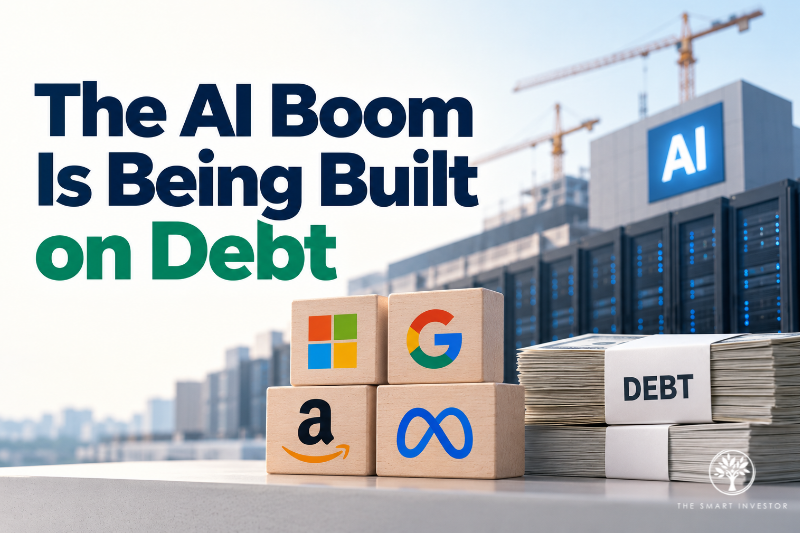
Big Tech companies such as Meta Platforms (NASDAQ: META) and Alphabet (NASDAQ: GOOGL) were previously known for their cash-rich, fortress balance sheets.
Their financial firepower to fuel the artificial intelligence (AI) revolution was nearly undisputed.
But now, debt is increasingly being used instead to finance data centres, specialised silicon, and the massive grids to power them.
The narrative has shifted from smart AI agents powering the future economy to a grim future of mounting financial debt that could drag down global growth.
Should investors be alarmed?
What Happened to Their Fortress Balance Sheets?
Historically, Big Tech operated as asset-light enterprises.
Their capital expenditure (capex) as a percentage of revenue was reportedly low, in the single digits (about 4%).
Today, the capex at the hyperscalers (the largest cloud-computing providers) amounts to more than half of their revenues.
Collectively, the AI spending by the four hyperscalers – Alphabet, Amazon (NASDAQ: AMZN), Microsoft (NASDAQ: MSFT), and Meta – is projected to surge 84% in 2026 to US$760 billion.
Crucially, global debt funding towards the AI infrastructural buildout is expected to double, reaching nearly US$570 billion in 2026, and to increase further as the hyperscalers’ capex is tipped to surpass US$1 trillion in 2027.
Borrowings and Off-Balance-Sheet Deals
Where is all this capital really coming from?
Corporate bond sales surged 11.8% to US$2.46 trillion in 2025, driven by US hyperscaler-linked issuances.
But the real financial shift lies in off-balance-sheet financing structures.
To preserve their credit ratings, the tech giants are turning to special purpose vehicles (SPVs), private credit, and graphics processing unit (GPU)-backed securitisations.
Consider Meta’s private capital deal with Blue Owl Capital (NYSE: OWL), which resulted in the two entities forming an SPV that issued over US$27 billion in private debt backed by Meta’s lease commitment and financial guarantees.
Under this deal, private-credit funds hold 80% of the SPV’s equity while Meta holds the remaining 20% in the Louisiana project.
Importantly, this minority stake allows Meta to keep the associated liabilities off its balance sheet.
Meta is not alone.
Collectively, Big Tech’s off-balance-sheet commitments have reportedly reached US$3.1 trillion, roughly four times greater than their expected capex of US$760 billion in 2026.
Silicon Obsolescence and Mounting Costs
With such massive leverage, the structural risks are real.
While massive capital to build AI-related hardware is spent upfront at unprecedented speed, the software running on it is monetised much more slowly.
To make matters worse, hardware generally depreciates much faster than software.
Critics have observed that the hyperscalers have artificially stretched the depreciation timelines of their GPUs to aggressively lower expenses and boost their profit margins.
On top of that, the recurring operating expenses of US$2.0 million to US$2.8 million per megawatt per year add pressure to the hyperscalers’ profitability.
A Systemic Bubble?
Rising debt to fund fast-depreciating hardware, without meaningful software revenue to offset it, does not paint a reassuring picture for investors.
Moreover, the true leverage might be understated due to the off-balance-sheet arrangements that obscure the full extent of financial obligations.
Crucially, the risks are interconnected among stakeholders.
Hyperscalers, neoclouds (young cloud-computing companies that focus on providing GPUs to customers), private-credit funds, sovereign investors, and even pension funds are linked through contracts and securitised debt, meaning any stress incurred in one of the nodes could send ripples across the whole ecosystem.
A Secular Boom?
Using debt to fund infrastructure is not uncommon, especially for the AI revolution, which is frequently touted as a once-in-a-lifetime industrial revolution.
Despite asset depreciation risks, AI data centres may stay useful for longer than expected, as older computing capacity can be repurposed for less demanding tasks.
What about the risk of a demand shortfall?
Arguably, this is unlikely, given AI’s wide total addressable market that spans across software development, healthcare, finance, manufacturing, research and public services.
What about leveraged players defaulting? That is possible for weaker players.
Therefore, investors should focus on the best-capitalised hyperscalers, which run some of the most profitable, cash-generating business models with healthy margins and strong balance sheets.
They are more likely to survive a shakeout and emerge even stronger.
Get Smart: How Investors Can Navigate the AI Debt Era
The AI boom isn’t inherently doomed by debt, but the era of premium valuation multiples is ending as investors demand more visibility for their investments.
Furthermore, given the enormous scale of AI infrastructure, funding it through debt could be considered rational, if done responsibly.
Still, the real risks will surface if spending accelerates with no end in sight while free cash flow dries up and visible returns stall.
For investors, the important question is therefore not “Is AI being built on debt?” but “Can the companies borrowing and investing today generate enough future cash flow to justify that debt?”
Balance-sheet transparency, favourable debt coverage, and monetisation potential should define the winners in the next phase of the boom.
Not all AI “winners” will survive this cycle.
But a few companies already have the scale, cash flow, and edge to pull ahead. We highlight what to look for in our FREE volatile market report. Download it here.
Follow us on Facebook, Instagram, Telegram and YouTube for the latest investing news and analyses!
Disclosure: Larry L owns shares of Meta, Alphabet, Amazon, and Microsoft.