2026 hasn’t been kind to Singapore real estate investment trusts (S-REITs).
As at 30 September 2026, the Straits Times Index (SGX: ^STI) had risen around 23% year-to-date, lifted by strong banking earnings.
The iEdge S-REIT Index (SGX: ^SREIT), meanwhile, had fallen about 12% on a price basis.
When unit prices slide faster than actual property performance, value investors naturally start looking.
Unit prices tell only half the story, though.
REITs must pay out at least 90% of taxable income to enjoy tax transparency, so distributions narrow the gap considerably over longer periods.
Looking past pure price action reveals a far more balanced total-return picture across the sector.
The key question here is: how do we separate genuine discount opportunities from classic yield traps?
Why Have Singapore REITs Lagged?
Singapore REITs lagged earlier due to persistent higher-for-longer interest rates.
Refinancing costs rose as older, low-cost debt matured.
At the same time, capital rotated into local banks offering stronger short-term earnings.
Weaker currencies in the REITs’ overseas markets also squeezed distributable income.
There are signs of stabilisation, though.
All three REITs featured below grew their distribution per unit (DPU) year on year (YoY) in their latest results, supported by high occupancy and, for Keppel DC REIT and Suntec REIT, positive rental reversions.
Frasers Centrepoint Trust (SGX: J69U), or FCT – The Defensive Income Play
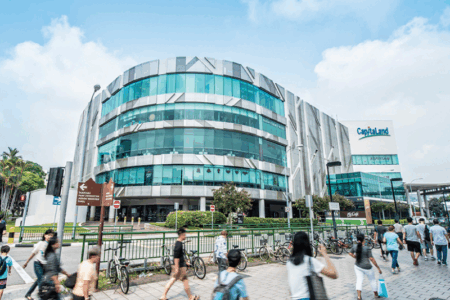
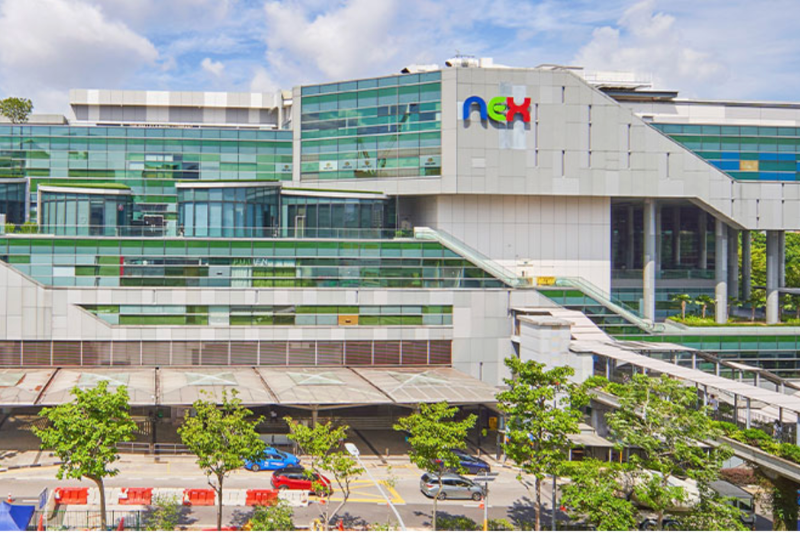
FCT manages an S$8.4 billion portfolio of nine heartland malls, including Causeway Point, NEX, and Northpoint City.
Essential services drive roughly 55% of gross rental income, insulating cash flows against economic slowdowns.
Operational execution remains strong, with committed retail occupancy at 99.6% as at 30 June 2026, alongside YoY gains in the first nine months of FY2026 (9MFY2026) shopper traffic (+2.0%) and tenant sales (+1.8%).
Its balance sheet is healthy.
Aggregate leverage was 40.4% as at 30 June 2026, and the proposed sale of White Sands would reduce it to about 36.5% on a pro forma basis (based on 31 March 2026 figures).
FCT has no debt left to refinance in FY2026, and its average cost of debt fell to 3.0% in 3QFY2026.
Payouts remain steady, with a 1HFY2026 DPU of S$0.06136.
At S$2.07 per unit (as at 30 September 2026), FCT provides a trailing distribution yield of 5.8%.
Upgrades at Hougang Mall and NEX, plus a 50% stake in the retail component of the new Bayshore Drive development, give FCT several sources of growth.
When market noise depresses prices for a trust running near-perfect occupancy, defensive income investors get a rare opportunity to lock in yield on the cheap.
Keppel DC REIT (SGX: AJBU) – The Growth REIT
Backed by its sponsor, Keppel Ltd (SGX: BN4), Keppel DC REIT offers pure-play exposure to data centres.
Its weighted average lease expiry (WALE) is 6.7 years by lettable area and 4.5 years by rental income, since more of its income comes from colocation contracts, which tend to be shorter.
Operating demand remains robust, with contracted power capacity at about 95% and positive rental reversions of around 10% on 1H2026 contract renewals.
Portfolio occupancy dipped to 92.5% after a contract expired at Cardiff Data Centre.
Capital management remains prudent, with aggregate leverage at 34.0%, S$673 million in debt headroom, and a 2.6% average debt cost, with 87% of borrowings on fixed rates.
Driven by organic growth and acquisitions, 1H2026 DPU rose 11.3% YoY to S$0.05714.
At S$2.12 per unit (as at 30 September 2026), the REIT offers an annualised yield of 5.4%.
This strong execution was bolstered by accretive acquisitions of Tokyo Data Centre 3 and the remaining stakes in Keppel DC Singapore 3 & 4.
Suntec REIT (SGX: T82U) – The High-Yield Opportunity
Suntec REIT offers a high-yield commercial play anchored by Suntec City and Marina Bay Financial Centre.
Distributable income rose 25.5% YoY to S$116.5 million in 1H2026, and DPU climbed 24.8% to S$0.03936.
The manager credited stronger Singapore office and retail performance, lower financing costs and a smaller Australian withholding-tax provision.
It expects full-year rental reversions of close to 10% at Suntec City Mall and near 5% for its Singapore offices.
At S$1.34 per unit (as at 30 September 2026), Suntec REIT’s annualised 1H2026 DPU gives a distribution yield of about 5.9%.
Despite the stronger results, the market appears wary of Suntec REIT’s balance sheet.
Aggregate leverage rose to 43% as at 30 June 2026, from 41.5% at end-2025.
The all-in financing cost did ease to 3.55%, but with leverage this high, there is less room to absorb higher rates when debt is refinanced.
The drag from overseas holdings isn’t disappearing overnight.
Office vacancy in London’s City and West End is around 7% to 8%, and the Melbourne and Adelaide office markets remain tenant-led, although Suntec REIT expects its Australian portfolio to stay stable.
Suntec REIT’s distribution coverage now rests heavily on its Singapore assets and on capital recycling.
With Suntec REIT yielding almost 6%, investors face a clear choice: buy into a genuine valuation discount, or stay clear of a yield trap constrained by balance sheet friction.
Are Singapore REITs Cheap Now?
Valuation metrics hint that Singapore REITs trade at historically steep discounts.
SGX Research’s 2Q2026 S-REIT chartbook put the sector’s aggregate price-to-book (P/B) ratio at 0.77x as at 30 June 2026, below its 10-year average of 1.0x.
A P/B below 1.0x means units are priced below the book value of the REITs’ assets.
The average distribution yield was 6.3%, about 384 basis points above the 10-year Singapore Government Securities (SGS) yield at the time.
That price tag, however, is grounded in reality.
Refinancing at higher rates keeps squeezing profit margins, while downward revaluations of overseas offices hit balance sheets directly.
Key Drivers of the S-REIT Outlook
The S-REIT outlook comes down to a simple balance between interest rate relief and underlying property performance.
A sustained recovery needs central bank rate cuts.
Lower borrowing costs ease refinancing pressure, narrow yield spreads, and stabilise property valuations.
On the ground, Singapore retail and office assets must keep securing positive rental reversions to drive DPU growth.
Ultimately, a lasting recovery needs both lower debt costs and rising payouts.
If interest rates stay high, maturing debt will have to be refinanced at higher costs.
That would shrink distributable income and leave less buffer for payouts.
Squeezed balance sheets could even force weaker trusts to issue lower-priced units, diluting existing unitholders’ distributions.
Sector pressure will remain until these debt and operational drags clear.
Get Smart: Underperformance Can Create Opportunity, But Don’t Buy Blindly
Lagging the STI in 2026 doesn’t automatically make Singapore REITs a bargain.
Investors should figure out which ones are just wrestling with short-term interest-rate issues, and which have bigger problems, such as poor assets or dividends they can’t support.
What’s tried and tested is this: Stick to trusts that own solid assets, show strong occupancy, and keep delivering consistent DPU growth, whatever sector they are in.
If you want to retire with a constant stream of dividends, these 5 stocks might be all you need. We’ve found 5 SG stocks that have kept paying (and growing) through inflation, rate hikes, and recessions. See what they are with our latest free report for SGX dividend investors. Click here to get instant access.
Follow us on Facebook, Instagram, Telegram and YouTube for the latest investing news and analyses!
Disclosure: Joseph G. does not own shares or units of any of the stocks mentioned.