The most compelling semiconductor plays tend to be global names such as NVIDIA Corporation (NASDAQ: NVDA) and Micron Technology, Inc. (NASDAQ: MU).
While Singapore does not mint such global tech giants, the small city-state still holds its own, being home to precision engineering and technology companies that play crucial roles in the global semiconductor supply chain.
Instead of designing artificial intelligence (AI) chips or building frontier language models, these AI enablers supply specialised testing equipment, precision front-end equipment components, and essential consumable tools for global chipmakers.
To sweeten the deal for local investors, these companies – AEM Holdings Ltd. (SGX: AWX), UMS Integration Limited (SGX: 558), and Micro-Mechanics (Holdings) Ltd. (SGX: 5DD) – pay tax-free dividends on top of potential capital appreciation.
AEM Holdings: Testing the Next Generation of AI Chips
AI processors are becoming more powerful.
But that power comes with a hefty operational cost: extreme heat generation.
While the complex designs of AI chips make them powerful, they also make them vulnerable to this intense heat.
Given this vulnerability, stress testing of costly AI chips under real-world operating conditions is more crucial than ever.
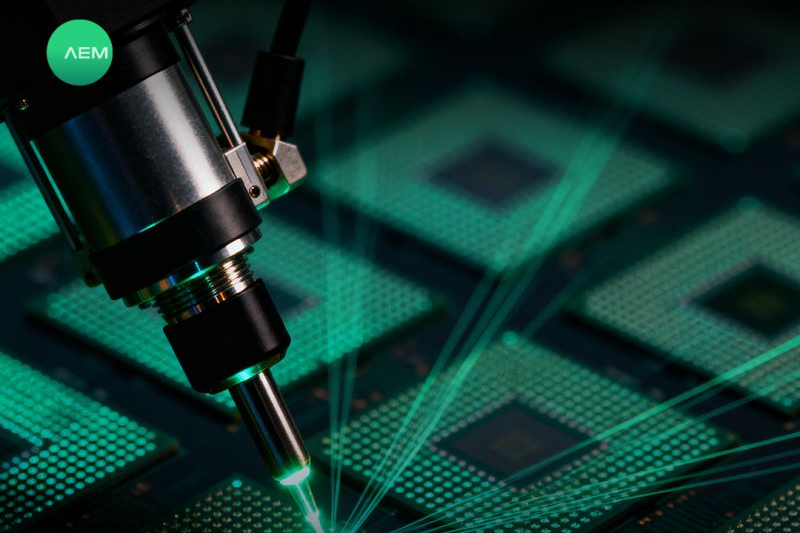
To this end, AEM’s PiXL technology fills the thermal integrity gap, offering precise thermal testing at scale to ensure high-powered AI chips can perform reliably under extreme conditions.
Strategically, it expands with a “Razor/Razorblade” model that generates recurring sales.
Crucially, analysts believe the collaboration between Intel Corporation (NASDAQ: INTC) and NVIDIA could lift demand for AEM’s testing solutions, though the benefit may only show up in the medium term.
Management has raised its FY2026 revenue guidance to between S$630 million to S$680 million, up from between S$550 million to S$600 million.
AEM’s group revenue for the first half of 2026 (1H2026) climbed 29.9% year on year (YoY) to S$247.2 million, while its net profit rose 875.6% YoY to S$30.8 million, driven by higher demand from its fabless AI/HPC customer.
Furthermore, the group’s partnership with ASE Technology (NYSE: ASX), a major outsourced semiconductor assembly and test (OSAT) provider, could help AEM tap demand from hyperscalers.
With a net cash position of S$56.6 million and a low debt-to-equity ratio of 0.05x, AEM’s strong balance sheet supports a 1H2026 interim dividend of S$0.024 per share, following a final dividend of S$0.013 per share for FY2025.
UMS Integration: The Front-End Precision Powerhouse
While AEM anchors the growth in back-end AI testing, UMS offers a front-end equipment play.
UMS has long provided precision component manufacturing and electromechanical assembly for front-end chipmaking equipment to Applied Materials (NASDAQ: AMAT), one of the world’s largest semiconductor equipment makers and its key customer.
Crucially, UMS has also onboarded another major semiconductor equipment maker as a customer, which is starting to reduce its reliance on a single client.
In the second quarter of 2026 (2Q2026), UMS’s revenue jumped 29% YoY to S$87.1 million, driving net profit up 90% to S$19.8 million, as initial contributions from this new customer ramped up, alongside increased contributions from existing customers and aerospace demand.
Notably, the company operates with net cash of S$38.6 million on its balance sheet as at 30 June 2026, with no bank borrowings, and declared a 2Q2026 interim dividend of S$0.010 per share, unchanged YoY.
Micro-Mechanics: The High-Margin Consumable Cash Machine
AI-linked equipment makers potentially face inconsistent revenue due to customers’ lumpy investment cycles.
Micro-Mechanics is less exposed to these swings.
Instead of selling costly one-off equipment, it provides high-precision, miniature consumable tools, such as die-attach and wire-bonding tools, that eventually wear out as chips are assembled and tested, sustaining recurring demand.
As global chip production rises, so does demand for these high-precision, complementary tools, which benefits Micro-Mechanics.
Additionally, by serving over 600 global customers through its localised manufacturing facilities, the company is cushioned against geopolitical friction.
In the fiscal year ended 30 June 2026 (FY2026), Micro-Mechanics’ revenue rose 15.8% to S$75.5 million on strong demand for its consumable tools, while operating cash flow edged up 3.5% to S$18.9 million.
To sweeten the deal for investors, the company has no debt, boasts a net cash position of S$30.1 million, and rewards shareholders with a total dividend of S$0.06 per share (unchanged YoY).
This includes a proposed S$0.03 final dividend, subject to shareholder approval at its annual general meeting on 26 October 2026.
Get Smart: Riding the AI Boom with Local Names
Here’s the thing about riding the AI boom: You don’t necessarily need to chase expensive US tech giants.
Local AI enablers like AEM, UMS, and Micro-Mechanics offer a way to gain exposure to three parts of the AI chip supply chain: testing, front-end manufacturing and consumable tools.
Beyond growing market demand, this AI-enabling trio boasts solid balance sheets and robust profitability.
Crucially, all three pay tax-free dividends, adding a stream of income for Singapore investors on top of any business growth.
Not all AI “winners” will survive this cycle.
But a few companies already have the scale, cash flow, and edge to pull ahead. We highlight what to look for in our FREE volatile market report. Download it here.
Follow us on Facebook, Instagram, Telegram and YouTube for the latest investing news and analyses!
Disclosure: Larry L. does not own shares in any of the companies mentioned.