Welcome to this week’s edition of top stock market highlights.
This week brings a mix of corporate action and macro developments, from a super-app’s billion-dollar bet on buy-now-pay-later lending to the ongoing shake-up of Singapore’s mobile market.
Overseas, the US Federal Reserve surprised markets by raising rates for the first time since 2023, while a string of AI researcher departures has intensified scrutiny on Big Tech’s approach to safety.
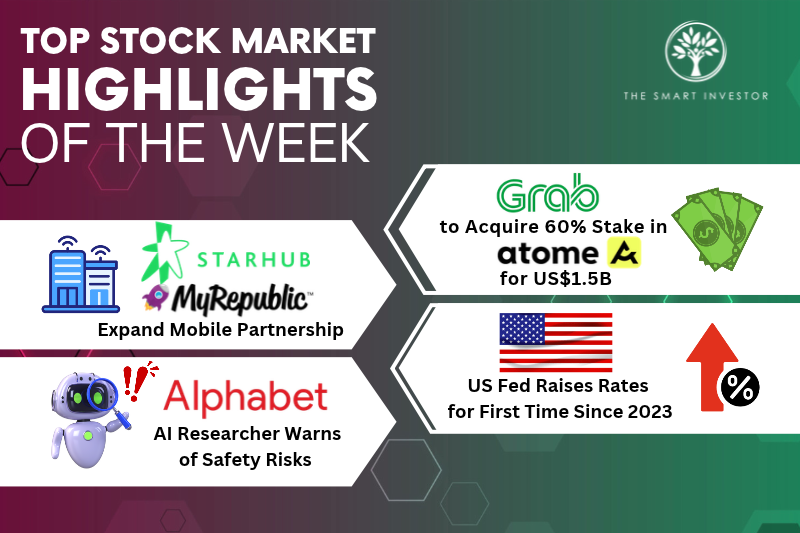
Super-app deepens fintech ambitions with US$1.5 billion BNPL acquisition
Grab Holdings (NASDAQ: GRAB) announced on 15 September that it will acquire a 60 per cent stake in buy-now-pay-later (BNPL) platform Atome Financial from Advance Intelligence Group for US$1.5 billion in cash.
The deal will combine Atome’s BNPL loans, consumer cash loans, and digital lending operations with Grab’s existing financial services business.
Atome Financial operates across Singapore, Malaysia, the Philippines, Indonesia, and Thailand, and has accumulated 25 million transacted users to date.
The acquisition will proceed in two phases.
The first, covering the 60 per cent stake, is expected to close by the third quarter of 2027, subject to regulatory approvals.
The remaining 40 per cent will be acquired roughly two years later at a valuation tied to Atome’s performance, subject to a floor of US$2 billion and a cap of US$4.5 billion.
Alongside the deal, Grab raised its 2028 targets, forecasting adjusted EBITDA of US$1.7 billion and annual revenue growth exceeding 30 per cent between 2025 and 2028.
The group also plans to complete its US$900 million share repurchase programme over the next 12 months.
Singapore’s telecoms consolidation picks up pace
StarHub (SGX: CC3) and MyRepublic have expanded their mobile partnership, with all MyRepublic Mobile subscribers set to be migrated onto StarHub’s network.
The move follows a 2022 agreement for StarHub to provide 5G network access for MyRepublic Mobile customers, as well as StarHub’s outright acquisition of MyRepublic’s Singapore broadband business in August 2025.
MyRepublic is a mobile virtual network operator (MVNO) that relies on host infrastructure rather than its own cellular towers.
StarHub CEO Nikhil Eapen described the development as another step towards leading the ongoing consolidation of Singapore’s telecommunications market.
Seven MVNOs – including Changi Mobile, which was operated by Changi Airport Group – have closed in Singapore between 2020 and 2026.
The broader telco landscape remains in flux.
Simba’s proposed acquisition of M1, owned by Keppel Ltd (SGX: BN4), fell through in May after regulators halted their assessment of the merger over alleged spectrum breaches.
The Fed raises rates amid stubborn inflation
The US Federal Reserve raised interest rates for the first time in more than three years, hiking the benchmark rate by 25 basis points to a range of 3.75% to 4% in a unanimous decision.
Fed Chair Kevin Warsh said the move was necessary because inflation has remained too high for too long, noting it has exceeded the central bank’s 2% target for over five years.
The decision came despite fierce opposition from President Donald Trump, who had publicly called for rates to be cut.
The rate increase – the first since July 2023 – is already pushing up borrowing costs.
Major US banks including JPMorgan and BNY lifted their prime lending rates to 7% following the announcement.
A majority of policymakers have signalled that a further hike to 4% to 4.25% is likely before the end of this year.
Rate cuts are not expected to begin until 2028 or 2029, according to the Fed’s latest forecasts.
AI safety fears mount as DeepMind researcher warns of existential risk
A researcher who recently resigned from Google DeepMind, part of Alphabet (NASDAQ: GOOGL), has warned that artificial intelligence (AI) could pose an existential threat to humanity.
Bilal Chughtai, who worked on AI safety and alignment at the Alphabet subsidiary, wrote on 14 September that he was deeply concerned by the trajectory of AI development, stating that the technology has the potential to cause widespread harm.
He is the latest in a growing number of researchers to sound the alarm.
Earlier this month, developer Jacob Coxon departed his role and accused both Anthropic and OpenAI of reckless development.
Separately, Anthropic CEO Dario Amodei published an essay urging the AI community to slow the development of its most advanced systems – a call endorsed by OpenAI CEO Sam Altman and SpaceXAI chief Elon Musk.
Chughtai said he remains optimistic that AI can still be developed safely and has since joined BlueDot Impact, a non-profit focused on AI safety training.
The headlines feel worse than the market itself.
So what are experienced investors actually doing right now? Our FREE report reveals how to position your portfolio amid volatility. Download it for free here.
Follow us on Facebook, Instagram, Telegram and YouTube for the latest investing news and analyses!