A 77% dividend increase is hard to ignore.
Especially if it comes from a blue-chip stock which is part of the Straits Times Index (SGX: ^STI).
DFI Retail Group Holdings Limited (SGX: D01) raised its interim dividend from US$0.035 per share to US$0.062 for the first six months of 2026 (1H 2026).
The percentage gain does not tell you where the increase came from.
Here’s a clue: its profit did not grow by 77% over the same period.
Instead, it was the board that changed its dividend payout policy to 70% in 2025, and the increase followed.
Where did the 77% come from?
Let’s start with 2025.
Underlying profit attributable to shareholders reached US$270 million, up 35% year on year.
For the full year, the ordinary dividend rose 33% to US$0.14 per share.
DFI also paid a special dividend of US$0.443 per share in October 2025, funded by asset sales.
That’s very nice.
But let’s keep the ordinary and special dividends apart.
Only the former tells you what the business is expected to pay again next year.
Now let’s move to 1H 2026.
Underlying profit attributable to shareholders was US$117 million, up 11%.
That’s the headline figure.
DFI also shared another comparison.
Underlying profit for its continuing businesses rose by 44%.
The continuing business figure leaves out Singapore Food, Mannings China, and the Robinsons Retail stake, all of which have been divested or closed.
Can free cash flow carry the dividend?
To be able to pay sustainable dividends, a business must generate enough cash.
Free cash flow is the metric to watch.
DFI defines free cash flow (FCF) as operating cash flow after lease payments minus purchases of tangible and intangible assets (“normal capital expenditure”).
In 2025, DFI generated operating cash flow after lease payments of US$430 million, up 30%.
FCF came in at US$281 million, up 78%.
Dividends paid during the year totalled around US$739 million, of which US$600 million was the special.
Take that out, and the ordinary dividend was less than the FCF the business generated.
The first half of 2026 gives you less room.
Operating cash flow after lease payments rose 16% to US$178 million.
The company spent more on capital, putting US$92.5 million into tangible and intangible assets in six months, up from US$63.3 million a year ago.
As a result, FCF slipped 5% to US$85 million.
DFI said that it was investing more to boost its competitive position and drive long-term value for shareholders.
For 1H 2026, dividends paid to investors amounted to US$141 million, with another US$40 million spent on buybacks as part of its long-term incentive plan.
This total amount spent was more than its FCF for 1H 2026.
As a result, it had to dip into its cash and borrowings to fund the difference.
That brings us to its balance sheet.
In 2025, DFI aggressively reduced its debt.
To do so, the company divested its stakes in Yonghui and Robinsons Retail, as well as its Singapore Food business, generating total gross proceeds of around US$1 billion.
This amount was directed towards paying down borrowings, helping DFI end 2025 with a net cash position of US$70 million.
However, as it spent more on dividends and buybacks for 1H 2026, it went back to a net debt position of US$22 million as of 30 June 2026.
DFI will have to make up the difference in the second half of the year.
Where does DFI earn its money now?
Group revenue was flat at around US$8.9 billion in 2025.
What changed was where the profit came from.
DFI has four main operating divisions, namely Health and Beauty, Convenience, Food, and Home Furnishings.
Health and Beauty brought in US$227.7 million of divisional operating profit, up 8% year on year.
That is roughly 55% of the US$411.8 million earned across DFI’s four divisions, generated from US$2.6 billion of sales, or about 30% of group revenue.
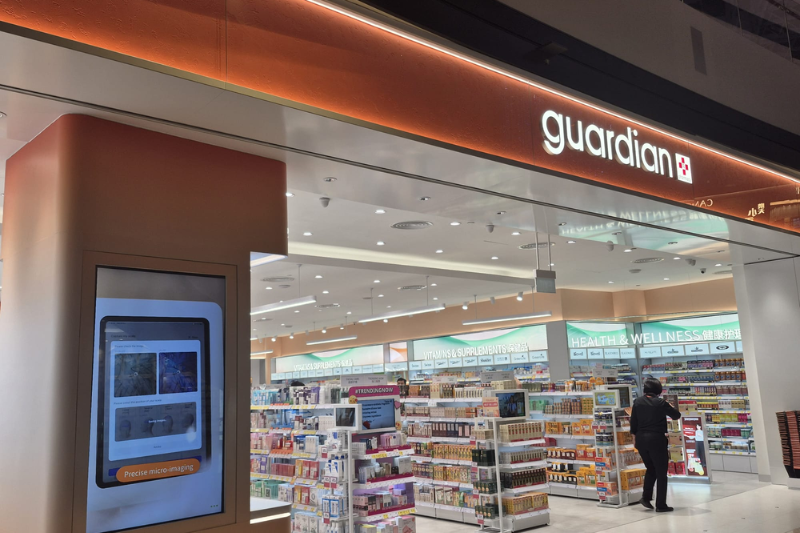
In other words, if you shop at Mannings or Guardian, you’re helping DFI’s biggest profit contributor.
Convenience earned US$96.7 million, down 6% year on year.
The culprit?
Cigarette volumes fell away after Hong Kong raised tobacco taxes in February 2024.
Hong Kong like-for-like sales dropped for 10 straight quarters, returning to growth in the second quarter of 2026.
How did DFI turn around the situation?
By pushing ready-to-eat meals, which made up 24% of Convenience sales in 2025.
Food chipped in US$61.5 million in operating profit.
Home Furnishings added US$25.9 million, up from US$16.1 million.
DFI is also investing in the DFI Omni Platform to arm its store network with digital capabilities to deliver personalisation and greater convenience.
The retailer is also developing high-margin revenue streams in retail media via DFIQ Media while monetising its data via DFIQ Insights.
Specifics are scarce at the moment.
That said, DFI reported that digital turned profitable in the first half of 2026.
E-commerce and DFIQ Media contributed around 35% of total revenue growth.
DFIQ Media revenue tripled year on year while online sales penetration reached 6.9%.
In June 2026, DFI agreed to buy Cody HK, an outdoor advertising operator with rights across Hong Kong’s bus and tram networks, for HK$30.2 million, or about US$3.8 million.
At that price, you are looking at a capability purchase rather than a land grab.
What should you watch from here?
First, go back to Health and Beauty, because there is keen competition in this space.
Segment sales for 1H 2026 grew 7% year on year to US$1.4 billion.
However, the division’s operating profit was flat at US$109 million.
Promotional spending in Southeast Asia ate the difference.
Second, investors should be watching DFI’s FCF generation for 2H 2026.
For the dividend to be sustainable, FCF needs to be enough to cover what the company pays out.
Third, Hong Kong could have an influence on the group’s operating profit, and the cigarette decline has not finished working through.
Finally, DFI has set 2028 goals of US$310 million to US$350 million in underlying profit and a return on capital employed of at least 15%.
Look for signs that it can achieve its targets.
Get Smart: Take a cue from Warren Buffett before you decide
Warren Buffett keeps a tray on his desk with two capitalised words on it: TOO HARD.
One of the best investors of our generation has reserved a place for ideas not worth his time.
Before you work out where DFI sits in your holdings, work out whether it earns a place at all.
The higher payout is real.
The policy behind it is less than a year old and will need time to be tested through a full cycle.
So, do this every six months.
Put the ordinary dividend next to free cash flow, leave the special out of it, and see how much room is left.
Then ask whether that gap is wide enough for its dividend to be sustainable.
Retirement doesn’t happen overnight. It’s built one decision at a time.
We found 6 SGX companies that have paid dividends every year for more than 20 years, through the Global Financial Crisis, COVID-19, and rising interest rates.
If you’re building long-term income for retirement, this free report is a great place to start. Download your copy today.
Follow us on Facebook, Instagram, Telegram and YouTube for the latest investing news and analyses!
Disclosure: Chin Hui Leong owns shares of DFI Retail Group.