Individual dividend stocks pay you regularly, but usually not every month.
For income investors looking to mimic the payout consistency of regular employment income, they need a portfolio of stocks with payout dates spread across the calendar.
We check out what it takes to achieve that.
The Monthly Paying Portfolio
Based on their 2025 dividend payout dates, these five dividend names collectively offer investors income every single month:
- Amova AM Singapore STI ETF (SGX: G3B), or STI ETF – a filler for January payout
- Keppel DC REIT (SGX: AJBU), or KDC REIT
- Singapore Technologies Engineering (SGX: S63), or STE
- DBS Group (SGX: D05)
- UMS Integration Limited (SGX: 558)
| Month | Company or ETF |
| January | STI ETF |
| February | KDC REIT |
| March | KDC REIT |
| April | DBS |
| May | DBS, UMS, STE |
| June | STE, STI ETF |
| July | UMS |
| August | DBS |
| September | STE, KDC REIT |
| October | UMS |
| November | DBS |
| December | STE, UMS |
However, dividends are sustainable only if they’re backed by quality businesses – so let’s take a deeper look at how they fare.
Keppel DC REIT – The REIT Income Anchor
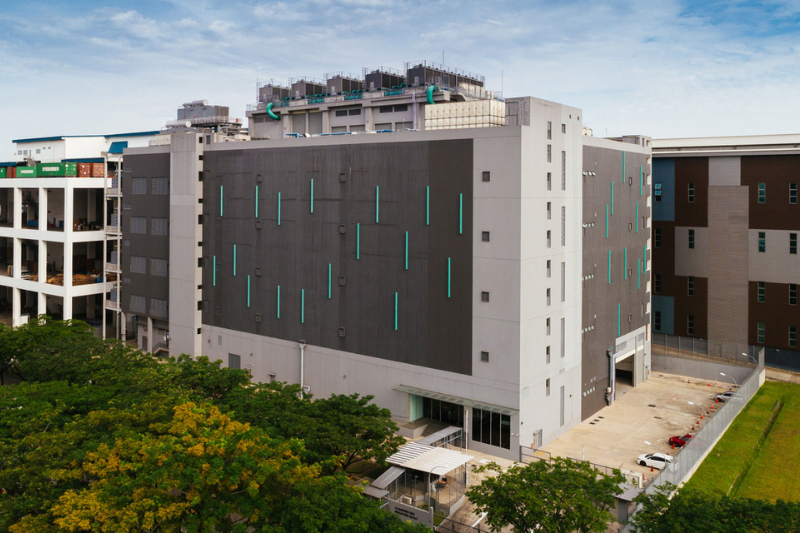
KDC REIT’s Singapore data centre portfolio anchors 62.7% of its S$6.3 billion in assets under management.
In the three months ended 31 March 2026 (1Q2026), KDC REIT’s gross revenue climbed 18.4% to S$121.0 million, driving a comparable 19.4% surge in net property income to S$105.2 million.
The REIT’s 1Q2026 distribution per unit (DPU) increased 13.2% year on year (YoY) to S$0.02833, supported by a resilient portfolio boasting a 95.6% occupancy rate, 6.5-year weighted average lease expiry, and 51% rental reversion.
KDC REIT’s balance sheet is healthy. Its leverage ratio is low at 35.1% with a well-staggered debt tenor of 3.3 years. This mitigates refinancing risks amid an uncertain interest-rate environment.
Moreover, the new master lease for Keppel DC Singapore 3 increases the likelihood of sustainable distributions, since there’s a fixed annual rental escalation of 3%.
Singapore Technologies Engineering — The Blue-Chip Dividend Payer
In the first quarter ended 31 March 2026 (1Q2026), STE’s revenue grew 11% to S$3.3 billion, driving net profit growth of more than 15%. The company enjoyed broad-based growth across all business segments.
The blue-chip company boasts a diverse portfolio spanning Defence, Commercial Aerospace, and Urban Solutions, providing resilience from geopolitical headwinds such as the Middle East conflicts.
STE’s large order book of S$34.5 billion, with S$8.0 billion expected to be delivered by the end of 2026, provides enormous revenue visibility to maintain a steady dividend payout for investors.
STE’s growing top-line revenue, resilient portfolio diversification, and revenue visibility, reflect a highly sustainable dividend outlook for the income investor.
DBS Group — The Dividend Growth Compounder
Singapore’s largest bank, DBS, reported a 1% increase in total income and net profit for the first quarter ended 31 March 2026 (1Q2026), to S$5.95 billion and S$2.93 billion, respectively.
The growth engines? Deposit growth, record fee income, a robust wealth management business, and improved market trading income.
Although the strengthening Singapore dollar and falling SORA rates were headwinds for DBS, they were successfully mitigated using effective hedging strategies.
DBS’s non-performing loans (NPLs) improved to 1.0% from 1.1% a year ago, underscoring its asset quality.
The world’s best bank maintains a fortress balance sheet with its fully phased-in CET1 ratio of 14.8% and allowance coverage of 131%. There’s more than enough liquidity to back its loans and support its dividend.
UMS Integration Limited — The High-Yield Opportunity
UMS is capitalising on its role as a one-stop strategic integration partner for semiconductor equipment manufacturers to meet surging AI-driven semiconductor demand.
To this end, UMS is ramping up production in its new state-of-the-art facilities in Penang to fulfil more complex AI-related demand from its key customers.
In 2025, UMS’s revenue climbed 4% YoY to S$251.1 million, led by its semiconductor segment. Net profit attributable to shareholders was up 2% to S$41.6 million
Crucially, UMS intends to fund its expansion through share placements instead of reducing dividends, demonstrating its commitment to maintaining a stable dividend payout.
Get Smart: Passive Income Works Best When It’s Predictable
By selectively combining dividend-paying stocks with staggered payout schedules, it’s possible to create a predictable monthly cash flow.
Aside from predictability, the cash flow is likely to increase as it did in 2025, compared to the previous year:
| Dividend Names | 2025 Payout per share (S$) | 2024 Payout per share (S$) | Changes |
| STI ETF | 0.17950 | 0.15740 | 14.04% |
| KDC REIT | 0.10035 | 0.08881 | 12.99% |
| DBS | 2.85 | 2.16 | 31.94% |
| UMS | 0.05000 | 0.05400 | -7.41% |
| STE | 0.17000 | 0.16000 | 6.25% |
Still, income investors should note that dividend increases and payout dates are subject to the discretion of individual companies and could vary occasionally.
While a perfectly even income stream is not possible, an astute mix of quality dividend names like the above-mentioned can come close to building a reliably growing income stream.
When the market is unpredictable, where can you park your money with confidence? Our latest FREE report reveals 5 Singapore dividend-payers built to withstand global storms. Get it now and see what’s still worth holding.
Follow us on Facebook, Instagram and Telegram for the latest investing news and analyses!
Disclosure: Larry owns shares of KDCREIT and DBS.