With interest rates remaining elevated, many Singapore investors are hunting for dependable income.
REITs that still pay out a dividend yield of more than 6% look especially attractive.
However, high yield alone is not enough to justify if a REIT makes for good investment.
Some of them offer sustainable dividend payouts backed by strong fundamentals, while others may be masking deeper risks that may be unknown to investors.
In this article, we will be looking at three REITs paying out a dividend yield of above 6% and whether they are worth adding to your portfolio.
CapitaLand China Trust (SGX: AU8U) – China-focused Retail & Business Park Landlord
CapitaLand China Trust (CLCT) is Singapore’s largest China-focused REIT.
The REIT’s portfolio is spread across different asset classes such as retail, business parks, and logistics facilities.
As at 30 June 2025, CLCT’s total asset under management (AUM) stands at S$4.5 billion and the REIT is sponsored by CapitaLand Investment, which owns about 25% stake in CLCT, with a fund under management scale of around S$117 billion.
For the third quarter of 2025 (3Q2025), revenue was down 8% year on year (YoY) from RMB452.8 million to RMB416.6 million.
This was attributed to lower revenue from the retail and business segments, as well as the absence of contribution from CapitaMall Yuhuating
Meanwhile, net property income (NPI) declined 8.5% YoY to RMB273.5 million.
Overall portfolio occupancy stood at 90.6%, with both retail and logistics segment clocking in at an occupancy rate of 97.1% and 96.6% respectively.
For the first nine months of 2025, rental reversion for the retail, business park and logistics segments stood at negative rates of 1.5%, 8.9% and 24.5% respectively.
Portfolio weighted average lease expiry (WALE) remains stable at 2.6 years by net leaseable area.
CLCT’s top 10 tenants contribute just 8.8% of the total rental income, reducing tenant concentration risks.
On the capital management front, CLCT’s gearing ratio stood at 38.8% and interest coverage ratio remained manageable at 2.9 times, with average debt to maturity of 3.4 years.
Currently, 80% of the debts are at a fixed interest rate, which will mitigate fluctuation in finance costs.
With a 12-month trailing dividend of S$0.0513 and share price at $0.79, this translates to a dividend yield of 6.49%.
Even as CLCT’s portfolio occupancy rate remained at a high of more than 90% and has a stable capital management profile, the negative portfolio reversion is a cause of concern on the organic growth of its distribution in the near term.
Mapletree Industrial Trust (SGX: ME8U) – Data Centre & Industrial REIT
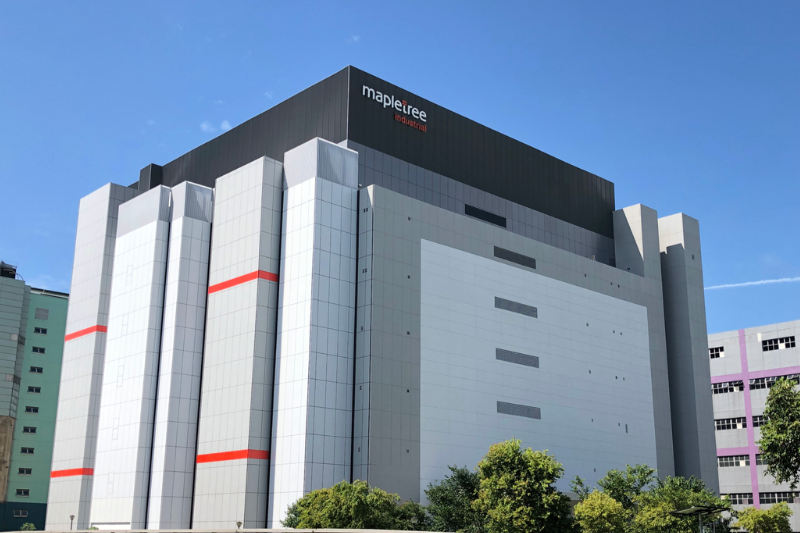
Mapletree Industrial Trust (MIT) is an industrial-focused REIT with exposure to the data centres segment as well as Hi-Tech Buildings and Business Space and General Industrial Buildings.
As at 30 September 2025, MIT’s portfolio consists of 136 properties and a total AUM of around S$8.5 billion, of which 47.2% are in North America, followed by Singapore at 45.2% and the rest in Japan.
MIT’s sponsor is Mapletree Investments, a global real estate development, investment, capital and property management company that owns and manages S$80.3 billion of assets across Asia Pacific, Europe, the United Kingdom and North America.
In their latest 2QFY2025/2026 results, NPI was down 7.8% YoY to S$124.0 million and distribution to unitholders was down 5.3% YoY to $90.7 million.
DPU stood at S$0.0318, which was a drop of 5.6% YoY, mainly due to absence of one-off divestment gain, reduced income from portfolio divestment and foreign exchange headwinds.
MIT’s overall portfolio occupancy rate held steady at 91.3%, while its Singapore portfolio achieved a positive rental reversion rate of 6.2% for renewal leases.
MIT’s WALE remained healthy at 4.6 years for the quarter and its top 10 tenants formed about 30.7% of MIT’s portfolio gross rental income.
Meanwhile, no single trade sector contributes more than 16% of the portfolio gross rental income.
Gearing ratio stood at 37.3% and close to 93% of its debt is hedged on fixed interest rate.
Interest coverage ratio remained healthy at 3.9 times, and debt to maturity remained fairly long at approximately 3.0 years.
At a share price of $2.06 and a 12-month trailing dividend of S$0.1322, the yield is 6.42%.
The current yield of more than 6% on MIT appears to be a mixture of opportunity and risks due to the fact that the portfolio remained healthy and stable, but the decline in DPU is an area that investors should take note of.
United Hampshire US REIT (SGX: ODBU) – Essential & Necessity Retail
United Hampshire US REIT, or UHREIT, owns a portfolio of 20 predominantly grocery-anchored and necessity-based properties along with two self-storage properties.
These properties have a total net lettable area (NLA) of around 3.6 million square feet with AUM of around US$751 million.
UHREIT’s sponsors are UOB Global Capital & The Hampshire Companies LLC.
Both sponsors have been in partnership for more than 15 years, having co-managed 3 funds and 3 co-investment portfolios together.
In UHREIT’s latest 9M2025 business update, gross revenue and net property income declined by 1.6% (US$53.8 million) and 1.9% (US$36.7 million) YoY respectively, primarily due to the absence of contributions from three properties divested in August 2024 and January 2025.
Distributable income was higher by 6.6% YoY to US$19.9 million due to lower financing costs and lower borrowings.
UHREIT’s committed occupancy rate for Grocery & Necessity portfolio remained high at 97%, and the leases are substantially on a triple net lease basis, with the majority having built-in rental escalations.
Meanwhile, self-storage properties maintained occupancy of 94.9%.
Grocery & Necessity portfolio currently has a WALE of 7.5 years and UHREIT has a high tenant retention rate of 90%.
In fact, UHREIT’s WALE for its top 10 tenants came in at 9.6 years, which suggests a long and predictable income stream.
Additionally, 59.0% of the REIT’s tenants provide essential services which also suggests stable income in the long term.
Gearing ratio is at 38.9%, with no refinancing requirement until November 2026 and no interest rate swaps maturing until December 2026, which will allow predictability in its financing cost.
With a share price of US$0.51 and a 12-month trailing dividend of US$0.0414, UHREIT offers a dividend yield of 8.12%, which appears to be attractive on all fronts.
However, as the REIT is denominated in USD, investors should also consider foreign exchange rate fluctuation as one of the risks tied to UHREIT.
What Makes a 6% Yield Safe — or Risky?
A high dividend yield from a REIT can reflect genuine value or deeper structural issues.
Some key factors can determine the long term sustainability of high dividend yields.
- Cash flow stability: Stable cash flow can support high yield payouts over the long run, while volatile cash flow could put dividend payouts at risk.
- Debt refinancing profile: A well-spread debt maturity profile reduces the risk of sudden fluctuations in financing cost, helping to stabilise distributable income.
- Asset quality and tenant strength: High-quality assets and strong tenants help ensure stable rental income, which supports dividend sustainability.
- Sector resilience: A resilient sector helps ensure that cash flow is not disrupted by prolonged vacancies.
- Sponsor support: Strong sponsor support enables a REIT to access growth opportunities and maintain stability in its distributions.
Get Smart: These REITs Deserve More Attention
Even though these REITs offering more than 6% yield look attractive, the bottom line is that sustainability matters more than just headline numbers alone.
Income investors should look beyond dividend yield and evaluate factors such as DPU trends, strength of their respective balance sheets and long-term portfolio resilience.
With careful selection, these high-yield REITs could play an important and crucial role in a diversified income portfolio.
If you want to retire with a constant stream of dividends, these 5 stocks might be all you need. We’ve found 5 SG stocks that have kept paying (and growing) through inflation, rate hikes, and recessions. See what they are with our latest free report for SGX dividend investors. Click here to get instant access.
Follow us on Facebook, Instagram and Telegram for the latest investing news and analyses!
Disclosure: Daniel does not own shares in any of the REITs mentioned.