May brings a cluster of blue-chip results that should sharpen the dividend picture for the second half of 2026.
Free cash flow is the lifeblood of dividends – and the three names below face very different stress tests on the road to their next distributions.
One is riding record numbers, one is navigating a doubled fuel bill, and one needs a single Singapore property to come good before its distribution per unit (DPU) can recover.
Here are three blue-chip dividend stocks worth watching in May.
1. SATS Ltd (SGX: S58) – Reporting 25 May 2026
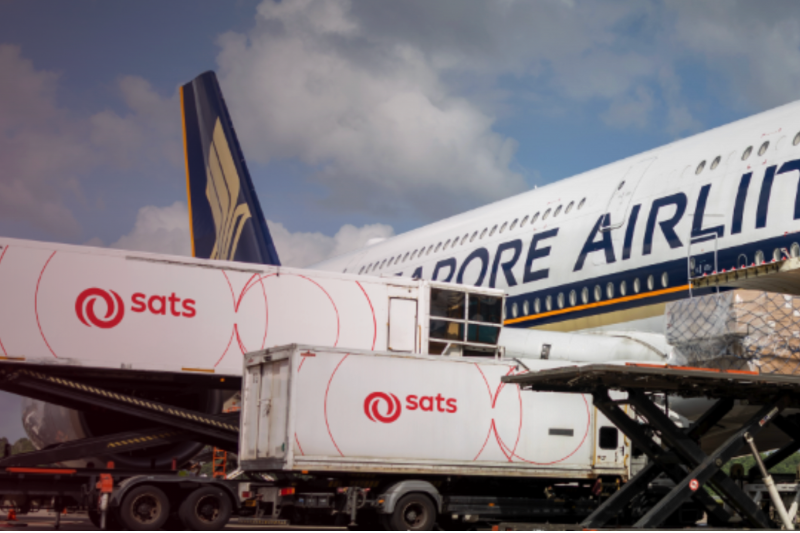
A global provider of gateway services and food solutions, operating across more than 225 stations in 27 countries, SATS is Asia’s leading airline caterer and one of the world’s largest air cargo handlers following its 2023 acquisition of Worldwide Flight Services.
Of the three names on this watchlist, SATS heads into May with the strongest earnings momentum.
Revenue for its third quarter ended 31 December 2025 (3QFY2026) rose 8.0% year on year (YoY) to S$1.6 billion, while net profit climbed 20.4% to S$84.7 million.
EBITDA margin expanded from 17.3% to 18.1%, evidence that operating leverage is feeding through.
Cargo was the standout.
Gateway Services revenue grew 10.0% YoY to S$1.3 billion, supported by a record 2.55 million tonnes of cargo processed.
Asia-Pacific volumes surged 10.6% and EMEAA jumped 16.4%, more than offsetting a 6.9% decline in the Americas linked to tariff impacts.
The cash-flow picture is encouraging.
Nine-month free cash flow of S$369.9 million comfortably covers the FY2025 total payout of S$0.05 per share, comprising a S$0.015 interim and a S$0.035 final dividend.
Cash of S$620.1 million sits against borrowings of S$2.4 billion, with leverage continuing to improve within Moody’s targets.
The risk to watch on 25 May: whether the Americas softness deepens, and whether airline customers’ capacity decisions in response to higher jet fuel costs begin feeding through to SATS’s volumes.
2. Singapore Airlines (SGX: C6L) – Reporting 14 May 2026
As Singapore’s flagship carrier, Singapore Airlines (SIA) operates full-service flights under the SIA brand and budget services through Scoot.
The group also held a 25.1% stake in Air India and operated 212 aircraft serving 134 destinations as at 31 December 2025.
Its 3QFY2025/2026 update was a story of operating strength.
Revenue hit a record S$5.5 billion, up 5.5% YoY, while operating profit surged 25.9% to S$791.9 million.
Net profit fell 68.9% YoY to S$504.6 million, but the bulk of that decline reflects the prior year’s one-off S$1.1 billion non-cash gain from the Vistara–Air India merger.
The dividend has already been recalibrated.
The interim dividend declared with 1HFY2025/2026 results halved to S$0.05 per share from S$0.10 a year ago, alongside a S$0.03 special dividend.
A further S$0.07 per share of the FY2025/2026 special tranche remains subject to shareholders’ approval at the upcoming AGM.
The cushion is the balance sheet.
Nine-month operating cash flow of approximately S$2.8 billion against capex of S$1.7 billion translates to estimated free cash flow of around S$1.1 billion.
Cash and bank balances of S$6.1 billion sit against total debt of S$10.4 billion, with the debt-to-equity ratio improving to 0.66x from 0.82x.
The fuel question now overshadows the FY2025/2026 outlook.
Amid the Middle East conflict and the effective closure of the Strait of Hormuz, jet fuel prices have roughly doubled, from US$85–90 to US$150–200 per barrel.
With fuel accounting for around 30% of group expenditure, SIA has raised fares but management has acknowledged these only partially defray the higher costs.
Hedging programmes typically track crude benchmarks rather than refined jet fuel, limiting their effectiveness in the current environment.
3. Frasers Logistics & Commercial Trust (SGX: BUOU), or FLCT – Reporting 5 May 2026
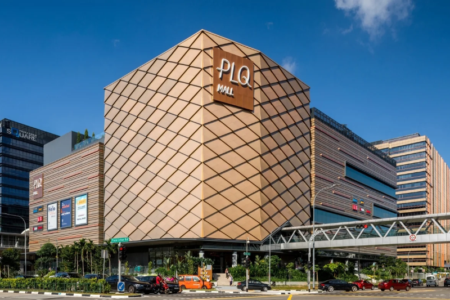
With 113 logistics, industrial, and commercial properties worth S$6.9 billion across Australia, Germany, Singapore, the United Kingdom, and the Netherlands, FLCT saw FY2025’s DPU fall 12.5% YoY to S$0.05950.
The drag was mainly due to a 26.4% surge in finance costs even as revenue rose 5.6% to S$471.5 million and adjusted net property income climbed 1.9% to S$326.1 million.
The REIT is sponsored by Frasers Property Limited.
The update from its first quarter ended 31 December 2025 (1QFY2026) offered early signs of stabilisation.
Portfolio occupancy improved to 96.2% from 95.1% a quarter ago, driven by Alexandra Technopark (ATP) jumping from 77.9% to 86.3% after the manager secured leases for roughly 83% of the ex-Google space.
Logistics & industrial occupancy held firm at 99.7% with rental reversions of +36.4% on an average-versus-average basis.
The commercial portfolio, however, posted a -1.6% reversion, reflecting weaker renewals at ATP.
Gearing eased to 34.8%, leaving S$592 million of debt headroom to the 40% regulatory limit.
The cost of borrowings held at 3.1%, while the interest coverage ratio slipped marginally to 4.1x.
The 5 May business update will be operational only – no DPU number is due until the half-year.
The two metrics worth tracking: whether ATP’s committed leases commence on schedule by 3QFY2026, and whether borrowing costs stabilise.
Get Smart: Three Different Points on the Same Journey
Headline dividends mean little without the cash flow and balance sheet to support them.
SATS heads into May with earnings momentum, free cash flow coverage, and a fuel shock that affects it only at one remove.
SIA’s payout has already been trimmed, but a strengthened balance sheet provides a cushion against the fuel-cost reset still to come.
FLCT needs Alexandra Technopark to deliver and finance costs to ease before any DPU recovery can be claimed.
Income investors will not get full clarity from any single May release.
But together, the three updates will tell us whether the FY2026 distribution outlook is firming or fraying.
The world’s gotten unpredictable, but some Singapore companies have quietly kept thriving. You’ve probably seen them in your daily life. And yes, they’ve kept paying dividends through it all. Meet 5 resilient stocks built to navigate global storms. Get the free report here and see how they’ve done it.
Follow us on Facebook, Instagram and Telegram for the latest investing news and analyses!
Disclosure: The Smart Investor owns units of FLCT.