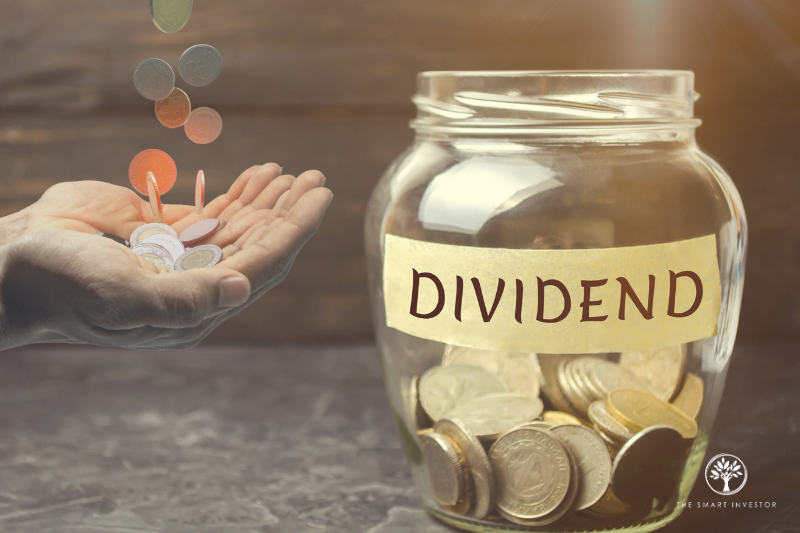
Dividend yield is perhaps the most important factor for some income investors when evaluating which stocks to invest in.
Because let’s be real, 8% to 10% yields are far more attractive than 4% returns.
Experienced investors, however, know that a high yield can sometimes be a red flag rather than an opportunity.
What Is Dividend Yield?
Dividend yield measures the company’s annual dividend per share as a percentage of its current stock price.
The yield will indicate how much cash an investor receives for every dollar invested.
There are two ways dividend yields can increase:
- When dividend payouts increase
- When the company’s stock price falls
While a higher dividend yield may seem attractive at first glance, percentages alone can be misleading. Here are three reasons why:
Reason #1: A High Yield May Signal a Falling Business
Imagine this: Company A traded at S$5 per share and paid a S$0.20 dividend last year. That translates to a 4% yield. If the share price cuts in half to S$2.50, the yield immediately flies up to 8%.
Companies with financial challenges often see their share prices plummet. However, that mechanically pushes the dividend yield up.
Instead of just looking at yield percentages, investors should ask:
- Why has the share price fallen?
- Is the business deteriorating?
- Has management warned about earnings?
If the business has fundamental issues, the high yield might be a red flag and could become a value trap.
Reason #2: The Dividend May Not Be Sustainable
A high yield is only valuable if it is sustainable.
Examining financial metrics such as the dividend payout ratio, free cash flow (FCF), and earnings trends is key here.
Sheng Siong (SGX: OV8) paid a total dividend of S$0.07 per share in FY2025, up 9.4% from S$0.064 a year ago, offering a 2.1% yield.
With a 68.4% payout ratio, the Group offers sustainable dividends with its debt-free record and a strong arsenal of S$215.8 million in FCF at the end of FY2025.
If a company is paying more in dividends than what it earns or using debt to maintain payments, the dividend may not be sustainable.
Remember, an attractive yield today could be followed by a dividend cut tomorrow.
Reason #3: High Yield Often Comes With Higher Risk
While ‘high-risk, high-returns’ isn’t always true, unusually high dividend yields often reflect increased risks that investors should not ignore.
Cyclical industries, businesses heavily exposed to commodity price swings, or those relying on a handful of major customers, can easily face earnings volatility that threatens future dividends.
If a business offers high yield but comes with heavy debt or weak financial positions, it is less likely to maintain dividends during challenging periods.
Finally, consider market risk.
Companies operating in industries facing structural decline, increasing regulatory pressure, or disruptive competition may struggle to sustain their earnings over time.
In these situations, a high dividend yield may be a warning sign that the market expects future challenges, rather than an attractive opportunity.
What Makes a Good Dividend Stock Instead?
Rather than chasing the highest yield, investors should look for businesses with:
- Growing dividends: Consistent dividend increases over time prove a company’s ability to generate profits for its shareholders.
- Strong FCF: Dividends backed by healthy cash generation, not debts.
- Healthy balance sheet: Strong finances with low or no debt help businesses weather economic downturns and protect payouts.
- Durable competitive advantage: Unique and sturdy advantages can give a company an edge over its competitors and maintain revenue growth.
DBS Group (SGX: D05) is a great example of a quality dividend stock.
The Group paid S$3.06 per share in total dividends for FY2025, 37.8% higher than FY2024’s S$2.22 payout per share.
As Southeast Asia’s biggest bank, DBS’s competitive advantages allow its total income to increase year after year, reporting S$5.95 billion for 1Q2026, up 1% YoY and setting a record high for the bank.
Strong REITs like CapitaLand Integrated Commercial Trust (SGX: C38U) (CICT) are also great income investments.
CICT reported gross revenue of S$426.7 million for 1Q2026, up 8.0% YoY.
Net property income (NPI) rose 7.9% to S$314.4 million.
As CICT distributes twice a year, no distribution per unit (DPU) was declared this quarter.
However, for FY2025, CICT achieved a DPU of S$0.1158, 6.4% higher YoY.
When a High Yield Is Actually Attractive
A high dividend yield is not always a red flag – it can sometimes present an attractive investment opportunity.
An elevated yield may simply reflect excessive market pessimism rather than deteriorating fundamentals if a company’s earnings are stable, its cash flow comfortably covers dividends, and its balance sheet is financially healthy.
Common Mistakes Income Investors Make
Buying purely based on dividend yield is a common mistake.
A high dividend yield alone does not indicate a good investment, as it could hide underlying financial problems rather than genuine value.
Ignoring declining earnings can cause your purchase to be a value trap.
Falling earnings can reduce a company’s ability to sustain or grow its dividend over time.
Remember, even profitable companies need sufficient cash flow to fund dividend payments without relying on debt.
Assuming past dividends guarantee future payouts is also a common folly – a long history of dividend payments does not guarantee that future dividends will remain unchanged.
Last but not least, concentrating dividend investments in a single sector increases the risk of income disruption if that industry faces difficulties.
Get Smart: A Safe Dividend Is Better Than a High Dividend
Your best investment might not be the one that gives you the highest yield.
A sustainable 4% yield that increases over time beats one that pays 9% now and halves next year.
The smartest investors focus on sustainable dividends paid by companies with healthy financials and strong free cash flow.
Some companies cut dividends in a downturn. These 5 didn’t.
Find out which Singapore blue chips have weathered past chaos…and why they could be your portfolio’s anchors in the next wave of downturn. Download the report free.
Follow us on Facebook, Instagram and Telegram for the latest investing news and analyses!
Disclosure: Wenting A. does not own any stocks mentioned.