Welcome to this week’s edition of top stock market highlights.
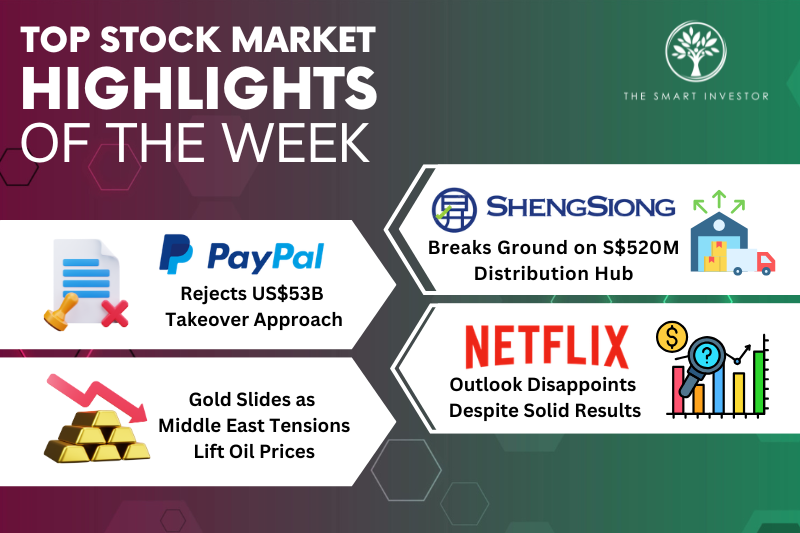
This week, Singapore’s homegrown grocery chain broke ground on an ambitious automated distribution hub, while over in the US, a US$53 billion takeover approach for a payments pioneer met a cool reception from its board.
We also review a streaming giant’s latest quarterly report card that failed to excite investors, and examine how escalating Middle East tensions have sent gold prices tumbling.
Sheng Siong commits S$520 million to automated distribution hub
Sheng Siong (SGX: OV8) broke ground on 13 July 2026 on a new integrated headquarters and distribution centre (IHDC) in Sungei Kadut, part of a S$520 million investment to support its next phase of growth.
The seven-storey facility, due for completion in 2029, will span more than 61,000 square metres and offer storage for over 70,000 pallet positions.
It will be able to support more than 120 stores across Singapore, up from the group’s current network of 90 outlets.
The site is roughly 2.5 times the size of the group’s existing Mandai Link distribution centre, which is nearing full capacity as the retailer opens more outlets and carries a wider product range.
Backed by Enterprise Singapore and JTC, the Sungei Kadut facility will integrate automated storage and retrieval systems, robotics, intelligent warehouse management technology and multi-temperature storage zones.
CEO Lim Hock Chee said the group studied automation and warehousing solutions in Europe, China and Australia before designing a facility tailored to its needs, adding that it should become one of South-east Asia’s most highly automated grocery distribution centres once completed.
PayPal’s board sees Stripe-Advent bid as undervaluing the company
Stripe and private equity firm Advent International have made a joint offer to acquire PayPal Holdings (NASDAQ: PYPL) at US$60.50 per share, valuing the payments company at more than US$53 billion.
The offer is backed by roughly US$50 billion in committed bank financing and represents around a 28% premium to PayPal’s closing price on 14 July 2026.
PayPal’s board, however, sees the bid as undervaluing the company and believes it faces regulatory and financing hurdles.
Its early view is that while the offer is a premium to the recent share price, it does not fully reflect the value achievable if management executes its turnaround strategy.
PayPal rose 2% on 16 July 2026 to US$56.73.
Combining Stripe and PayPal would create one of the world’s largest online payments companies, processing some US$3.7 trillion of annual volume.
PayPal’s market capitalisation peaked at about US$360 billion in 2021 and fell to as low as roughly US$36 billion this year, having shed more than 40% of its value over the past 12 months.
Investors will watch PayPal’s 28 July earnings report for signs its core checkout business is stabilising.
Streaming giant’s outlook underwhelms as engagement reporting is pared back
Netflix (NASDAQ: NFLX) reported second-quarter revenue and earnings roughly in line with analyst estimates on 16 July 2026, but its shares fell more than 8% in after-hours trading as investors were disappointed by the earnings forecast.
Revenue came in at US$12.56 billion, up 13% year on year (YoY) and marginally below expectations, with the increase attributed to membership growth, pricing and higher advertising revenue.
Earnings per share were US$0.80 against US$0.79 estimated.
Net profit for the quarter stood at US$3.40 billion, up from US$3.13 billion a year ago.
Netflix expects third-quarter revenue to grow 12% and narrowed its full-year 2026 revenue guidance to between US$51 billion and US$51.4 billion, from US$50.7 billion to US$51.7 billion previously.
Management called engagement “healthy”, noting members watched more than 97 billion hours in the first half, but said its “What We Watched” reports will move to an annual release from 2027 to keep attention on financial metrics.
The group still expects to roughly double advertising revenue YoY to US$3 billion.
Middle East tensions lift oil, denting the yellow metal’s appeal
Gold fell 2% to a more than two-week low on 16 July 2026 as escalating Middle East tensions pushed oil prices and US Treasury yields higher.
Spot gold was down 1.9% at US$3,984.64 per ounce by 2.05pm EDT, having touched its lowest level since 1 July earlier in the session, while US gold futures settled 1.5% lower at US$3,992.10.
Oil prices stayed near a one-month high as concerns over Middle East energy supplies grew after Iran asked Yemen’s Houthis to stand ready to close the Red Sea oil route should the US strike Iranian power infrastructure.
Higher oil prices stoke inflation concerns, raising expectations of elevated interest rates and denting gold’s appeal as a non-yielding asset.
Traders are now pricing in roughly a 53% chance that the US Federal Reserve will hike rates in September, according to the CME FedWatch Tool.
Other precious metals also slid, with silver down 3.6% to US$55.68 per ounce, platinum off 3.1% to US$1,621.83 and palladium 4.1% lower at US$1,260.70.
Retirement doesn’t happen overnight. It’s built one decision at a time.
We found 6 SGX companies that have paid dividends every year for more than 20 years, through the Global Financial Crisis, COVID-19, and rising interest rates.
If you’re building long-term income for retirement, this free report is a great place to start. Download your copy today.
Follow us on Facebook, Instagram and Telegram for the latest investing news and analyses!