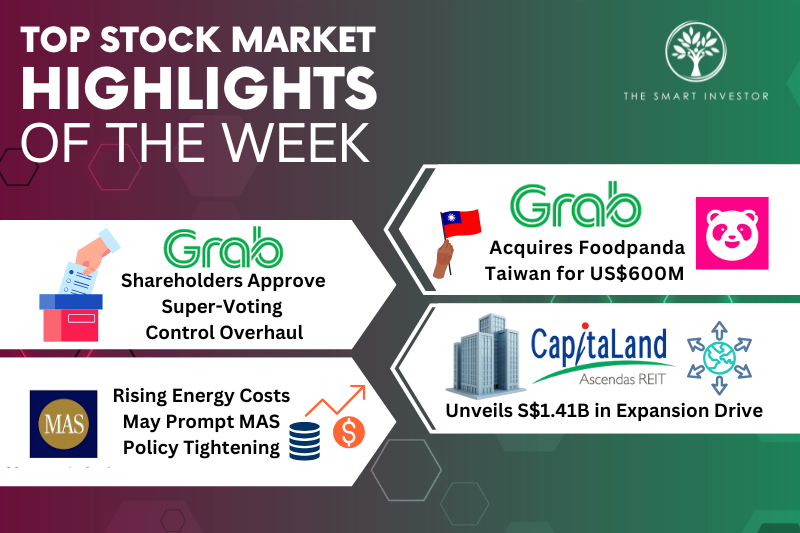
This week’s Singapore market landscape was defined by bold regional manoeuvers and tightening economic outlooks.
Grab Holdings Limited (NASDAQ: GRAB) dominated headlines with a landmark US$600 million acquisition of foodpanda Taiwan alongside a significant governance overhaul.
Meanwhile, CapitaLand Ascendas REIT (SGX: A17U) executed a massive S$1.41 billion expansion into data centres and logistics.
However, these growth stories face a sobering backdrop as rising energy prices, driven by Middle East tensions, push the Monetary Authority of Singapore (MAS) towards a likely policy tightening this April.
Grab Steps Outside Southeast Asia with US$600 Million foodpanda Taiwan Deal
Grab Holdings made history this week by acquiring Delivery Hero’s foodpanda business in Taiwan for US$600 million in cash.
This marks the superapp’s first expansion beyond its Southeast Asian home base.
The deal, structured on a cash-free and debt-free basis, is expected to close in the second half of 2026, with a full migration of users and merchants planned for early 2027.
Taiwan becomes Grab’s ninth market, providing a presence across 21 cities.
The acquisition leaves Uber Eats as the primary competitor on the island of 23 million people.
Foodpanda’s Taiwan operations are already profitable on an adjusted EBITDA basis and generated US$1.8 billion in GMV in 2025.
Grab projects the deal will contribute at least US$60 million in adjusted EBITDA by 2028.
To accelerate growth, Grab intends to introduce its proprietary AI-powered tools, including GrabMaps for route optimization and an AI merchant assistant.
CEO Anthony Tan noted that Taiwan’s high-density logistics landscape is a natural fit for Grab’s existing operational expertise.
Grab’s Super-Voting Overhaul Raises Founder Control to Nearly 75%
At an extraordinary general meeting (EGM) held on 24 March 2026, Grab shareholders approved a resolution to double the voting power of Class B ordinary shares from 45 to 90 votes per share.
Passing with 85.9% approval, the move significantly consolidates control under CEO Anthony Tan, whose voting power rises from 59.9% to approximately 74.9%.
This gives Tan a definitive two-thirds majority, even as other Class B holders, like co-founder Tan Hooi Ling and former president Ming Maa, convert their holdings into Class A shares.
The board justified the overhaul as a means to preserve long-term strategic focus and ensure GXS Bank remains under Singaporean control per MAS requirements.
However, governance observers have raised concerns, noting that the change materially dilutes the influence of Class A shareholders without altering their economic stake.
While the move secures Tan’s leadership vision against short-term market pressures, it highlights the ongoing tension between founder-led control and standard equitable governance in the tech sector.
CapitaLand Ascendas REIT’s S$1.4 Billion Push into Logistics, Business Space and Japan Data Centres
CapitaLand Ascendas REIT, or CLAR, announced a massive S$1.41 billion acquisition spree spanning Singapore and Japan.
The deals are expected to be distribution per unit (DPU)-accretive, providing a pro forma uplift of approximately S$0.0318, or 2.1%.
In Singapore, CLAR is acquiring the ramp-up logistics complex at 25 Loyang Crescent for S$504.2 million and a 50% stake in Ascent at Science Park Drive for S$245.0 million.
The headline transaction is a S$620.7 million investment for a 49% stake in a Tier III hyperscale data centre in Osaka, Japan.
This freehold facility is fully leased to a global hyperscaler with a 14.2-year weighted average lease expiry (WALE) and 1% annual rent escalations.
CEO William Tay highlighted this as a strategic move into Japan’s data centre market, which is projected to grow 24% annually through 2030 due to AI demand.
Upon completion, Singapore will remain the core of CLAR’s S$19.9 billion portfolio at 66%, but the expansion diversifies its international footprint in high-growth digital infrastructure.
War-Driven Energy Prices Put MAS on Course to Tighten Monetary Policy in April
Singapore’s inflation outlook has shifted as energy prices surge due to Middle East tensions. Economists from DBS Group Holdings Ltd (SGX: D05), United Overseas Bank Ltd (SGX: U11), and Malayan Banking Berhad (KLSE: MAYBANK) now largely expect the MAS to tighten monetary policy at its April 2026 review.
While February headline inflation fell slightly to 1.2%, core inflation – the MAS’s preferred gauge – hit a 14-month high of 1.4%.
Import cost pressures are expected to rise, potentially pushing inflation toward the upper end of the MAS’s 1% to 2% forecast range.
Maybank has already adjusted its core inflation forecast to 1.9%.
Consumers are already feeling the pinch from rising electricity, petrol, and food costs.
Consequently, the Singapore dollar nominal effective exchange rate (S$NEER) has been trading near the top of its policy band, signalling market anticipation of a tightening move.
UOB analysts suggest a 50-basis-point steepening of the policy slope in April to combat these skewed upside risks.
It almost feels like the government is paying companies to make you wealthier. Singapore’s new S$5 billion market boost could send fresh money into local stocks. We identified 5 companies positioned to benefit, including familiar names with surprising wealth potential. Our free report reveals these hidden opportunities before the money flows in. Download it now before it’s too late.
Follow us on Facebook, Instagram and Telegram for the latest investing news and analyses!