The S&P 500 has delivered strong returns over the years, making it one of the most popular benchmarks for investors worldwide.
Currently, the index has a price return of about 18% over the past year, and 11.3% annualised over the past five years (for a total return of around 70% over 5 years).
Consistently outperforming the S&P 500 is difficult because the index represents some of the world’s largest and most successful companies.
Still, a select group of companies has managed to outperform it, and they tend to share common traits such as strong business models, competitive advantages, and exposure to powerful long-term trends.
Although a company may beat the S&P 500 in any year, it’s harder to do so over a five-year period.
We will take a closer look at companies that have managed to outperform over both the past one and five years.
These companies share similar traits.
First, they’ve grown both their top and bottom lines over the period.
Second, they possess strong competitive advantages.
Third, they serve a large market, which provides room for continued expansion.
NVIDIA Corporation (NASDAQ: NVDA) – The AI Winner
NVIDIA, one of the biggest winners from AI-driven demand, has returned 34% over the past year (to 28 August), and 910% over the past five.
The company’s revenue for its fiscal year ended 30 January 2022 (FY2022) was US$26.9 billion, with operating income of US$10 billion, a margin of 37%. By FY2026, these had grown to US$216 billion and US$130 billion (a 60% margin) respectively.
NVIDIA’s CUDA computing platform has become the industry standard for GPU acceleration which allows for more efficient use of NVIDIA chips, and locks users into using its hardware.
The company, which dominates the GPU market, isn’t resting on its laurels.
Recently, it moved into the CPU space, challenging incumbents Intel Corp (NASDAQ: INTC) and Advanced Micro Devices Inc (NASDAQ: AMD).
This is part of its strategy to vertically integrate its systems and produce more of the various chips that go into a full-stack AI platform.
NVIDIA is also expanding its customer base beyond hyperscalers (such as AWS and GCP) and frontier AI labs (OpenAI and Anthropic) by serving large enterprises, AI startups, and sovereign countries.
For NVIDIA, the biggest risk is that the AI boom turns to bust, resulting in an oversupply of its chips globally.
It has also entered into numerous unconventional financing arrangements with customers that may result in additional liabilities should the demand for the latter’s products fail to materialise.
Alphabet Inc. (NASDAQ: GOOG) – The Cloud Compounder
Alphabet’s shares have risen by about 45% and 135% over the past one and five years, respectively.
This was driven by strong growth in its top and bottom lines, which increased from US$258 billion and US$79 billion (income from operations) in 2021 to US$403 billion and US$129 billion in 2025, respectively.
This translates to a 32% margin last year.
Alphabet is able to harness AI in several ways: the technology is driving Search usage, Gemini App users (who have tripled in the past year), engagement with YouTube, and demand for its Cloud services.
A big source of future growth comes from the direct sale of its TPU chips, which can power AI workloads and could create a new revenue stream of US$900 billion according to estimates.
However, all of this AI investment has impacted Alphabet’s free cash flow, which turned negative in the most recent quarter (2Q2026).
The company even issued US$80 billion in shares earlier this year to fund its AI investments, diluting existing investors.
If these investments pay off, shareholders will benefit in the long run.
However, there is the risk that returns disappoint, which would affect Alphabet’s ability to outperform the S&P 500 index in the future.
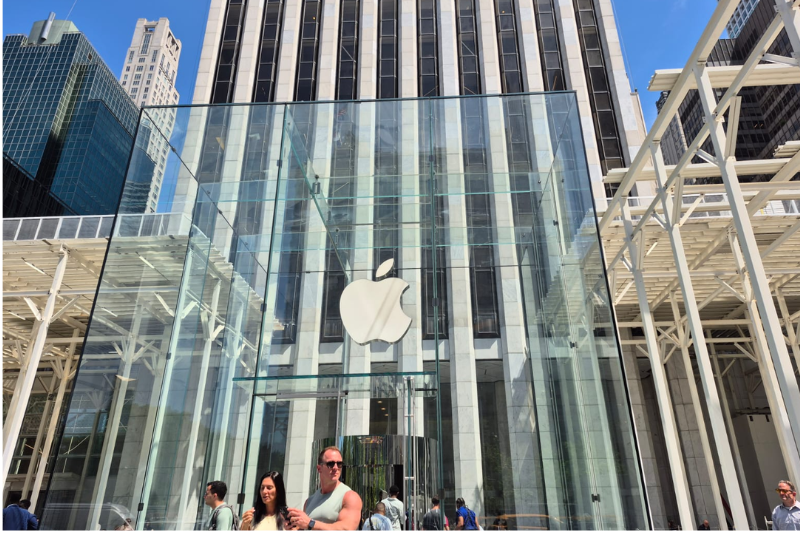
Apple Inc. (NASDAQ: AAPL) – The Consumer Leader
Over the past year, Apple’s shares have returned approximately 33%, with a five-year total return of 104%.
Unlike NVIDIA and Alphabet, Apple beat the S&P 500 not because of AI, but because of the dominance of its brand among consumers and its ability to monetise this consumer base.
For its financial year ended 25 September 2021 (FY2021), Apple’s revenue was US$366 billion, which translated into operating income of US$109 billion, a 30% margin.
Five years later, Apple’s FY2025 revenue was US$416 billion, while its operating income was US$133 billion, up by 14% and 22% respectively.
This revenue stream is well diversified.
In FY2025, the Americas accounted for 43% of sales, Europe 27%, and the rest of the world 30%.
Apple dominates the market for premium smartphones, which translates into superior pricing power.
Crucially for investors, Apple is also a cash generation machine that, unlike many of its Magnificent 7 peers, is not spending all its free cash flow on AI.
In FY2025, the company generated US$99 billion in free cash flow and returned US$106 billion to shareholders in the form of dividends and share buybacks.
However, this lack of investment also means that Apple’s growth prospects may be more limited.
Its smartphone business is mature, while growth in its services business has recently slowed, with no signs yet of the next blockbuster product.
Get Smart: Winners Need to Keep Winning
Past performance does not predict future returns.
Beating the S&P 500 is impressive, but investors should not make the mistake of choosing stocks based on past share price gains.
Instead, they should focus on investing in businesses that can continue growing, innovating, and creating value for shareholders – these are the companies that have future earnings potential, which will ultimately be reflected in the share price.
Investors should also heed valuation.
Great companies can be poor investments if their valuations are excessive.
For long-term investors, the question is not simply “How much has this stock risen?” but “Can this company become significantly more valuable over the next five to ten years?”
The headlines feel worse than the market itself.
So what are experienced investors actually doing right now? Our FREE report reveals how to position your portfolio amid volatility. Download it for free here.
Follow us on Facebook, Instagram, Telegram and YouTube for the latest investing news and analyses!
Disclosure: Silas H. does not own shares in NVIDIA, Alphabet, Apple, Intel, AMD, or Amazon.