Many Singaporeans may agree that the 2.5% interest rate offered by the Central Provident Fund (CPF) Ordinary Account (OA) is safe and guaranteed, and it doesn’t require much decision-making on your part.
On the Singapore Exchange (SGX: S68), or SGX, we see a lot of established names with dividend yields much higher than 2.5%.
Can we get higher dividend yields without taking on excessive risks?
The answer lies entirely with you and your comfort level with market volatility.
CPF vs Dividend Stocks: A Crucial Difference
The difference between CPF and dividend stocks is that CPF provides capital certainty along with returns that are guaranteed.
Moreover, there is no risk since market volatility is not a concern.
However, the returns on dividend stocks are not as straightforward as CPF.
They are based on business performance and market value.
Potential income may be higher, but this is subject to price and payout changes.
Although dividend stocks have higher returns to offer, they come with a degree of uncertainty.
What Makes a Dividend Stock “Lower Risk” in Practice
When we look at dividend stocks, we are not just looking at the yield, but we also want to know how reliable that yield is.
In general, companies that have been able to maintain their dividends over time have a number of characteristics in common.
These companies usually have a resilient business model and tend to have a strong and consistent free cash flow and a more conservative dividend payout.
Another important factor is the balance sheet; companies with low debt levels are more able to absorb any potential difficulties that they face in the market.
With that in mind, look for companies that combine steady earnings, disciplined payouts, and strong balance sheets.
Here are three stocks on the SGX that stand out.
Oversea-Chinese Banking Corporation (SGX: O39), OCBC – The Dividend Stability Leader
Being one of the largest financial institutions in Singapore, OCBC has a diverse income model, ranging from consumer banking to wealth management and insurance services.
The lender reported a net profit of S$7.42 billion in the full year 2025.
Performance held steady as strong non-interest income growth offset the impact of falling interest rates on lending margins.
Based on its recent share price of S$21.61, this translates to a dividend yield of 4.5%, above the CPF OA rate.
Another factor which justifies the sustainability of the dividend policy is the bank’s strong capital position.
The common equity tier 1 (CET1) ratio is 15.1%, which is above the regulatory requirement set by the Monetary Authority of Singapore (MAS).
The asset quality is also strong, with a non-performing loan (NPL) ratio of 0.9%.
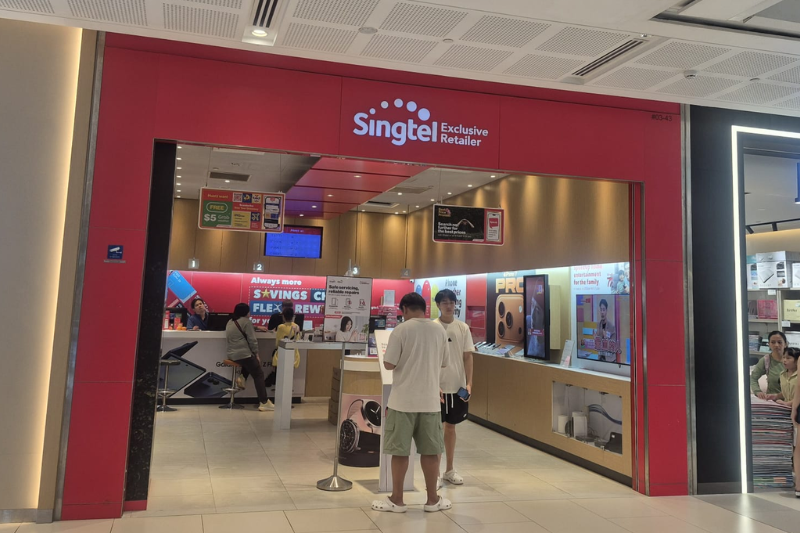
Singapore Telecommunications (SGX: Z74) – The Defensive Income Generator
Singtel’s diversified telecommunications business provides resilience during market downturns, counterbalancing the variability of earnings from its regional associates and investments.
Its earnings are anchored by subscription-based businesses across Singapore and regional markets, which provide resilient cash flows that are generally less sensitive to broader economic cycles.
However, the company remains under competitive pressure, with mobile service revenue declining 11% in the first half of fiscal year 2026 ending 31 March 2026 (1HFY2026) due to intense price competition and lower roaming revenue.
NCS, however, secured strong bookings of S$855 million during the quarter with a healthy pipeline across sectors.
Singtel has maintained support for dividends based on operating cash flow and a disciplined approach to capital management.
For 1HFY2026, the telco declared an interim dividend of S$0.082 per share (comprising a core dividend of S$0.064 and a value realisation dividend of S$0.018), up 17.1% compared to a year ago.
Looking at the current share price of Singtel at S$4.99, this translates to a 3.6% dividend yield, which is higher than what CPF OA members receive.
Keppel Ltd (SGX: BN4) – The Strong Balance Sheet Compounder
Keppel is shifting focus to a capital-light business model with recurring income streams, with a focus on fee-based asset management and infrastructure investments.
The conglomerate is strengthening the earnings visibility for the longer term following the expansion of its business from offshore and marine to infrastructure, energy transition, data centres, and asset management.
The group proposed a total FY2025 distribution of approximately S$0.47 per share, up 38% from FY2024, comprising ordinary cash dividends of S$0.34 and a special dividend of approximately S$0.13 (S$0.02 in cash plus one Keppel REIT unit for every nine Keppel shares, equivalent to approximately S$0.11).
Based on the current share price of S$12.47, the dividend yield for the company is 3.8%.
Looking ahead, Keppel aims to scale funds under management (FUM) to S$100 billion by end-2026 and S$200 billion by 2030, supported by a deal flow pipeline of about S$33 billion across its three divisions.
Why Some Investors Still Choose Dividend Stocks Over CPF
Despite the safety of CPF, many investors prefer dividend stocks for their potential for higher income and capital gains.
These stocks also offer flexibility, which enables investors to make the required adjustments depending on the market conditions.
While these features introduce more risk, they provide growth opportunities that a fixed account cannot match.
What Could Go Wrong
Dividend stocks are not risk-free.
If a company’s earnings weaken, dividends may be reduced or suspended.
Additionally, share prices can be volatile, fluctuating significantly based on market sentiment.
A high dividend yield should therefore never be viewed in isolation; it must be evaluated against the company’s underlying business fundamentals.
Get Smart: Higher Yield Requires Clear Thinking
Investing in dividend stocks will enable you to earn a higher rate of return compared to your CPF savings.
Success, however, requires selectivity and constant evaluation.
Focus on companies with strong earnings visibility, disciplined capital allocation as well as proven resilience.
While CPF provides certainty, dividend stocks offer upside – balancing the two is the key to an informed investment strategy.
What if every stock trade in Singapore puts money in your pocket? One company earns whenever the market moves. Its free cash flow has grown close to 10% a year, and dividends are set to rise 40% over the next three years. Our free 2026 Dividend Playbook reveals this legal monopoly. Download it for free now.
Follow us on Facebook, Instagram and Telegram for the latest investing news and analyses!
Disclosure: Darien.C does not own shares in any of the companies mentioned.