The Smart Investor
    Facebook Instagram
    Sunday, September 13
    Facebook Instagram LinkedIn
    The Smart Investor
    • Home
    • About
      • About Us
      • Careers
    • Smart Investing
      • Getting Started
      • Investing Strategy
      • Smart Analysis
      • Smart Reads
    • US Stocks
    • Special Free Reports!
    • As Featured on BT
    • Our Services
      • Our Services
      • Subscribe now!
    • Login
    • Cart
    The Smart Investor
    Home»Smart Analysis»Will Cheaper House Loans for You Spell Trouble for Singapore Banks?
    Smart Analysis

    Will Cheaper House Loans for You Spell Trouble for Singapore Banks?

    Chin Hui LeongBy Chin Hui LeongMarch 16, 2020Updated:July 8, 20203 Mins Read
    Facebook Twitter LinkedIn Email WhatsApp
    Share
    Facebook Twitter LinkedIn Email WhatsApp

    The US Fed Reserve moved to lower interest rates to zero overnight, in what was the largest single-day rate cut since the Global Financial Crisis (GFC). 

    If interbank interest rates in Singapore were to decline in tandem, then Singapore banks may find themselves lending out money at lower interest rates (read: that’s cheaper housing loans for you). 

    For banks, that could mean earning less for every loan made. 

    As such, the latest Fed rate cut seems like bad news for our local banks. 

    But there are more factors to consider. 

    Not the first time rates are zero 

    The Federal Funds Rate is the interest rate that banks charge to lend reserves (funds held at the Federal Reserve) to each other overnight.

    Singapore’s version is the SIBOR, or Singapore interbank offered rates. 

    This is not the first time interest rates have been reduced to near-zero. 

    In fact, for much of the decade prior to 2017, the SIBOR had remained below the 1% mark, as shown in the diagram below.  
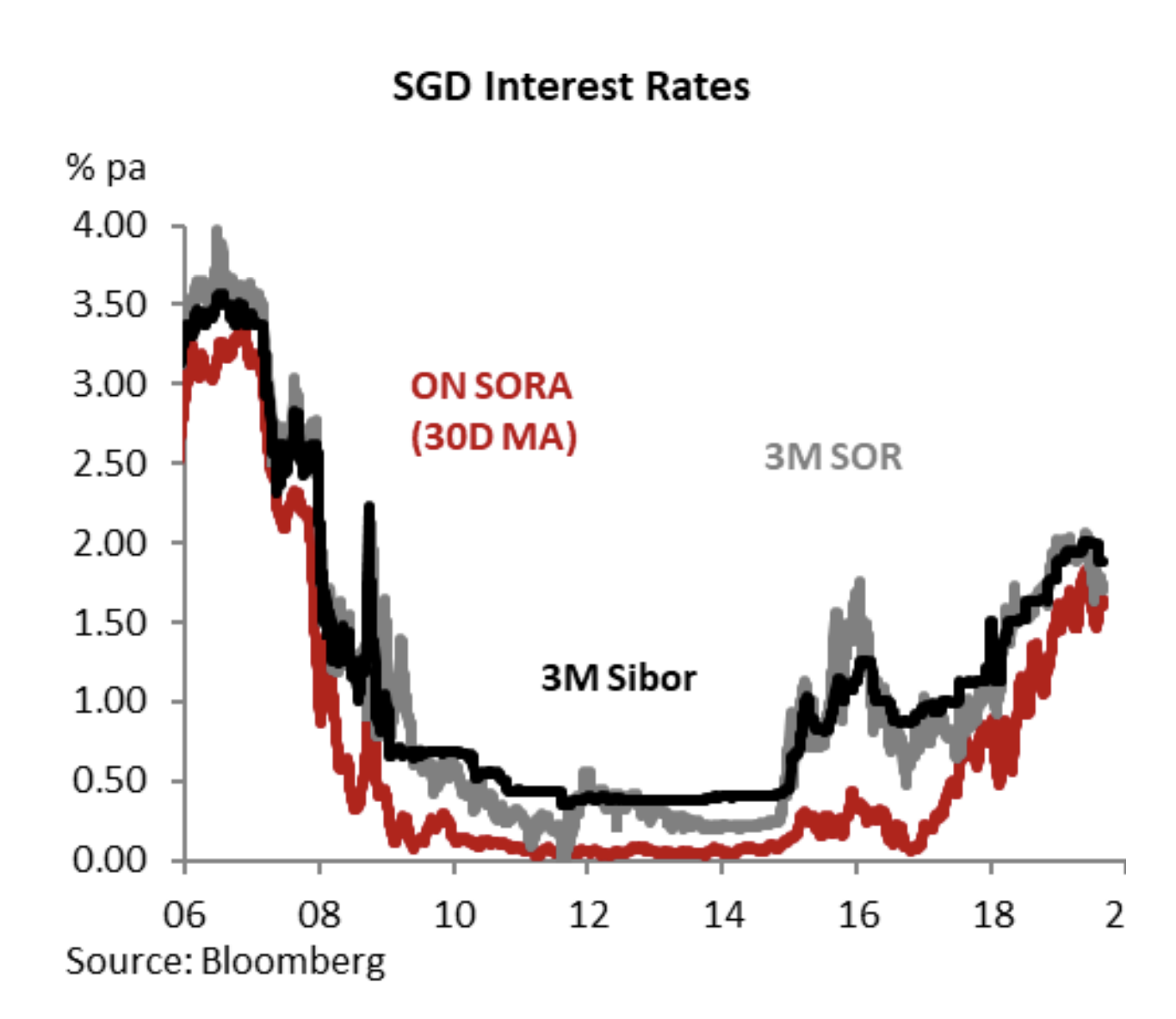
    Notably, there was a sharp decline in interest rates during the GFC, where the SIBOR declined from around 3.5% in 2007 to less than 1% in 2009. 

    The fall was steep, to say the least.  

    Gradual, not drastic

    When it comes to the banks, the decline in interest rates does not impact the bank’s net interest margin (NIM) in the same manner. 

    Take Oversea-Chinese Banking Corporation (SGX: O39) or OCBC for instance.

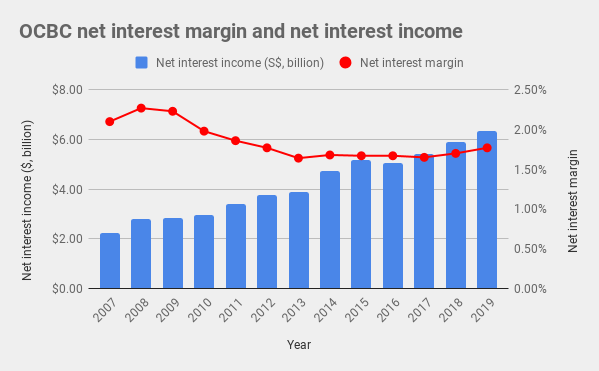
    The chart below shows how the bank’s NIM (represented by the red line) reacted during this period. 
    Source: OCBC annual reports and earnings announcements 

    As you can see, the decline of OCBC’s NIM was more gradual, starting from 2009 before flattening out starting from 2013. 

    Said another way, history informs us that it usually takes time for a major rate cut to make its way through the bank’s portfolio of loans. 

    Interestingly, OCBC actually grew its net income despite the lower NIM. 

    Get Smart: Not the only factor 

    Low-interest rates may hamper a bank’s ability to earn more net income.  

    But that’s not the only way banks earn their keep. 

    Banks can also earn non-interest income by providing services such as wealth management, life assurance, fund management, brokerage, credit cards, trading, and more. 

    For context, OCBC earned over 40% of its total income from non-interest income sources for 2019. 

    That’s on the positive side. 

    On the other end, OCBC is expecting loans from industries hit hard by the coronavirus such as hospitality, retail, and transport to come under pressure. Secondary impacts could also be felt in manufacturing. 

    Meanwhile, with oil prices crashing last week, it is also possible that loans by oil and gas companies will also be negatively impacted. But the extent is unknown at this point. 

    We’ll find out more when our local banks report in the coming quarter or during the mid-year. Stay tuned. 

    FREE special report: The Bear Market Survival Guide. If you’d like to learn how to survive this bear market, CLICK HERE to download our special free report.

    Get more stock updates on our Facebook page or Telegram. Click here to like and follow us on Facebook and here for our Telegram group.


    Disclosure: Chin Hui Leong owns shares in OCBC

    Yahoo
    Share. Facebook Twitter LinkedIn Email WhatsApp

    Related Posts

    The Smart Investor Smart Reads Pic 7

    Smart Reads of the Week: Singapore Dividend Stocks, Rising Payouts, REIT Opportunities, and US Growth

    September 13, 2026

    Top Stock Market Highlights of the Week: Apple, Qualcomm, Sembcorp Industries and Mapletree Logistics Trust

    September 12, 2026

    4 Quality Dividend Payers to Boost Your Retirement Nest Egg Yields

    September 11, 2026
    Facebook Instagram LinkedIn Telegram YouTube TikTok
    • Careers
    • Disclaimer & Privacy Policy
    • Advertising & Media Enquiries
    • Subscription Terms of Service
    © 2026 The Smart Investor. All Rights Reserved. The Smart Investor, thesmartinvestor.com.sg, an investment education website managed by The Investing Hustle Pte Ltd (Company Reg No. 201933459Z) is not licensed or otherwise regulated by the Monetary Authority of Singapore, and in particular, is not licensed or regulated to carry on business in providing any financial advisory service. Accordingly, any information provided on this site is meant purely for informational and investor educational purposes and should not be relied upon as financial advice. No information is presented with the intention to induce any reader to buy, sell, or hold a particular investment product or class of investment products. Rather, the information is presented for the purpose and intentions of educating readers on matters relating to financial literacy and investor education. Accordingly, any statement of opinion on this site is wholly generic and not tailored to take into account the personal needs and unique circumstances of any reader. The Smart Investor does not recommend any particular course of action in relation to any investment product or class of investment products. Readers are encouraged to exercise their own judgment and have regard to their own personal needs and circumstances before making any investment decision, and not rely on any statement of opinion that may be found on this site.

    Type above and press Enter to search. Press Esc to cancel.