Singapore’s stock market is finally showing real signs of life again.
After years of slow, quiet trading, the Straits Times Index (STI) has broken into new all-time highs.
Blue chips such as DBS (SGX: D05), Singtel (SGX: Z74) and Keppel (SGX: BN4) are gathering strength.
Several major REITs, including Mapletree Logistics Trust (SGX: M44U), or MLT, and CapitaLand Ascendas REIT (SGX: A17U), or CLAR, are showing early stabilisation after a rough two years.
Investors are asking the same question.
Is this just a rebound, or the start of something much bigger for dividend investors?
To find the answer, we need to zoom out and look at the forces shifting beneath the surface.
A Market Finally Moving With Tailwinds Again
Something important is happening.
Several tailwinds are starting to align at the same time, and the impact could shape 2026 and beyond.
Interest rates are finally peaking.
REITs have been squeezed by high financing costs for the past two years.
That pressure is easing.
If rates fall further, REITs such as MLT and CLAR could begin rebuilding their DPU growth.
Blue chips have emerged stronger.
DBS and OCBC (SGX: O39) remain well-capitalised with resilient earnings.
Singtel and ST Engineering (SGX: S63) are sharpening their focus on core growth drivers.
The strongest companies have not only survived the last few years, they have improved.
MAS is stepping in with a bold plan.
A S$5 billion Equity Market Development Program (EQDP) initiative is now underway, designed to revitalise the SGX, attract more listings and deepen liquidity.
This is a structural push, not a one-off policy.
When market fundamentals improve at the same time confidence returns, dividend investors often see their best opportunities.
And that is why many analysts believe: 2026 could be one of the most important years for dividend investing in more than a decade.
But Not Every Stock Will Win From Here
A rising market can make everything look attractive.
That is exactly when mistakes happen.
Some stocks offer high yields that are not backed by real earnings power.
Others look cheap but carry long-term structural risks.
Early in a market recovery, weaker names often bounce first, creating the illusion of strength.
The strongest dividend opportunities tend to share a few traits:
- Reliable free cash flow
- Prudent gearing
- Sensible payout ratios
- A durable competitive moat
- Clear visibility into earnings or DPU growth
- A proven history of resilience
These qualities support sustainable dividends, the kind that grows and compounds quietly year after year.
The Window to Prepare Is Opening Now
Market cycles rarely announce themselves.
They turn quietly, long before the crowd realises what is happening.
Singapore’s market is not just hitting new highs. It is sending signals that should matter to income investors.
Record highs do not always mean a peak.
In many cases, they mark the start of a broader re-rating, especially when fundamentals are improving at the same time.
If passive income is part of your long-term plan, this is a crucial moment to get ahead.
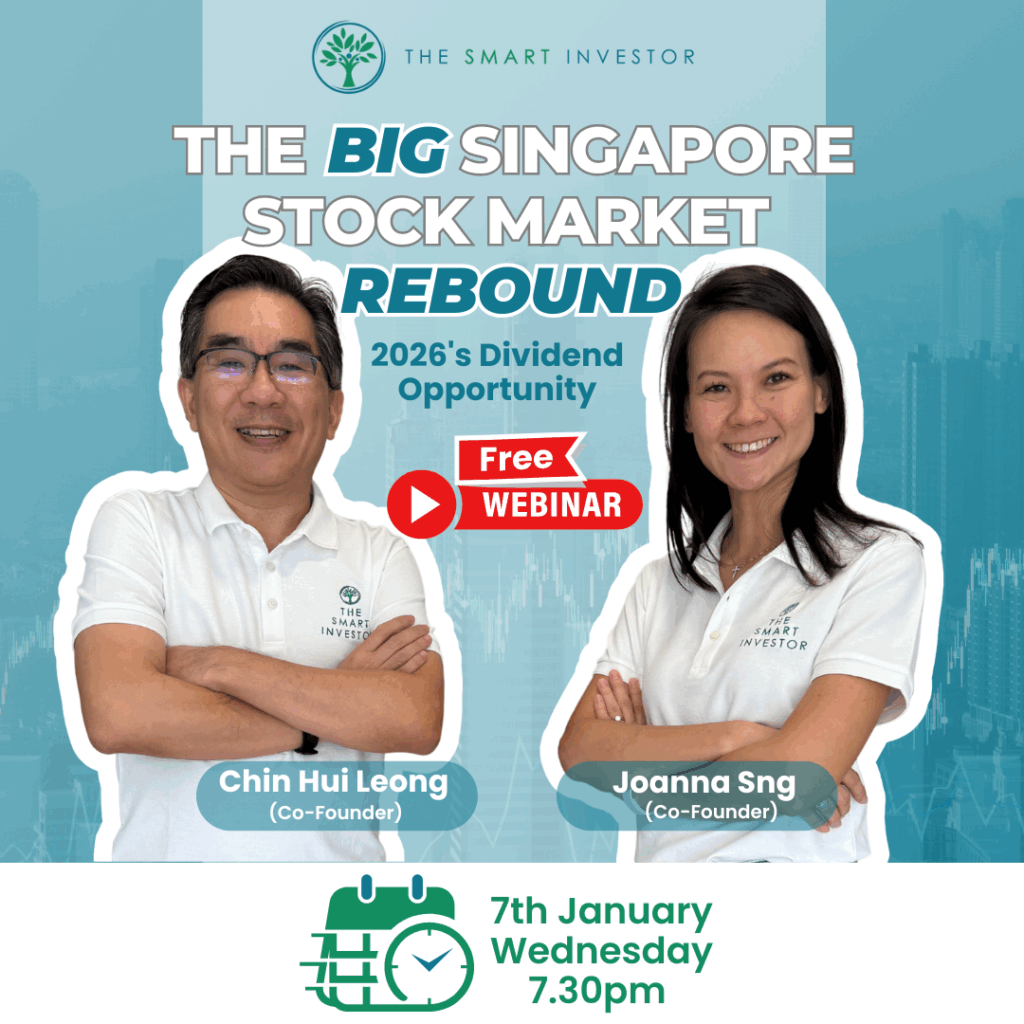
Join Us for the Free Webinar: 2026’s Dividend Opportunity
In The Big Singapore Stock Market Rebound (2026’s Dividend Opportunity), we will cover:
- Whether Singapore’s rally is built to last
- Which sectors may lead the next wave of dividend growth
- Examples of resilient companies such as DBS, OCBC, Singtel, MLT and CICT
- How dividend investors can position themselves before 2026 begins
If you are serious about strengthening your dividend strategy, this session will help you cut through the noise and plan with confidence.
Watch the webinar replay here.
Disclosure: Felicia T. owns shares in CapitaLand Integrated Commercial Trust, DBS, Mapletree Logistics Trust and OCBC.