Most of us know compounding is powerful.
Fewer of us stop to look at the numbers.
In Singapore, there are two very different ways to put it to work.
On one side, you’ve got your CPF Special Account (SA), quietly doing its thing with guaranteed, government-backed interest.
On the other, dividend blue chips, where your money rides on real business earnings, payouts, and market mood swings.
Both grow your wealth, but how they get the job done is night and day.
So which could leave you with more after 10, 20 or 30 years?
How Compounding Works: The Power of Time
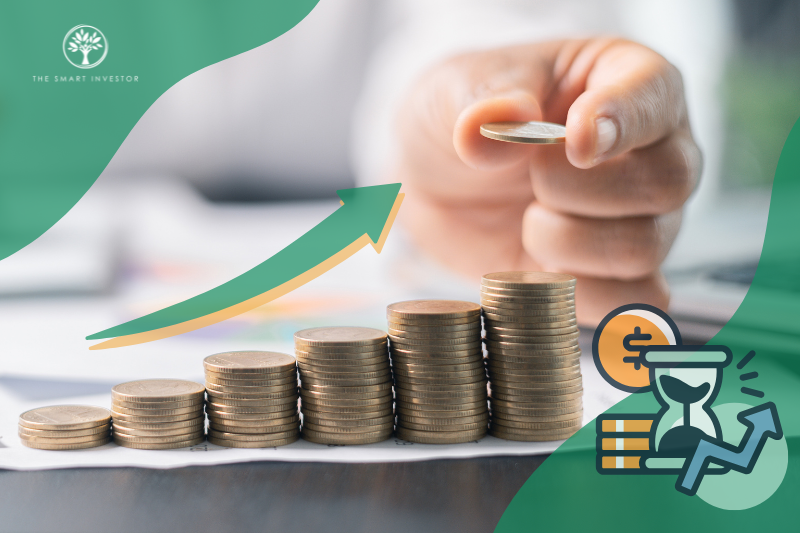
Compounding simply means earning returns on your returns.
Your money grows, then that bigger pile grows again, and so on.
For stocks, this only works if you reinvest your dividends.
Spend them, and you’re collecting income, not compounding.
And because growth stacks up year after year, even a small gap in returns can snowball into a big difference over decades.
CPF Special Account: The Appeal of Predictable Compounding
Your SA earns at least 4% a year.
The rate is pegged to the 12-month average yield of 10-year Singapore Government Securities plus 1%, but the government guarantees a 4% floor, now extended to 31 December 2027.
That floor is doing real work.
For 4Q2026, the pegged rate remains below 4%, so the floor is what keeps SA savings at 4%.
If you’re below 55, you also earn up to 1% extra on the first S$60,000 of your combined CPF balances.
Members aged 55 and above get an extra 2% on the first first S$30,000 and 1% on the next S$30,000, but this mostly goes into their Retirement Account (RA), as their SA has closed.
So what does 4% do to S$10,000?
| Investment Period | CPF Savings at 4%* |
|---|---|
| 10 years | S$14,802 |
| 20 years | S$21,911 |
| 30 years | S$32,434 |
*Assumes 4% a year, compounded annually, with no top-ups or withdrawals.
Your money more than triples over 30 years, with zero exposure to market swings.
The trade-off?
It’s locked away.
Unlike shares in a brokerage account, you can’t withdraw it whenever you like.
Blue-Chip Dividend Stocks: The Potential for Higher Returns
With stocks, compounding happens when you reinvest dividends to buy more shares, which then pay you even more dividends.
Even better if the company keeps growing its earnings and payouts.
Singapore’s blue chips have been doing just that.
DBS Group Holdings Ltd (SGX: D05) posted a record net profit of S$8.82 billion for the first nine months of 2026 (9M2026), up 2.0% year on year (YoY).
The company also declared a quarterly dividend of S$0.81 per share, consisting of S$0.66 ordinary dividend and S$0.15 capital return dividend.
Oversea-Chinese Banking Corporation Limited (SGX: O39), or OCBC, grew even faster, with 9M2026 net profit up 10.0% YoY to S$6.24 billion.
Earlier this year, it also raised its interim dividend by 15.0% YoY to S$0.47 per share, paying out 50.0% of its first-half profit.
Singapore Exchange Limited (SGX: S68) grew adjusted net profit after tax (NPAT) by 24.6% YoY to S$759.5 million in FY2026.
On top of the 4QFY2026 dividend of S$0.115 per share, SGX declared a one-off dividend of S$0.125 per share funded by capital recycling gains, bringing its FY2026 total dividend to S$0.57 per share, up 52.0% YoY.
Excluding the one-off, the dividend rose about 18.7%.
But unlike CPF interest, none of this is guaranteed.
DBS’s third-quarter profit, for one, fell 5% YoY to S$2.81 billion as market trading income slumped 65% amid weaker equity markets.
Share prices swing, and companies can cut dividends when times get tough.
That’s why it pays to focus on total returns, dividends plus price gains, rather than yield alone.
S$10,000 Invested: CPF SA vs. Blue-Chip Stocks Over 30 Years
Here’s how S$10,000 could grow under different return assumptions.
| Investment Period | CPF SA at 4% | Stocks at 3% | Stocks at 6% | Stocks at 8% |
|---|---|---|---|---|
| 10 years | S$14,802 | S$13,439 | S$17,908 | S$21,589 |
| 20 years | S$21,911 | S$18,061 | S$32,071 | S$46,610 |
| 30 years | S$32,434 | S$24,273 | S$57,435 | S$100,627 |
Assumes annual compounding, reinvested dividends and no top-ups. Stock returns are hypothetical total returns.
At 3% a year, stocks actually trail the CPF SA.
At 6%, S$10,000 grows to about S$57,435 after 30 years, about 1.8 times CPF’s S$32,434.
At 8%, it exceeds S$100,000, more than three times CPF.
Notice that moving from 6% to 8% alone adds over S$43,000.
That’s how much small differences matter over time.
Just remember, real stock returns rise and fall along the way, and actual results can look very different.
Which Approach Is Better for Long-Term Investors?
There’s no clear winner, because they do different jobs.
The CPF SA forms a solid retirement base for those who seek stability: predictable growth and protected capital.
The trade-off is limited access to your money.
Blue chips offer growth and flexibility.
You get the potential for higher returns, and you can sell or spend the dividends when you need to.
In exchange, you’ll have to sit through market swings, possible dividend cuts and even losses.
That’s why combining both can work well for many investors.
Let CPF be your stable foundation, and let blue chips add income and long-term growth on top.
Just stay diversified and give your investments enough time.
Get Smart: Compounding Rewards Patience, but Risk Matters
The CPF SA gives you certainty, while blue chips give you potential.
As the numbers show, a couple of percentage points a year can mean tens of thousands of dollars over 30 years.
But higher potential returns always come with higher risk.
Use CPF as your foundation, and put extra cash to work in quality dividend payers.
In the end, compounding comes down to time, consistency and knowing what you’re getting into.
Don’t let market uncertainty hijack your financial dreams. While headlines scream gloom, 5 Singapore companies have been quietly building wealth and paying reliable dividends. You’re probably overlooking them. Discover these resilient giants and their secrets to sustained income, even through global storms. Click here to download your free report now and secure your financial future!
Follow us on Facebook, Instagram, Telegram and YouTube for the latest investing news and analyses!
Disclosure: Si-Fan T. owns shares in DBS, OCBC, and SGX.