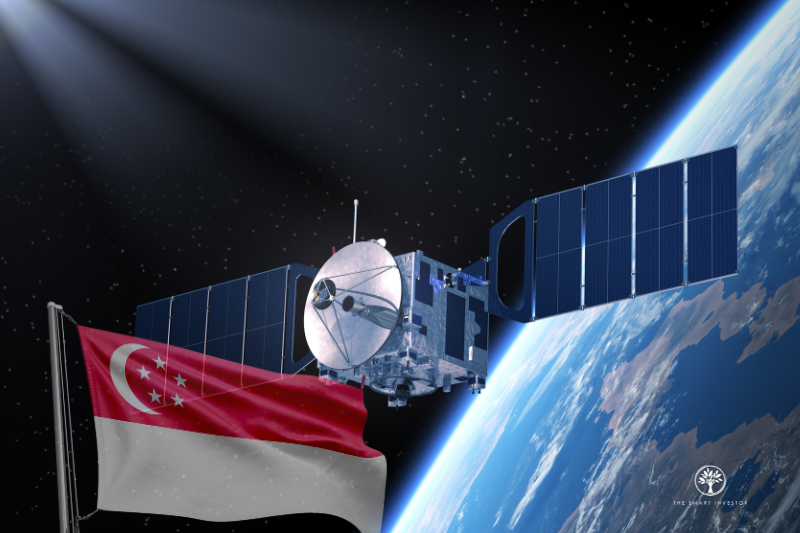
Singapore will establish its first national space agency, the National Space Agency of Singapore (NSAS), on 1 April 2026.
The move is expected to unlock the full potential of space technology applications in this expanding economic frontier.
The sky is no longer the limit – space is.
We check out some names that could potentially benefit from this new chapter.
ST Engineering (SGX: S63), or STE: Government Partnership in Space Sector Growth
Aside from designing and producing satellites, STE’s Defence & Public Security (DPS) co-owns Earth-observation satellites with the Singapore government, providing satellite imagery and analytics services
Meanwhile, Urban Solutions & Satcom (USS) focuses on Satcom’s ground segment infrastructure to maintain communication with those satellites from Earth.
In the first nine months of 2025 (9M2025), the DPS segment contributed 44% of its revenue, while that of USS contributed 15.9%.
Together, they contributed close to 60% of STE’s revenue – a substantial share that could grow further with the establishment of NSAS.
Overall, STE’s 9M2025 revenue grew 9% to S$9.1 billion year on year (YoY), driven by broad-based growth across all its segments of DPS, USS, including Commercial Aerospace.
This growth is backed by a record-high S$32.6 billion order book, giving STE multi-year revenue visibility.
STE raised its total planned dividends for FY2025 by 27.8% over its ordinary dividend base to S$0.23 per share, using cash proceeds received after successfully divesting non-core assets to strengthen its portfolio.
This move is in line with its objective of sharing value realisation with shareholders.
Singtel (SGX: Z74): Geospatial Analytics Powered by High-Performance AI
While STE designs and co-owns satellites with the Singapore government, Singtel’s “Digital InfraCo” segment provides project-based satellite deployment services to build a larger ecosystem of AI-related infrastructure, such as sovereign AI services.
Such infrastructure could potentially include NSAS’s provisions of bespoke geospatial data analytics support for government agencies, driving meaningful growth in its “Digital InfraCo” segment, which is currently contributing just 3% of the revenue for its nine months ended 31 December 2025 (9MFY2026).
For 9MFY2026, its group revenue grew modestly by 2% to S$10.6 billion YoY in constant currency terms, supported by strong growth mostly from NCS and Optus, which helped offset weakness from its traditional mobile and broadband businesses.
Despite its 9MFY2026 net profits surging 110% to S$5.3 billion YoY in constant currency terms, it’s driven by one-off gains from the partial divestments of its Airtel stakes and Intouch-Gulf Energy merger.
For the half year ended 30 September 2025 (1HFY2026), Singtel continued to reward shareholders by increasing its interim dividends by 17% YoY to S$0.082 per share.
Given that Singtel’s “regional associates” already provide mobile and other connectivity services across the Equatorial Belt, the establishment of NSAS can potentially boost their market share even further.
Addvalue Technologies (SGX: A31): Adding Value to The Space Economy
With its strong commercial momentum as a “one-stop shop” developer of satellite-based communication products, Addvalue’s business is directionally aligned with NSAS’s establishment.
For the first six months ended 30 September 2025 (1HFY2026), its revenue climbed 54% to US$8.8 million, with earnings spiking 3702% to US$2 million YoY, driven by the momentum in both the Advanced Digital Radio (ADR) and Space Connectivity (SPC) segments.
Its SPC business is anchored by its IDRS (Inter-Satellite Data Relay System) service, contributing US$3.2 million, or 37% of its total 1HFY2026 revenue.
Utilising specialised IDRS terminals, Addvalue delivers the “world’s first and only near-real-time, always-on data communication solution” specifically for the commercial Low Earth Orbit (LEO) satellite industry.
Aside from the increasing sales of IDRS terminals, Addvalue also expects its recurring airtime revenue to rise as more satellites are launched over the next 12 months.
Its growing SPC segment accounted for US$10 million, or 55.6% of the Group’s total order book, representing a significant revenue visibility for the next 12 months.
Having emerged from its previous loss-making financial position recently, Addvalue does not currently pay dividends, making it unsuitable for income investors.
Get Smart: Seize the Growth Momentum in Space
Singapore’s new space agency won’t just launch satellites – it launches an entire ecosystem of investment opportunities, potentially anchored by these space-related businesses:
- STE’s DPS and USS businesses are direct beneficiaries through its defence and satellite co-ownership with the Singapore government.
- Being a key provider of the nation’s digital backbone, Singtel’s Digital InfraCo and regional associates offer high‑capacity digital infrastructure essential for NSAS operations.
- Addvalue Technologies plugs into the commercial LEO market with its unique IDRS technology, offering near-real-time data relay, increasing the commercial viability of satellites.
Together, these companies are positioned to shape the architecture of Singapore’s nascent space economy.
For investors, it’s an opportunity to ride an emerging growth frontier.
We’ve found 5 SGX-listed dividend stocks with strong track records in turbulent markets. If you want consistency in an uncertain world, start here.
Follow us on Facebook, Instagram and Telegram for the latest investing news and analyses!
Disclosure: Larry L. does not own shares in any of the companies mentioned.