In early February this year, the growth runway for air travel looked clear for a smooth take-off.
But the launch of Operation Epic Fury on 28 February 2026 in Iran drove oil prices sky-high, above US$100 per barrel.
The consequences are far-reaching for consumers, who were hit not just at petrol kiosks but also in rising utility bills.
For local aviation darlings operating businesses sensitive to oil prices and inflationary pressures, the impact could be just as significant.
We examine what these headwinds could mean for their businesses – and for investors’ portfolios.
Singapore Airlines (SGX: C6L), or SIA: The Fuel Squeeze
In the aviation sector, fuel consumption isn’t just an expense item – it’s the lifeblood that determines whether a business soars or goes into free fall.
As the national carrier with a passenger load factor of 87.5% and fuel expenses making up roughly 29% of its total expenditure, SIA is naturally not spared from the margin squeeze of rising fuel expenses.
Yet, in its third quarter ended 31 December 2025 (3QFY2025/26), revenue surged 5.5% to S$5.5 billion year on year (YoY), driving operating profit up about 26% to S$792 million, despite net fuel cost rising 3.7%.
For now, it appears that SIA’s demand remains robust, with the combination of rising passenger demand and fuel hedging strategies more than offsetting the effects of rising fuel prices.
Still, should oil prices continue to rise in 2026, these gains could be reversed – something for investors to be cautious about.
How SATS Ltd (SGX: S58) and SIA Are Caught in the Ripple Effect
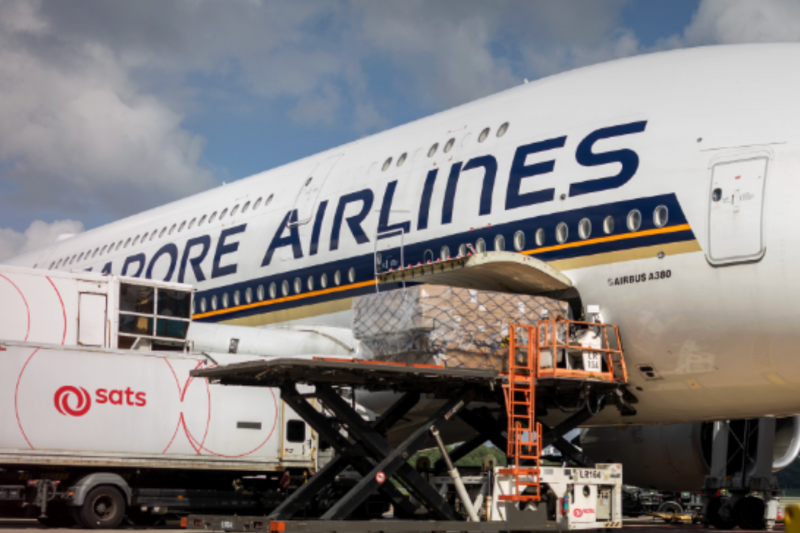
In its third quarter ended 31 December 2025 (3QFY2026), SATS derived 34% of its revenue from the Singapore region, anchored by SIA as its largest customer.
With SIA preparing for further downside by introducing fare hikes, potentially dampening demand for air travel, reduced demand for air travel could impact close to one-third of its revenue.
Despite its revenue being geographically diversified, sector-wise, roughly 92% of its revenue is aviation-related, meaning it remains vulnerable to the broader industry’s downturn induced by rising oil prices.
The gateway provider reported a favourable performance in 3QFY2026, with revenue climbing 8% to S$1.65 billion, thanks to record-high cargo volumes driven by seasonal peak demand.
Like SIA, where the full impact of rising oil prices hasn’t been baked into SATS’s latest results, investors should monitor whether the current momentum can be sustained as higher fuel costs increasingly put downstream pressures on SATS’s businesses.
What to Watch for in 2026: Key Indicators
Despite ongoing geopolitical headwinds in the Middle East, SIA is aggressively expanding in the Asia-Pacific region, planning new daily services to Hangzhou and Western Sydney International Airport, slated for mid- and late-2026 respectively.
Even with these expansions, maintaining a healthy passenger load factor at the current level of 87.5% is key to ensuring the new services translate into a sustained revenue growth.
For SATS, its acquisition of Worldwide Flight Services in 2023 resulted in a combined network operation that covers trade routes for more than 50% of global air volume.
While this scale of air volume is remarkable, elevated oil prices could make air freight a luxury, making slower sea routes more attractive instead – something for investors to be cautious about.
Should Investors Fasten Their Seatbelts?
It’s tempting to succumb to persistent headline news warning of never-ending turbulence.
However, recent developments show it’s not all doom and gloom.
After all, despite ongoing geopolitical conflicts in Europe and the Middle East (even before Operation Epic Fury), SATS’s ability to outperform IATA’s benchmark growth in global cargo volume for nine consecutive quarters underscored its resilience.
This optimism is also supported by SIA’s expansions to Sydney and Hangzhou, which could potentially offset the headwinds of rising fuel costs.
Still, with 92% of SATS’s revenue tethered to aviation, any drop in global demand presents a structural concentration risk.
However, this risk could be mitigated if SATS continues to diversify away from aviation, partnering with major trading companies such as Mitsui & Co. Ltd (TYO: 8031) to expand its reach into the non-aviation food and retail sectors – a silver lining that investors should observe.
Get Smart: Stay Vigilant but Don’t Panic
It may not be all bad news, despite what you read or hear.
Volatility could be your friend – but only if it allows long-term investors to accumulate quality companies at more reasonable valuations.
The key is to diversify your portfolio not just across different assets, but spreading your investments across different time periods.
As of now, rising oil prices are a headwind due to a regional conflict, not a global catastrophe – at least not yet.
Imagine a life where steady income flows, no matter the market. Our new free report, “Retire Early with Dividends,” reveals how. We’ve pinpointed 5 dependable Singapore dividend stocks that offer a proven, stress-free path to financial freedom. Stop just dreaming and start building your early retirement plan today. Your free guide awaits here.
Follow us on Facebook, Instagram and Telegram for the latest investing news and analyses!
Disclosure: Larry L. does not own shares in any of the companies mentioned.