It’s no secret that Singapore is a nation obsessed with property.
For years, the narrative was one of relentless growth, but as we cross into early 2026, the script has flipped from “frenzy” to “stability.”
After 22 consecutive quarters of hikes, the HDB Resale Price Index finally remained flat (0% growth) in the final quarter of 2025.
The once-insatiable demand for million-dollar flats in the heartlands is meeting a clear ceiling on prices, with more towns now seeing prices dip than rise.
Meanwhile, the “gravity-defying” rental market has also found its ceiling.
With a massive wave of over 13,000 HDB flats reaching their Minimum Occupation Period (MOP) this year and thousands of new private condos hitting the market, the supply-demand imbalance has eased.
Rents for both private and HDB units are projected to grow by a modest 0% to 3% in 2026, a far cry from the double-digit spikes of the post-pandemic era.
For the retail investor, this shift marks a new reality.
With property prices plateauing and rental yields facing downward pressure from increased supply, the massive financial and time commitment of physical ownership is becoming harder to justify.
If capital appreciation is slowing and rents are stabilising, is there a more efficient way to secure your financial future?
A Huge Commitment and A Time Drain
While owning property may seem like a surefire way to make money, it is also a huge financial drain.
The down payment alone on a million-dollar condominium will be in the six-digit range, and you get stuck with a big loan that you need to service for years, if not decades.
Aside from being a financial drain, owning a property is also time-consuming.
You need to collect rent from your tenant, search for a new tenant once the current one has vacated, and periodically check on the unit to ensure it’s well-maintained and in a liveable condition.
Yet another problem with physical property is that it’s tough to diversify – the financial outlay required means you get to only select one, or at most two, properties with little money left to spare.
An Indirect Way to Earn Rental
The good news is there’s an easier, hassle-free method to earn rental other than owning a property.
The solution?
Buying units of a real estate investment trust (REIT) or shares of a property development cum investment company.
A REIT owns a portfolio of different properties that are managed by a professional manager.
The manager ensures that rental income is collected by the REIT, which is then paid out as distributions to unitholders.
REITs are perfect for income-seeking investors as there is a requirement for them to pay out at least 90% of their earnings as distributions to enjoy tax incentives.
Such a rule makes them suitable as income-generating instruments that churn out a regular, steady dividend every quarter or half-year.
Parkway Life REIT (SGX: C2PU) is a healthcare REIT that owns hospitals in Singapore and nursing homes in Japan.
The REIT has continued its impressive streak, paying out rising core distributions for 18 consecutive years.
Its distribution per unit (DPU) has grown from S$0.0683 in 2008 to S$0.1529 for FY2025, supported by its inflation-linked master leases and expansion into Europe.
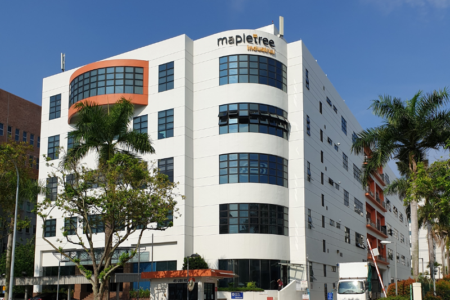
Mapletree Industrial Trust (SGX: ME8U) is another REIT that has never failed to increase its distributions since its IPO.
The industrial REIT paid out a distribution per unit (DPU) of S$0.0841 for FY2011/2012 and this grew to S$0.1357 for FY2024/2025.
Owning A Slice of Many Different Properties
Owning a REIT is a great way to gain exposure to a wide range of properties, allowing you to diversify your property ownership.
By doing so, you reduce the risk related to owning just a single property.
Property companies can also provide you with the same type of exposure.
An example is Frasers Property Limited (SGX: TQ5), or FPL.
FPL is a property giant that had total assets of approximately S$39.7 billion as of 30 September 2025, maintaining its position as a dominant suburban retail and industrial player.
Or you can choose to own a slice of blue-chip real estate giant City Developments Limited (SGX: C09), or CDL.
The group reported total assets of S$35 billion (at fair value) as of 31 December 2025.
CDL recently achieved its highest-ever residential sales value in Singapore, bolstered by successful launches like Norwood Grand and Union Square Residences.
Laughing At The Taxman
Owning shares of property businesses or REITs also allows you to enjoy rental income tax-free.
Companies are taxed at the corporate level for the rental income they earn, and when you receive dividends or distributions, you need not pay income taxes on this cash inflow.
Contrast this with the rental income earned from owning physical property, which has to be declared and added to your earned income to form total chargeable income.
Get Smart: Invest in Quality REITs and Real Estate Stocks
You can easily earn a stream of dividend income from owning quality REITs and property stocks.
Not only is this rental income tax-free, but it also allows you to partake in a vast range of properties to diversify your real estate exposure.
The initial outlay is also low, requiring you to fork out just several hundred dollars to buy 100 units of a REIT.
The biggest upside is that you can save time and effort as the REIT is professionally managed by a management team that will ensure the properties are well-maintained and that rental is collected on time.
When the market is unpredictable, where can you park your money with confidence? Our latest FREE report reveals 5 Singapore dividend-payers built to withstand global storms. Get it now and see what’s still worth holding.
Follow us on Facebook, Instagram and Telegram for the latest investing news and analyses!
Disclosure: Calvina L. does not own any shares of the companies mentioned. Royston Y. owns shares of Mapletree Industrial Trust.