Exchange-traded funds or ETFs are hailed as a low-cost and diversified way to invest in the stock market.
There’s truth to this statement.
But as with any investment vehicle, we shouldn’t take a good idea too far.
ETFs have pitfalls you should know before you start investing in them.
You may want to look beyond what’s shown on paper and consider the real-life implications of putting your money into ETFs.
There is no free lunch.
Concentration in numbers
On paper, ETFs offer immediate diversification for a small sum of money.
It’s an ideal arrangement for investors who are starting out.
Yet, as you will soon find out, some indexes are more concentrated than others.
The recent “special rebalance” of the NASDAQ 100 Index (INDEXNASDAQ: NDX) has exposed the influence of the largest stocks within the index.
It’s no different in Singapore.
The Straits Times Index (SGX: ^STI) of the STI is heavily weighted towards the big three Singapore banks.
On paper, when you put S$1,000 into the SPDR STI ETF (SGX: ES3), an ETF that mimics the STI, you are investing in 30 of Singapore’s listed companies.
Yet, at the end of June 2023, DBS Group Holdings Ltd (SGX: D05), United Overseas Bank Ltd (SGX: U11) or UOB and Oversea-Chinese Banking Corporation (SGX: O39) or OCBC accounted for 43.6% of the STI.
Said another way, when you put S$1,000 into the SPDR STI ETF, around S$436 goes to the banking trio above.
Take note, not all ETFs are as diversified as you think.
Lower volatility does not mean no volatility
Most Singaporeans will be familiar with the slogan “Low Crime Doesn’t Mean No Crime”.
The corollary for ETFs would be: lower volatility does not mean no volatility.
After the events of the last three years, some investors switched their attention to ETFs, believing that they are less volatile and therefore, less stressful to hold.
Sure, that’s generally true.
However, if you are fearful of 10% or 30% drops, listen up.
The STI is not immune to drastic drops.
For instance, in March 2020, the STI fell by 30% in a matter of weeks.
Here’s another thing you should know: 10% drops are fairly frequent, occurring in four out of every five years between 1993 and 2022.
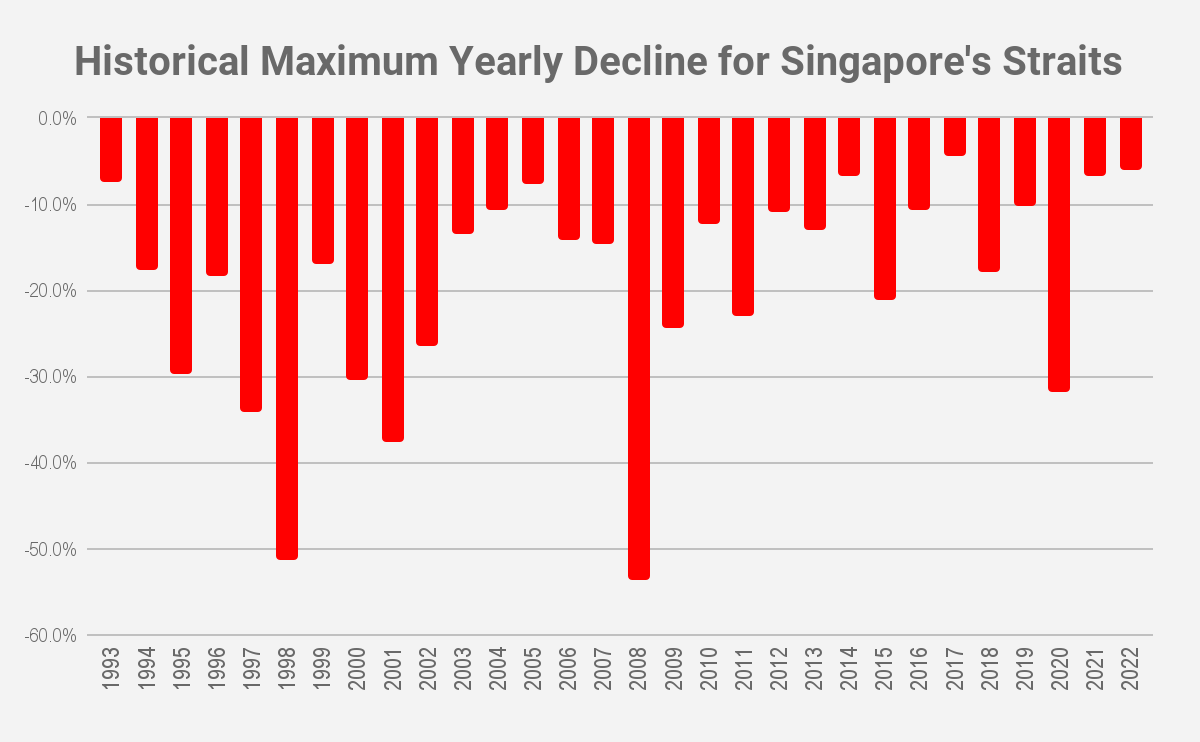
Source: S&P Global Market Intelligence, Yahoo Finance, WSJ, author’s calculation
Here’s the MOST important thing people don’t tell you …
When an index declines, you will have no idea what is happening.
You shouldn’t.
The whole idea of investing in ETFs is to be hands-off, therefore you will have to stay the course despite not knowing what exactly is occurring in the stocks within the index.
If you start digging into the 30 companies, it defeats the purpose of investing in index funds, in my book.
Take note, that’s the deal you have to accept if you decide to invest.
It’s not as easy as it looks if you don’t steady your nerves.
Passive vehicle, active investor
Speaking of jittery investors, a passive investment vehicle such as index ETFs will not save you if you are actively trading in and out of the fund.
An index ETF is only as good as the investor’s temperament.
To use an analogy, an index ETF is like a car with a good safety rating you can use for your investment journey. However, if you engage in reckless behaviour, swinging in and out of lanes, having a safer car will not prevent you from accidents.
What’s more important is YOUR passive behaviour.
Consider these statistics:
- In 2016, 14 out of 15 most heavily traded securities in the US were ETFs, a sign that these funds have become a favourite among market speculators.
- According to S&P Global Market Intelligence, retail investors held ETFs for an average of 19 months.
In our book, 19 months is a good start, but you can tilt the odds in your favour if you hold longer.
History tells us that the probability of positive returns rises if you hold for a longer period of time.
For instance, if you hold for a year, your chances of getting positive returns is around 74%. Increase it to three years, and you will be at 84%. Stretch it to a decade and your odds increase to almost 94%.
Needless to say, day trading is a terrible idea.
Your odds of a positive outcome are not much more than a coin flip.
Get Smart: A confession and a way forward
At this point, you may think that I hate ETFs.
Nothing could be further from the truth.
In fact, when I first started investing, I diligently put money into index funds every month for around seven years. What I have related above is from my own practical experience investing in these funds.
Over time, I found more comfort in investing in individual stocks.
By knowing what is happening within the business, I was able to make better decisions during times of distress.
The best gift a responsible parent can give their child is a secure, comfortable financial future. And we found that dividend investing is one of the easiest and effortless methods to do it. Our latest FREE report reveals how you can do it, plus the 3 SGX stocks you can buy today to start future-proofing your child’s financial future. Click HERE to grab a copy of the guide.
Disclosure: Chin Hui Leong owns shares of S&P Global, DBS Group, UOB and OCBC.