For a lot of Singaporeans, once you’ve got your first HDB flat sorted, the next thought is usually, “Should I upgrade?”
But before putting S$50,000 towards a larger home or private property, consider this: what else could that money do?
Investors call this the opportunity cost – the value of the alternatives we give up when making a financial decision.
Put that capital into a basket of Singapore REITs, and you’re looking at steady passive income, with a real chance for growth over the years.
So, what’s actually better for your financial future – a pricier property or a bigger portfolio?
The Traditional Singapore Dream
Owning a bigger, better home.
For years, Singaporeans have grown up believing that moving up the property ladder leads straight to greater wealth.
Bigger homes mean more space, more comfort, and perhaps, bragging rights at family gatherings.
Property has also been one of Singapore’s most successful wealth-building tools, with many homeowners benefiting from decades of rising prices.
But upgrading is not purely an investment decision. It is also a lifestyle choice.
The challenge here is that perfect home and the perfect investment rarely line up. Sometimes you have to choose which matters more.
What S$50,000 Really Represents
In Singapore’s property market, S$50,000 may look like a stepping stone. But it could also be a building block.
Used for an upgrade, it helps fund a larger or nicer home.
Invested instead, it could become a growing portfolio.
That is the essence of opportunity cost. Every financial decision comes with alternatives, and capital is a limited resource.
So where does that S$50,000 do the most work for you?
Depending on how you use it, even a sum that seems modest now can multiply, thanks to steady returns and compounding over the years.
Before you know it, S$50,000 today could turn into a seriously larger nest egg after a decade, or three.
Why REITs Are Worth Considering
REITs open the door to real estate investing without the stress of buying or managing your own property.
One purchase gives you access to a wide range of assets, such as shopping malls, warehouses, offices, hospitals, even data centres.
Take CapitaLand Integrated Commercial Trust (SGX: C38U) as an example.
It owns a diversified portfolio of retail and office assets, with reported portfolio occupancy of 95.2% in the first quarter of 2026 (1Q2026).
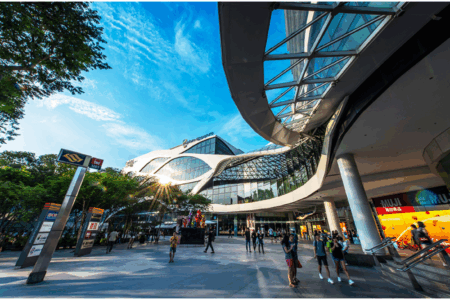
These include Plaza Singapura, Raffles City Singapore, CapitaSpring, and the proposed Paragon acquisition.
At the same time, REITs generate regular distributions from rental income, creating a stream of passive income.
REITs naturally offer variety; whereas if you buy one property, your investment is tied to that single asset.
With a REIT, you’re getting a slice of sometimes dozens of properties at once.
Frasers Centrepoint Trust (SGX: J69U), for instance, owns suburban malls such as Causeway Point, Northpoint City, and Waterway Point, and reported portfolio occupancy of 99.8% in 1HFY2026.
Instead of putting all your bricks in one building, REITs spread your risk across an entire portfolio.
What S$50,000 in REITs Could Potentially Deliver
Unlike a property, a REIT does not need a tenant to move in before it starts working for you.
A S$50,000 REIT portfolio can generate regular distributions that provide a stream of passive income.
Reinvest those payouts, and each distribution buys more units that can generate even more income in the future.
The power of compounding becomes even more apparent over longer periods.
Take Parkway Life REIT (SGX: C2PU) as an example.
The healthcare REIT increased its annual distribution per unit (DPU) from S$0.0774 in 2009 to S$0.1492 in 2024, effectively doubling the income generated per unit over 15 years.
Reinvested distributions create a powerful double compounding effect.
REITs are also more flexible than physical property.
Units can be bought or sold in minutes, without the legal fees and paperwork associated with real estate transactions.
In short, REITs can help your money collect rent without collecting keys.
The Hidden Costs of Upgrading
The purchase price is just the start.
When you take on a bigger mortgage, you’re usually signing up for higher property taxes, more expensive maintenance, insurance bills, and often some renovations, too.
Plus, you’re locking a big chunk of your money into one asset. So, if the real estate market dips, your risk goes up.
When an HDB Upgrade Still Makes Sense
Let’s be real – not every move comes down to dollars and cents.
Sometimes you just need more space.
Maybe your family is growing, or maybe you’re thinking about the future and want a place that fits your plans.
In times like these, upgrading isn’t just about the numbers.
The Hybrid Approach
Of course, the choice is not always either-or.
Many investors upgrade their homes while gradually building an investment portfolio alongside it.
It’s not about picking one path and ignoring the other.
The real goal is to find that balance between enjoying your life now, while also building wealth for the future.
The Bigger Lesson: Think Like an Investor
Investors think differently about money.
They understand the difference between buying something to live in and buying something to generate returns.
The key is intentional capital allocation. Before spending a dollar, ask what else that dollar could be doing.
Sometimes, the hardest-working money is the money you choose to invest.
Get Smart: Your Best Investment Property Might Not Be One You Live In
Upgrading your home does wonders for your lifestyle.
But there’s real power in investing in REITs, as they generate income, offer diversification, and can help your wealth grow steadily over time.
Neither option is always the perfect answer.
But before you put S$50,000 into renovating your home, it’s worth considering what that same sum could do somewhere else.
Sometimes, the best property investment is one you never have to renovate.
What if the current “market turmoil” isn’t a crisis… but a setup?
History shows most pullbacks don’t become crashes. The real edge is knowing how to act early. Our FREE report reveals the framework smart investors use. Download it now.
Follow us on Facebook, Instagram and Telegram for the latest investing news and analyses!
Disclosure: Joseph G. does not own shares in any of the companies mentioned.