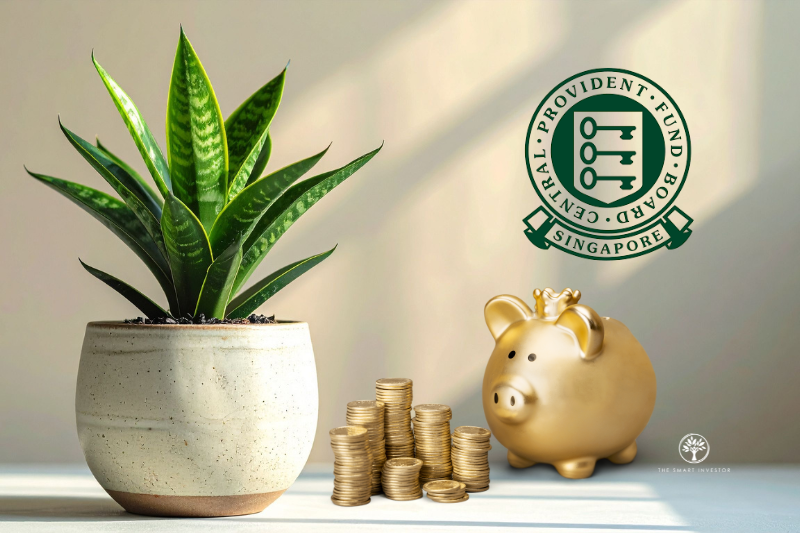
CPF is built to fund retirement.
But what if you have more than enough?
For some Singaporeans, excess CPF savings can be invested through the CPF Investment Scheme (CPFIS) to build an extra stream of passive income.
Here’s how dividend-paying stocks and REITs can help turn spare CPF funds into regular cash flow, without forgetting the risks.
What Is “Excess CPF”?
“Excess CPF” refers to CPF savings that are not needed for retirement, housing, healthcare, or other near-term needs.
Before investing, investors should make sure their retirement foundation is secure.
Through CPFIS, eligible members can invest part of their CPF savings in approved products, including selected stocks and REITs.
However, CPFIS investments carry market risk, unlike CPF’s guaranteed interest.
Why Dividend Investing Appeals to CPF Investors
Dividend stocks and REITs don’t just sit quietly in your portfolio; they pay you real cash.
That ongoing stream of income can top up your CPF LIFE payouts or other retirement sources.
Over time, if you’ve picked strong businesses, they often raise their dividends too, so your income keeps up with inflation.
What Makes a Good CPF Dividend Investment?
Focus on companies with solid balance sheets, steady cash flow, and a track record of stable or rising dividends.
Reasonable payout ratios are important, but the quality of the business counts just as much.
Ultimately, you want investments that hold up and keep delivering, no matter what the market is doing.
Here are examples of good businesses that are CPFIS-eligible dividend investments.
DBS Group Holdings Ltd (SGX: D05)
DBS offers a mix of strong profitability, steady dividends, and disciplined capital management.
For the first quarter of 2026 (1Q2026), DBS reported net profit of S$2.93 billion, up 1% year on year (YoY), while ROE stood at 17.0%.
The bank declared a 1Q2026 ordinary dividend of S$0.66 per share and a capital return dividend of S$0.15 per share, bringing it to a total of S$0.81.
Based on its share price of S$71.96 on 17 July 2026, DBS’s total 1Q2026 dividend of S$0.81 per share annualises to a dividend yield of about 4.5%.
Including the capital return dividend, its annualised payout ratio is around 77% using 1Q2026 annualised earnings per share of S$4.19.
With a CET1 ratio of 17.0% and non-performing loan ratio of 1.0%, the bank maintains a robust balance sheet and high asset quality, providing individual investors with a safe, sustainable income stream for long-term CPF compounding.
Singapore Exchange (SGX: S68), or SGX
SGX catches the eye with its asset-light business model, strong cash flow, and steady quarterly dividends.
In the first half of FY2026 (1HFY2026) adjusted net profit jumped 11.6% YoY, reaching S$357.1 million, and adjusted earnings per share hit S$0.334.
The bourse operator generated net cash from operating activities of S$363.7 million for 1HFY2026.
Dividends climbed to S$0.2175 per share for 1HFY2026, compared to S$0.18 the year before.
Together with a history of zero debt and high return on equity, SGX’s cash-generative model makes it a resilient, high-quality candidate for individual investors seeking consistent dividend growth under CPFIS.
CapitaLand Integrated Commercial Trust (SGX: C38U), or CICT
CICT gives investors property-backed distributions through its broad portfolio of retail, office, and integrated developments.
In 1Q2026, CICT generated gross revenue of S$426.7 million, a solid 8% jump YoY.
Its FY2025 distribution per unit (DPU) came in at S$0.1158, which works out to a yield of about 4.7%, based on a unit price of S$2.47.
As a REIT, CICT must distribute at least 90% of its taxable income, making DPU sustainability a key focus.
To support this payout, its balance sheet remains prudent, with aggregate leverage at 38.5%, average cost of debt at 2.9%, and interest coverage ratio at 3.8x as of 31 March 2026.
This balance sheet strength is backed by solid operations, with portfolio occupancy standing at 95.2% and weighted average lease expiry (WALE) at 3.0 years.
Reflecting this underlying strength, CICT has built a long distribution track record, with DPU rising steadily from S$0.1058 in 2022 to S$0.1158 in 2025.
These operational metrics underline portfolio stability, ensuring that CICT remains a dependable, real-asset anchor for individual investors aiming for stable CPFIS distributions.
How a Dividend Portfolio Can Become a “Monthly Cash Machine”
Companies and REITs pay out dividends at different times during the year, so building a well-chosen portfolio gives you steady, predictable cash coming in.
While you’re still working, it makes sense to reinvest those dividends, allowing your capital to compound and time to do the heavy-lifting.
Once you retire, though, those same payouts shift roles and become income you can actually spend.
Risks to Consider and the CPF Trade-Off
Dividends aren’t set in stone.
If a company’s profits take a hit, management might cut or even stop payouts altogether.
Investing through the CPFIS also comes with an added trade-off – share prices fluctuate, and there’s always an opportunity cost to consider.
While CPF Ordinary Account interest is guaranteed, market returns are not.
By putting your CPF funds into stocks, you are aiming for higher capital growth and rising dividends over the long term, but you are also taking on more risk and uncertainty.
Dividend investing suits those who already have a comfortable CPF cushion set aside, are investing for the long haul, and won’t panic during market volatility.
It is meant to complement your retirement plan, not fully replace CPF LIFE.
To protect your capital, avoid common pitfalls: don’t get lured solely by the highest yields, and don’t pile all your money into just a few stocks.
Get Smart: Let Your CPF Work Beyond Retirement
CPF provides a strong foundation for retirement.
For investors with excess savings, CPFIS can help add another layer of income.
Used wisely, it lets your CPF do more than retire quietly.
Imagine owning businesses that continued paying shareholders even when markets were falling. That’s the appeal of dividend investing done well. Our FREE report reveals 6 SGX companies that paid dividends every single year for two decades, through the Global Financial Crisis, COVID-19, and 2022’s rate shock. Start building the kind of income stream that could fund a more comfortable retirement. Get your free report here.
Follow us on Facebook, Instagram and Telegram for the latest investing news and analyses!
Disclosure: Joseph G. does not own shares of any companies mentioned.