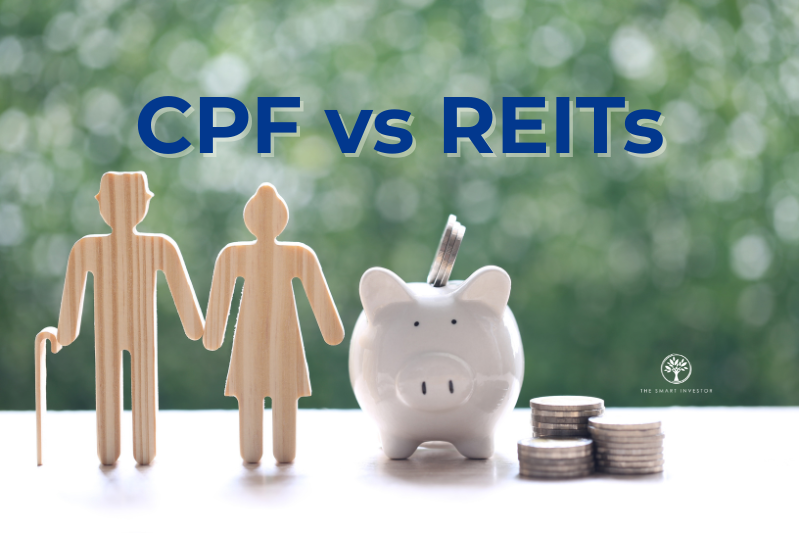
Singapore’s Central Provident Fund (CPF) forms the bedrock for many Singaporeans’ retirement.
But as living costs rise, investors have started asking if CPF alone is enough.
Singapore REITs (S-REITs), known for steady and regular income, have become a popular complement to CPF for Singaporeans.
Here, we look at both CPF and REITs as retirement income tools, and find out which builds a stronger income stream in 2026.
Understanding CPF as a Retirement Income Tool
CPF, being low risk and backed by the government, is designed to provide a predictable retirement income for Singaporeans.
Currently, CPF savings earn a minimum of 2.5% interest p.a. for Ordinary Account (OA) and 4% interest for Special Account (SA) and Retirement Account (RA), with these floor rates guaranteed by the Singapore Government.
These returns are generally higher than those of regular savings accounts.
Furthermore, they are not subject to market volatility, making them an ideal choice for those who are risk-averse.
Upon reaching your retirement age, savings from your OA and SA get transferred to the RA.
If you have at least S$60,000 in RA, you are enrolled in the CPF Life scheme, where you will receive monthly payouts for life.
This reduces the risk of you outliving your savings, providing peace of mind, especially with longer life expectancy.
However, it is not without flaws.
CPF savings are largely locked up until retirement age, with limited access to the funds earlier in life.
And while CPF is designed to meet essential living needs, it would not fully cover higher lifestyle expectations, healthcare costs, or inflation-driven expenses.
How REITs Generate Retirement Income
REITs distribute rental income from their properties to their unitholders.
They have stringent regulatory requirements in Singapore, including distributing at least 90% of taxable income to unitholders to qualify for tax benefits.
Distributions are typically paid out every quarter or half-yearly, and are tax-free for investors in Singapore.
However, unlike CPF savings, these payouts are market-linked and not guaranteed.
The payouts may fluctuate due to variables such as occupancy, rental costs, and financing costs.
Compared to CPF, REITs offer higher income potential but with variability and risks.
Income Stability vs Income Growth
Inflation, being one of the biggest hidden risks to long-term income, can slowly reduce your purchasing power over time.
Your savings in CPF grow slowly, but they are stable and risk-free.
CPF Life might prevent you from running out of money, but it cannot fully protect you from rising prices.
On the other hand, REIT income can grow more over time through acquisitions and rental increments.
For example, with a trailing annual dividend yield of approximately 4.6%, CapitaLand Integrated Commercial Trust (SGX: C38U), or CICT, can better help keep pace with inflation.
However, its returns are not guaranteed and come with business and market risks.
Stability and growth often trade off against each other, and finding the sweet spot that balances both would benefit investors the most.
Risk, Volatility, and Peace of Mind
The “best” suitable income stream is largely dependent on your risk tolerance.
REIT unit prices can swing sharply during interest rate cycles or economic shifts.
CPF balances, however, are not affected by market prices, providing a “sleep-well-at-night” assurance.
Emotional responses to risk, spending, and uncertainty can quietly undermine well-designed retirement plans.
Ultimately, while REITs offer growth, your emotional tolerance for price fluctuations should dictate your mix.
The “best” income stream isn’t the one with the highest yield, but the one that ensures you don’t panic-sell when you need stability most.
Can CPF and REITs Work Better Together?
Rather than viewing them as mutually exclusive, integrating CPF and REITs allows investors to harness the best of both worlds.
CPF provides predictable returns with zero downside risk, acting as a reliable foundation upon which you can lean back on without worries.
REITs will be your income layer, coming in to supplement CPF with higher yields.
For long-term stability, focus on blue-chip stalwarts like CICT, Frasers Logistics & Commercial Trust (SGX: BUOU), and Keppel DC REIT (SGX: AJBU).
These names boast resilient balance sheets and proven payout track records.
Younger investors with higher risk tolerance might allocate 70-80% of their discretionary capital towards REITs to maximize compounding.
The goal remains the same: using CPF for “certainty” and REITs for “growth.”
What This Means for Investors in 2026
There is no one-size-fits-all solution to retirement planning.
Sustainable income is increasingly important with rising longevity.
CPF remains an important foundation in every Singaporean’s retirement planning, but supplementary income sources such as REITs are increasingly relevant to combat inflation.
Get Smart: Build Income With Balance
Choosing between CPF and REITs is a false dilemma.
CPF provides certainty without volatility, while REITs offer yield with growth potential.
Each plays a distinct role in retirement planning.
By integrating the stability of the Singapore government’s interest rates with the compounding power of high-quality real estate, you create a diversified income stream capable of weathering any market cycle.
Balance isn’t just a strategy; it’s your roadmap to a worry-free retirement.
If you want to retire with a constant stream of dividends, these 5 stocks might be all you need. We’ve found 5 SG stocks that have kept paying (and growing) through inflation, rate hikes, and recessions. See what they are with our latest free report for SGX dividend investors. Click here to get instant access.
Follow us on Facebook, Instagram and Telegram for the latest investing news and analyses!
Disclosure: Wenting does not own any of the above-mentioned stocks.