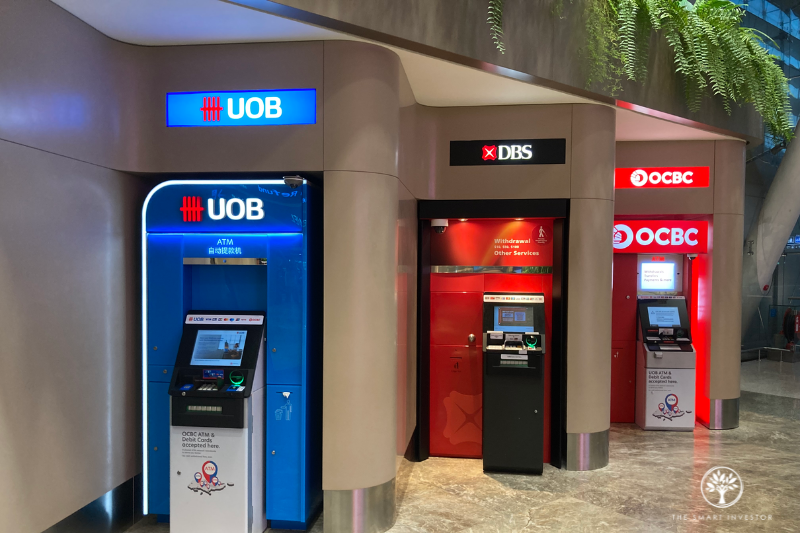
DBS, UOB, and OCBC have seen strong share performances over the last few years.
The main question for investors now is: With a rate easing cycle, can these banks continue their upward share momentum, or are they due for a pullback?
Why Bank Stocks Surged
High interest rates increase the spread banks earn between the interest charged on loans and the interest paid on deposits.
Known as net interest margin (NIM), this metric has increased for Singapore’s banks from the COVID years to 2024, leading to strong growth in their net interest income (NII).
Record profits for the banks and the payment of generous dividends ensued.
From 2022 to 2024, all three banks have grown their net income at an average compound annual growth rate (CAGR) of 16.5%.
The banks also took this opportunity to bolster their capital positions.
These factors likely played a role in their strong share price growth up to 2024.
This year, DBS, with its 21.4% year-to-date return, is the only one of the three to outperform the Straits Times Index’s 17% gain so far. OCBC’s stock price is up just 1.0% while UOB’s has declined by 5%.
DBS Group (SGX: D05)
Singapore’s largest bank, DBS Group Holding Limited (SGX: D05), has been making strides in diversifying away from NII, with strong growth seen in its fee-income business, particularly from wealth management.
In the second quarter of 2025 (2Q 2025), DBS’s NII grew 2% year-on-year (YoY) to S$3.6 billion, and was flat quarter-on-quarter (QoQ). Management expects YoY growth for NII in 2025.
NIM stood at 2.05% as of June 2025.
Management has alluded to a lower NIM in the following quarters.
Meanwhile, wealth management income surged 25.3% YoY to S$649 million, buffering the low growth in NII. At 46.5% of DBS’s total fee income, the strong growth from wealth management helped to stabilise DBS’s profit.
The bank’s net profit of S$2.8 billion in 2Q 2025 increased 1% YoY, although it declined 3% QoQ.
A generous dividend payer, DBS has increased its ordinary dividend per share (DPS) by 70.8% from S$1.37 in 2022 to S$2.34 over the last twelve months (LTM).
The bank’s ordinary DPS for the first half of 2025 is S$1.20, up 11% YoY. This trend is expected to continue with management guiding for a similar increase in DPS for the second half of 2025.
UOB (SGX: U11)
Since United Overseas Bank Ltd (SGX: U11) completed the final phase of its acquisition and integration of Citigroup’s consumer banking assets in November 2023, it has offered investors larger exposure to regional economic growth.
In 2Q 2025, UOB’s NII declined 3% both YoY and QoQ to to S$2.3 billion owing to lower rates.
NIM came in at 1.91% for 2Q 2025, with management expecting this metric to decline to a range of 1.85%-1.95% for 2025 from 2.03% in 2024.
But UOB also reported a 6% YoY increase in loans to S$115 billion, and fee income of S$636 million, up 3% from a year ago. Non-interest income was S$1.1 billion (32.5% of total income).
For 2025, management expects loans to grow at a low single-digit rate and fee income to increase at a high single-digit rate.
Unlike DBS, UOB’s DPS was down 3% YoY in the first half of 2025 to S$0.85.
OCBC (SGX: O39)
For 2Q 2025, Oversea-Chinese Banking Corporation Ltd (SGX: O39) saw NII decreasing 6% YoY and 3% QoQ to S$2.3 billion.
NIM compression had a more pronounced impact on OCBC than its peers, with net profit slipping 7% YoY and 4% QoQ to S$1.8 billion. Lower margins had offset 7% loan growth in 2Q 2025 compared to 2Q 2024.
OCBC’s management is guiding for 2025’s NIM to be 1.90%-1.95%, with NII declining YoY.
Although OCBC’s insurance arm, Great Eastern (SGX: G07), and its non-fee income segment (predominantly wealth management) diversify away from NII, overall net income earnings might actually become more volatile.
Insurance contributions from Great Eastern (6.4% of total income) declined 23.1% YoY because of lower rates, resulting in a valuation decline of its insurance contract liabilities.
Lower earnings led OCBC to reduce its interim dividend for the first half of 2025 to S$0.41 per share, down 6.8% YoY to ensure it maintains a 50% payout ratio.
Headwinds to Consider
Rate cuts will lead to lower NIM for all three banks.
Although loan growth may offset some margin pressure, Singapore’s mature market constrains any large increases.
Credit quality could also decline because of global economic uncertainty, which will pressure earnings.
However, this is not yet seen, as all three banks reported stable non-performing loan ratios (NPLs) over the last twelve months.
Looking at valuation, OCBC’s trailing price-to-book (P/B) ratio of 1.3 times offers relative value compared to its three-year average of 1.1 times.
Likewise, UOB’s trailing P/B ratio of around 1.2 times compares favourably to its three-year average of 1.14 times.
DBS is the odd one out with its trailing P/B ratio of 2.2 compared to the three-year average of 1.57.
What This Means for Investors
Each bank provides investors with a slightly different exposure: DBS is more resilient given its diversification and strong fee income performance, UOB offers exposure to regional growth, and OCBC is a value play with an insurance arm that is facing greater NIM pressure.
Get Smart: Banks Offer Modest Growth but Reliable Income
While explosive share price appreciation is not expected going forward, banks still serve as reliable dividend anchors in any portfolio with their steady dividend payout.
Investors will do well to just let these quality banks compound long-term, regardless of the possible near-term appreciation being capped.
When the market is unpredictable, where can you park your money with confidence? Our latest FREE report reveals 5 Singapore dividend-payers built to withstand global storms. Get it now and see what’s still worth holding.
Follow us on Facebook, Instagram and Telegram for the latest investing news and analyses!
Disclosure: Wesley does not own shares in any of the companies mentioned.