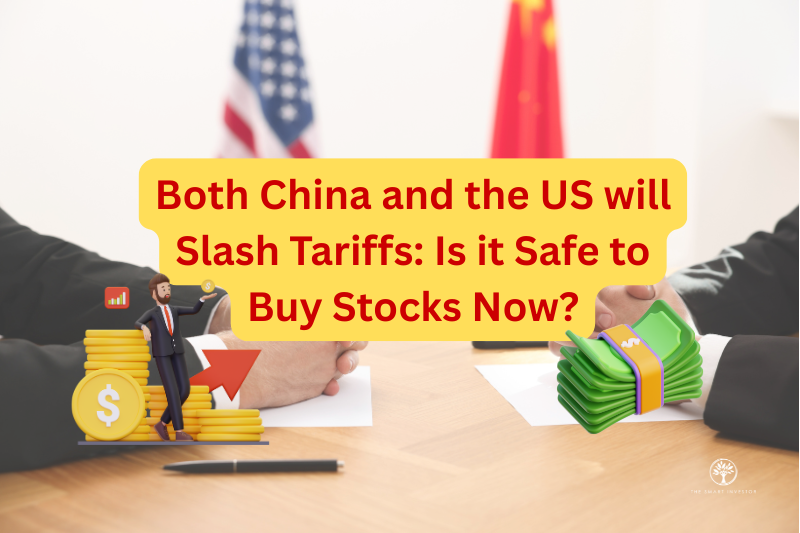
A deal was struck between the US and China, with both nations pledging to reduce their tariff rates.
This agreement was negotiated in response to President Trump’s raft of reciprocal tariffs that were imposed on 2 April.
Although Trump dialled back on these tariffs with a 90-day pause, an air of uncertainty lingered as markets digested the news.
US tariffs on China dropped from 145% to 30%, while China’s tariffs on US imports plunged to just 10% from the previous 125%.
In addition, the White House slashed the “de minimis” tariff on Chinese shipments from 120% to 54%, along with a US$100 flat fee commencing 14 May.
With both countries having negotiated some form of trade deal, should investors breathe a sigh of relief?
Paused but not cancelled
Investors should note that these tariffs have only been paused for 90 days, but have not been cancelled.
The reductions will be effective for 90 days while both parties go back to the negotiation table.
In effect, the US still has the minimum “base” tariff rate of 10% that was imposed on more than 180 countries.
These tariffs are still in place and represent the baseline tariff rate that the US is imposing on all imports from other countries.
A fragile situation
Trump is well-known for being temperamental, as evidenced by his constant flip-flopping on policy issues and pronouncements.
His initial rant for “Liberation Day” accused a host of countries of taxing the US and his job was to “Make America Great Again” by creating jobs back home and shifting production back to the US.
Hence, these tariffs should be viewed as a bargaining tool used by the President to extract concessions from other countries.
Just last week, the US sealed a trade deal with the UK that helped to lift some, but not all, of the US tariffs on British goods.
Trump will be busy negotiating with other countries including China, and may re-impose the reciprocal tariffs, announce new sectoral tariffs like he did for the movie and automotive industries, or backtrack on some of his promises.
In short, the situation remains fragile as countries are still on edge.
Anything can happen as negotiations could either go smoothly, end in an impasse, or conclude with either side waging a renewed trade war.
Second and third-order effects
The immediate effect of the tariffs will be to increase the costs of doing business for a wide swath of companies.
With businesses having to pay an additional tax to export their goods to the US, companies may be forced to either raise prices or absorb these taxes, thus affecting their profit margins.
As a result, businesses may hold back from spending and investments for now as they assess the situation and take a “wait-and-see” attitude.
Should prices increase in response to the tariffs, consumers may also tighten their purse strings and stay cautious as inflation rears its ugly head again.
Companies may also start to re-jig their supply chains in response to these tariffs, resulting in a changed business landscape in the years to come.
These are just the first-order effects from the tariffs, though.
There are second or even third-order effects which can be tough to predict as they will be predicated on how companies react and how their competitors respond to these moves.
Proceed with caution
For these tariffs, the only thing we can be certain of is that there will be more uncertainty.
It’s still early days as Trump begins negotiations with various nations amid the pause.
An uneasy truce has been called with China as both parties are eager to continue trading without excessive disruptions to existing supply chains.
However, there is no guarantee that a resolution will take place, and investors need to brace themselves for possible nasty surprises in the future.
Stock markets have calmed down and recovered but could be poised for more volatility ahead.
The air of uncertainty has yet to clear and investors are bracing for more turbulence ahead.
Get Smart: Stick with quality
Uncertainty should be no stranger to investors.
The same uncertainty persisted through the Global Financial Crisis back in 2008 to 2009 and, more recently, the pandemic which lasted from 2020 to 2022.
The good news is that both crises were eventually resolved, allowing markets to climb to new records.
Investors should stick with quality names with proven track records during uncertain times.
Examples include blue-chip stocks such as DBS Group (SGX: D05) and Singapore Exchange Limited (SGX: S68).
For income investors, they can seek shelter in resilient REITs such as CapitaLand Integrated Commercial Trust (SGX: C38U) and Keppel DC REIT (SGX: AJBU).
Big Tech is spending hundreds of billions on AI, and the ripple effects are just beginning. Our new investor guide shows how AI is changing the way companies generate revenue, structure their business models, and gain an edge. Even if you already know the major players, this report reveals something far MORE important: The why and how behind their moves, and what it means for your portfolio. Download your free report now.
Follow us on Facebook and Telegram for the latest investing news and analyses!
Disclosure: Royston Yang owns shares of DBS Group, Singapore Exchange and Keppel DC REIT.