Retirement income is not built on a single good quarter.
It is built on distributions that hold up, year after year, through rate cycles and property cycles alike.
That is the lens worth applying to the latest updates from three of Singapore’s blue-chip REITs.
Each is funding its future payouts through a different engine.
The question for anyone relying on these distributions is whether that engine protects the payout or quietly borrows from it.
Keppel DC REIT (SGX: AJBU)
Of the three, Keppel DC REIT offered the most direct evidence of a growing payout.
Distributable income rose 20.7% year on year (YoY) to S$74.6 million, and distribution per unit (DPU) climbed 13.2% to S$0.02833.
That is distribution growth, not just revenue growth, and the distinction matters for income investors.
Gross revenue itself rose 18.4% YoY to S$121.0 million.
The balance sheet supports the payout rather than straining it.
Aggregate leverage fell to 35.1%, leaving roughly S$550 million in debt headroom, while the average cost of debt improved to 2.6%.
Around 84.8% of borrowings sit on fixed rates, which gives income visibility when interest rates move.
A rental reversion of about 51% on renewed contracts during the quarter points to pricing power, underpinned by demand from artificial intelligence workloads.
The income rests heavily on one asset class across 10 countries.
Management flagged increased global uncertainty but expects limited operational impact, noting net electricity costs are under 3% of operating expenses.
The concentration is worth holding in mind even as the numbers impress.
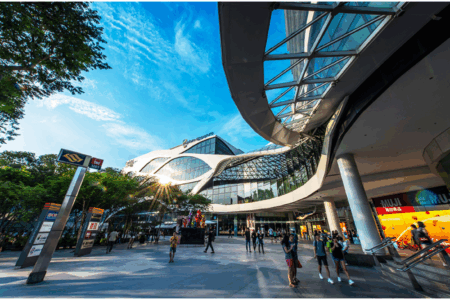
CapitaLand Integrated Commercial Trust (SGX: C38U), or CICT
CICT, one of Singapore’s largest REITs, posted gross revenue of S$426.7 million, up 8.0% YoY, with net property income (NPI) rising 7.9% to S$314.4 million.
CICT distributes half-yearly, so no DPU was declared this quarter.
The underlying income looks healthy.
Rental reversions came in at +4.4% for retail and +6.1% for office year to date, shopper traffic rose 3.2% YoY and tenant sales per square foot rose 2.2%.
Committed occupancy stood at 95.2%, though that was down 1.7 percentage points from the previous quarter.
Much of the income story now turns on the pipeline.
CICT proposed acquiring Paragon for an agreed property value of S$3.9 billion, partly funded by divesting Asia Square Tower 2 for S$2.48 billion.
The deal indicated pro forma DPU accretion of 1.7%.
That accretion is prospective, not banked, and the proposed transactions still have to complete before the payout sees the benefit.
CapitaLand Ascendas REIT (SGX: A17U), or CLAR
CLAR, Singapore’s oldest industrial REIT, requires the most care from an income reader this quarter.
Like CICT, it reports DPU half-yearly, so it disclosed no revenue, NPI or DPU.
Operationally the signals are strong.
Portfolio rental reversion reached +10.6% on renewed leases, with the US leading at +15.1% and a newly acquired Spanish logistics portfolio adding income at 100% occupancy.
But portfolio occupancy eased to 90.5%, down from 91.5% a year ago, and aggregate leverage rose to 42.0%.
Here is where income investors should slow down.
CLAR completed a S$903.5 million equity fund raising in April 2026, which is expected to ease leverage back to around 37.3%.
The acquisitions are described as DPU-accretive, but raising equity issues new units, and per-unit distributions are what a retiree actually spends.
Operational reversion strength and per-unit dilution are two different things, and the half-year DPU will be the figure that settles which one wins out.
Get Smart: Judge the Payout, Not the Quarter
A strong quarter is not the same as a durable distribution.
Keppel DC REIT showed actual DPU growth backed by a conservative balance sheet.
CICT held its underlying income steady while leaning on a pipeline that has yet to complete.
CLAR delivered operational strength but raised equity that has to be weighed against per-unit payouts.
For retirement income, the work is to keep asking whether each payout is being funded by the business or by financial engineering.
Two of these three did not declare a DPU this quarter at all, so the half-year numbers will tell the fuller story.
Until then, judge the engine, not the headline.
Imagine receiving steady rent increases for more than two decades. It sounds unusual, but one healthcare REIT already has rental escalations locked in until around 2042. Income visibility like this is hard to find today. We break down how this REIT built such dependable cash flow in our FREE dividend report and how it could strengthen a retirement portfolio. Get the free report here.
Follow us on Facebook, Instagram and Telegram for the latest investing news and analyses!
Disclosure: The Smart Investor owns units of Keppel DC REIT, CICT and CLAR.