Apple and Samsung’s rivalry in the tech industry has entered a new phase as artificial intelligence (AI) reshapes the competitive landscape. Both companies are adapting their strategies to leverage AI while competing for market share and investor confidence.
Here’s an analysis of their evolving competition across market position, innovation, and financial performance.
Global Market Trends
Despite a challenging economic backdrop, Apple (NASDAQ: AAPL) and Samsung (KRX: 005930) dominate the global tech landscape. Both companies are leveraging AI to redefine their product offerings, optimise user experiences and set benchmarks for the industry.
According to a report by the International Data Corp (IDC) in 2023 Apple overtook Samsung to become the largest seller of smartphones worldwide. This was a historic moment, ending Samsung’s 12-year streak at the top. Apple’s global market share climbed to 20%, while Samsung followed closely at 19.4%.
While Apple and Samsung maintained their lead in 2024, both companies faced pressures due to reduced consumer spending and fierce competition from Chinese brands such as Xiaomi and Oppo, which focused on budget and mid-range sectors.
While Samsung maintains its lead in product diversity with a wide range of price points, Apple’s strategy of premium devices equipped with cutting-edge technology has proven to be an effective growth driver.
Market Leadership Dynamics
The battle for leadership doesn’t stop at smartphone dominance — it extends across multiple industries, ranging from smartwatches to AI-powered home ecosystems.
Apple’s Approach to AI
Apple’s integration of AI within its ecosystem has been largely focused on privacy-centric machine learning applications. These include:
- Siri Enhancements: Improvements in natural language processing allow Siri to deliver smarter, faster responses.
- AI in Daily Use: Features like personalised Siri Shortcuts, AI-driven photo tagging, and predictive text streamline the user experience across devices.
- Health and Fitness AI: Through the Apple Watch, Apple’s AI applications for fitness tracking and health insights have set new standards.
Samsung’s Approach to AI
Samsung, on the other hand, has pushed boundaries in innovation by embedding AI across nearly all its product lines:
- SmartThings Ecosystem: Samsung’s AI ties together its smart home products, enabling seamless device interconnectivity.
- Camera Technology: Its advanced AI image processing and scene optimisation features make it a leader in mobile photography.
- AI Chips: Custom chips designed exclusively for powering AI functions within its devices have given Samsung hardware an additional edge.
While Apple has taken a more tightly integrated approach, Samsung’s reach into more varied market segments extends its AI dominance into the broader consumer electronics realm.
Revenue & Profit Comparison

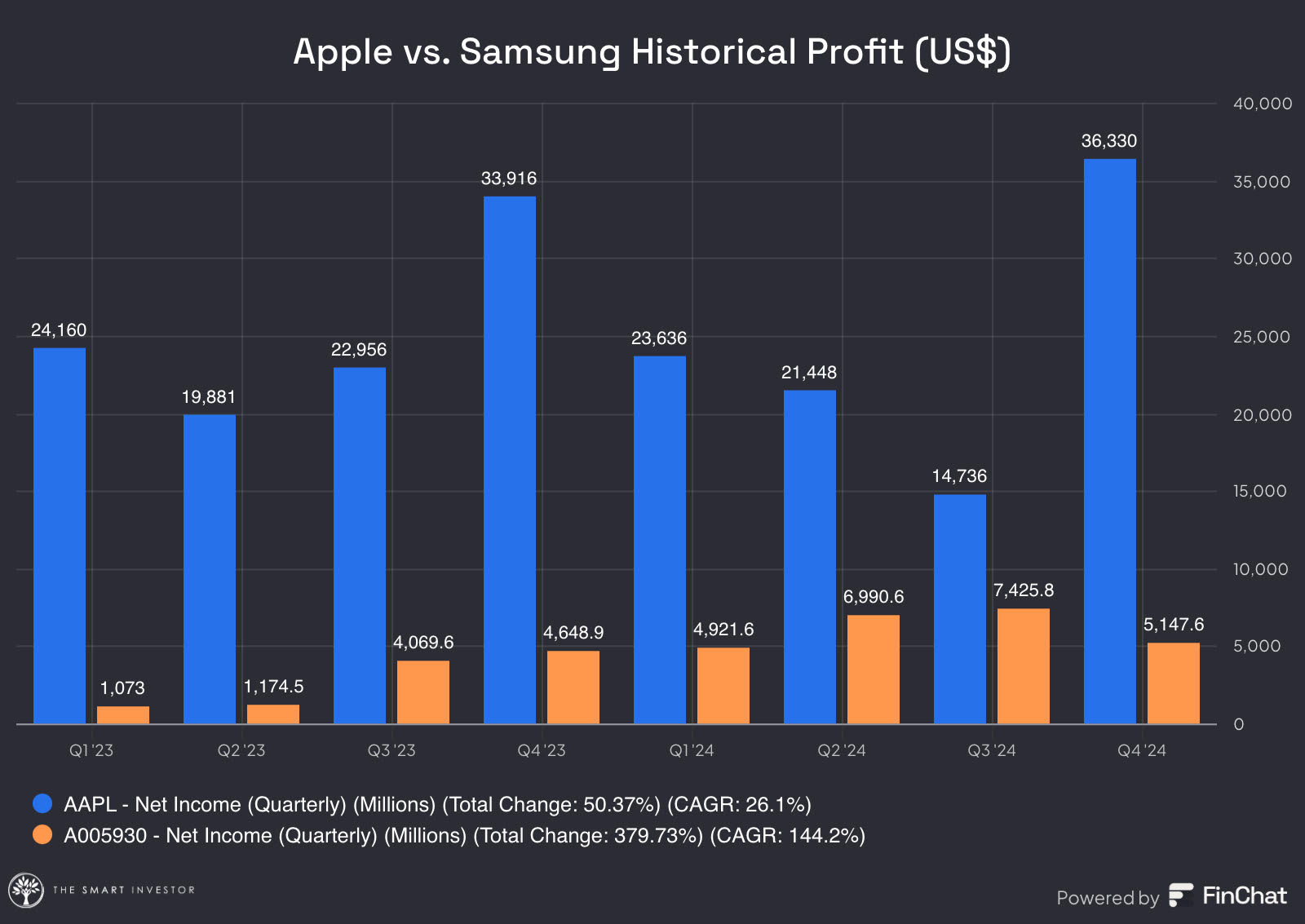
Based on the above charts, the financial performance comparison between Apple and Samsung reveals Apple’s dominant market position and superior operational efficiency.
While both companies operate at a massive scale in the tech sector, Apple consistently generates more than double Samsung’s revenue and maintains substantially higher profit margins. This fundamental difference in financial performance highlights these tech giants’ contrasting business models and market positioning.
Apple’s revenue demonstrates clear seasonal patterns, peaking in Q4 with new iPhone releases. From Q1 2023 to Q4 2024, revenue grew 31.07% to reach US$124.3 billion. The company’s exceptional profit conversion is evident in its quarterly earnings, ranging from US$14.7 billion to US$36.3 billion, showcasing strong pricing power and operational excellence.
Samsung’s performance, while substantial, follows a different trajectory. With modest revenue growth of 5.18%, quarterly revenues range between US$45.6 billion and US$60 billion. However, the company’s 379.73% profit growth, despite lower absolute numbers, indicates improving operational efficiency and effective cost management.
For investors, these metrics highlight key strategic differences. Apple’s sustained high margins reflect its premium market position and ecosystem strength. In contrast, Samsung operates on thinner margins across more diverse market segments, though its recent profit improvements suggest successful strategic adjustments.
Overall, Apple offers more predictable returns and stronger fundamentals, while Samsung presents a potential value opportunity given its significant profit growth trajectory. This differential extends beyond just numbers, reflecting fundamental differences in market approach and value creation strategies.
Smartphone Sales Comparison
Apple and Samsung have consistently been at the forefront of the global smartphone market, but their sales and market share demonstrate their contrasting strategies and strengths.
Sales and Market Share (2024)
| Apple | Samsung | |
| Global Smartphone Sales | 225.9 million units | 222.9 million units |
| Market Share | 18% | 18% |
| Regional Strength | North America, Europe | Emerging Markets, Asia |
Apple’s focus on premium devices has secured it a dominant position in high-income regions. In contrast, Samsung’s broader range of devices, including budget and mid-range models, ensures a stronghold in emerging markets.
Their combined market presence highlights their influence in shaping consumer preferences and global trends.
Investment Considerations
If you’re a stock investor weighing which company to back, it’s important to consider key factors such as growth potential, market position, and adaptability:
| Apple | Samsung | |
| Strengths | Premium pricing and high customer loyalty | Diversified operations (e.g., semiconductors) hedging against slowdowns in any single segment |
| Strong services ecosystem generating recurring revenue | High penetration in emerging markets offering growth potential | |
| Challenges | Heavy reliance on iPhone sales | Struggles to maintain margins on low- and mid-level devices |
| Increasing competition in the premium market from Huawei and Google | Reliance on Android OS restricting vertical integration compared to Apple’s proprietary iOS ecosystem |
Apple and Samsung each offer distinct investment propositions: Apple excels through its premium ecosystem and strong customer loyalty, while Samsung leverages its diverse product range and broader market reach.
For investors, the choice depends on whether you value Apple’s consistent premium strategy or Samsung’s diversified innovation approach.
We have just revealed the top 7 US tech stocks poised for remarkable growth. In today’s fast-paced market, betting on these giants could mean more money in your pocket. With a focus on solid fundamentals and innovative prowess, these selections should earn a place in your portfolio. Click here to grab your FREE report now and start investing in the future, today.
Follow us on Facebook and Telegram for the latest investing news and analyses!
Disclosure: Joanna Sng owns shares of Apple.