Three Straits Times Index (^SGX: STI) blue-chip stocks raised their payouts in the same reporting season.
The increases ran from 33% to 77%.
Size alone tells you little here.
A bigger property portfolio funds a payout differently from a smaller interest bill.
Each of the three increases below traces back to a different line.
Income investors need to know which lines repeat.
Has the business engine matched the dividend step-up?
Singapore Exchange Limited (SGX: S68) is Singapore’s sole stock market operator and a multi-asset exchange.
For the fiscal year ended 30 June 2026 (FY2026), net revenue climbed 13.9% year on year (YoY) to S$1.5 billion.
Equities – Cash did the heavy lifting, jumping 28.1% to S$502.9 million as securities daily average traded value rose 34.9% to S$1.8 billion.
Fixed Income, Currencies and Commodities (FICC) added 17.0% to S$376.2 million on record currency and commodity derivatives volumes.
Net profit rose a more modest 7.8% YoY to S$698.4 million, weighed down by a S$53.4 million goodwill impairment on Scientific Beta and weaker investment gains.
Stripping these out, adjusted net profit surged 24.6% to S$759.5 million.
Proposed total FY2026 dividends reached S$0.570 per share, including a one-off additional dividend of S$0.125, up 52% from S$0.375 a year ago.
Adjusted net profit outpaced reported earnings growth, showing that core operating momentum easily supported the core payout expansion.
Operating cash flow rose to S$870.7 million, though free cash flow edged up just 2% YoY to S$788.8 million as capital expenditure stepped up to S$94.2 million for technology modernisation.
The balance sheet stayed sturdy with S$1.8 billion of cash against S$628.2 million of borrowings.
Management set medium-term revenue growth guidance at 6% to 8%, excluding treasury income.
For FY2027, expenses are expected to rise by 6% to 8%, with capital expenditure around S$100 million and full debt repayment planned.
Looking ahead through FY2028, dividends are projected to increase by 0.25 cents quarterly.
What is paying for the bigger cheque?
Hongkong Land (SGX: H78) develops and manages premium mixed-use property in Asian gateway cities. Its portfolio spans Hong Kong Central, Singapore Central and China.
The group lifted its interim dividend to US$0.08 per share from US$0.06, payable 14 October 2026.
Underlying profit attributable to shareholders rose 11% YoY to US$259.1 million.
Underlying earnings per share advanced 14% to US$0.1207 on a reduced share count.
That profit growth traces to a single line.
Operating profit stayed broadly flat at US$318.9 million.
Higher LANDMARK contributions and a 43% jump in China Integrated Properties’ earnings offset the income the group gave up from Marina Bay Financial Centre Tower 3.
Net financing charges fell to US$56.2 million from US$88.0 million a year ago.
Active capital recycling drove that reduction.
Cumulative capital recycled has reached US$3.7 billion, or 93% of the group’s target.
Free cash flow is the engine behind sustainable dividends.
Hongkong Land’s FCF fell to US$153.2 million from US$207 million as renovation spending nearly doubled to US$109.3 million.
Reported profit reached US$1.3 billion against US$220.9 million a year ago, but a US$725.1 million revaluation gain drove that figure.
Revaluation gains fund no distributions.
The group held cash of US$2.7 billion against borrowings of US$6.1 billion.
Net debt therefore came to US$3.4 billion and net gearing to 11%.
Is a bigger interim dividend the whole story?
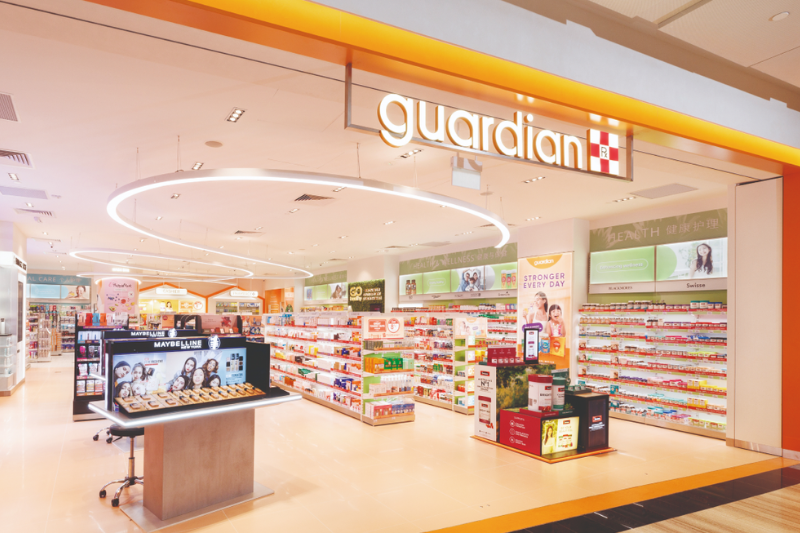
DFI Retail Group (SGX: D01) operated 7,659 outlets across 12 markets as at 30 June 2026.
The group runs health and beauty, convenience, food, home furnishings and restaurant chains.
DFI declared an interim dividend of US$0.062, up 77% YoY from US$0.035.
That comparison covers ordinary dividends only.
The group also paid a special dividend of US$0.443 a year ago and declared none this time.
Total declared dividends therefore fell from US$0.478 to US$0.062.
The two measures do not compare like for like.
The operating picture improved.
Revenue dipped 6% YoY to US$4.1 billion.
The group attributed that decline to two changes.
It sold its Singapore Food business and closed Mannings China.
Underlying subsidiary revenue from continuing businesses rose 4% excluding those changes.
Like-for-like sales rose 3%.
Underlying profit attributable to shareholders climbed 11% YoY to US$117 million, and was 44% higher on a continuing-business basis.
Those two percentages measure different things.
Free cash flow eased 9.3% YoY to US$382.7 million on higher capital expenditure.
The group held cash of US$164.2 million against borrowings of US$186.4 million excluding lease liabilities.
That left net debt at US$22 million.
Management raised full-year guidance to organic revenue growth of 3.0% to 4.0% and underlying profit of US$285 million to US$305 million.
Get Smart: Size is the sizzle; the income source is the steak
The largest increase of the three arrived alongside the sharpest fall in total dividends.
Another came from an exchange where adjusted profits and cash flows remain strong while balance-sheet leverage is slated to hit zero in FY2027.
Percentage change on its own ranks these three in the wrong order.
A better habit runs the other way.
Take the increase first, then find the line that paid for it.
Trading volume expansion and a lower interest bill both lift a payout.
Only one of them can keep lifting it, because an interest bill can only fall so far.
Ask what has to stay true for that line to fund the next increase, and whether management has committed to anything that makes it so.
Don’t let market uncertainty hijack your financial dreams. While headlines scream gloom, 5 Singapore companies have been quietly building wealth and paying reliable dividends. You’re probably overlooking them. Discover these resilient giants and their secrets to sustained income, even through global storms. Click here to download your free report now and secure your financial future!
Follow us on Facebook, Instagram and Telegram for the latest investing news and analyses!
Disclosure: The Smart Investor owns shares of SGX.