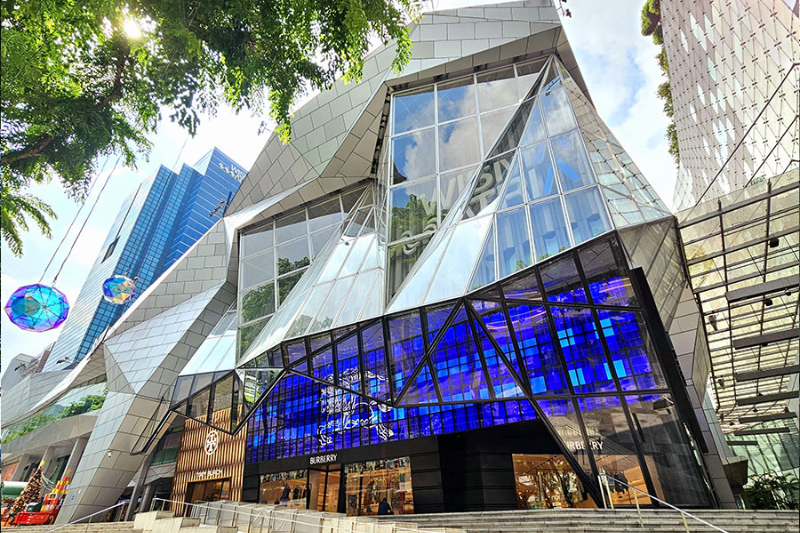
For years, some investors believed that e-commerce would replace shopping malls.
Weaker retail assets have indeed struggled, but many high-quality malls continue to enjoy strong footfall, healthy tenant demand, and positive rental growth.
Here are three Singapore retail real estate investment trusts (REITs) holding their ground against the structural shift to online shopping.
Why E-commerce Hasn’t Killed Every Shopping Mall
Physical retail still has advantages that e-commerce cannot replicate.
Dining, healthcare, beauty, and fitness all require a physical location, and grocery shopping remains a reliable traffic driver.
Location matters, since malls are usually integrated with MRT stations or transport hubs, or are well-located in heartlands that enjoy high footfall.
CapitaLand Integrated Commercial Trust (SGX: C38U), or CICT
CICT is Singapore’s largest REIT by market capitalisation, with a S$27.4 billion portfolio of 25 properties across Singapore, Germany, and Australia.
Committed portfolio occupancy stood at 95.2% as at 31 March 2026, with retail at 97.8% and office at 93.7%.
Rental reversions were positive across the board: retail leases renewed at +4.4% and office at +6.1% year to date.
Shopper traffic rose 3.2% year on year (YoY) and tenant sales per square foot grew 2.2%, so footfall is translating into actual spending.
Asset enhancement initiatives (AEIs) are ongoing at Lot One, Raffles City Tower, and Tampines Mall, with a further S$160 million upgrade planned for Plaza Singapura and The Atrium@Orchard starting in 3Q2026.
The REIT has also proposed acquiring Paragon on Orchard Road for an agreed property value of S$3.9 billion, part-funded by divesting Asia Square Tower 2 for S$2.48 billion.
Many CICT malls are steps from an MRT interchange – you’re already there and probably walking through on your way home or to work.
Starhill Global REIT (SGX: P40U)
Starhill Global REIT has a smaller, more concentrated portfolio of nine mid- to high-end properties across six Asia-Pacific cities, anchored by prime assets Wisma Atria and Ngee Ann City on Orchard Road.
Both malls are well-connected with basement access to Orchard MRT station, and the tenant mix at both leans on international luxury brands that continue to be present in high-end shopping malls regardless of what’s happening online.
Committed portfolio occupancy climbed to 97.2% as at 30 June 2026, up from 94.6% a year earlier.
Growth is slow, though: FY2026 gross revenue rose 0.2% and net property income 0.1%, lifting distribution per unit (DPU) 0.8% YoY to S$0.0368 cents.
With Singapore’s 2026 international visitor arrivals forecast to reach 17 million to 18 million, Orchard Road malls like these are direct beneficiaries.
The REIT’s real long-term strength is its lease book, with a weighted average lease expiry (WALE) of 7.3 years, underpinned by long-dated master leases at Ngee Ann City.
Frasers Centrepoint Trust, (SGX: J69U), or FCT
FCT is a defensive and suburban retail play with nine malls plus one office property worth S$8.4 billion, sitting next to or near MRT stations with a combined catchment population of 3 million.
One of those nine is on the way out: FCT has proposed divesting White Sands at an agreed property value of S$467 million.
Approximately 54% of gross rental income comes from tenants selling essential goods and services — supermarkets, dining and healthcare.
Retail portfolio committed occupancy was 99.6% as at 30 June 2026.
Although rental reversion was not disclosed for the third quarter ended 30 June 2026 (3QFY2026), shopper traffic rose 2.4% YoY, while tenant sales edged up 0.2% YoY, held back by tenancy churn and refresh.
For the first half of FY2026, DPU rose 1.4% YoY to $0.06136, largely because unit count rose from the equity raise that funded last year’s Northpoint City South Wing acquisition.
Management’s growth strategy leans on AEI: Hougang Mall AEI is over 98% committed and on track for September 2026 completion, while NEX’s Phase 1 AEI achieved 87% pre-commitment.
What Makes These Retail REITs Different?
CICT and FCT are defensive because essential services make up a meaningful share of both portfolios, keeping footfall resilient even when consumers cut back elsewhere.
Both are able to drive positive rental reversions and high occupancy rates.
Starhill Global’s occupancy is high partly by construction: master and anchor leases with periodic rent reviews made up 54.3% of gross rental income as at 31 March 2026.
Rents on those leases rise at contracted review dates rather than at renewal, which buys income visibility at the cost of moving more slowly than the open market.
All three REITs are doing AEIs: refurbishing a mall repositions the tenant mix and gives management room to raise achievable rents.
The Risks Investors Should Still Consider
Higher-for-longer interest rates raise financing and refinancing costs, leading to lower DPUs.
Consumer behaviour keeps shifting toward online channels, which means malls need to keep evolving their tenant mix rather than standing still.
An economic slowdown would pressure discretionary spending even at essential-heavy malls.
Tenant concentration is also worth checking for any REIT you’re considering — a mall that depends heavily on one or two anchor tenants carries more risk than the occupancy rate alone suggests.
What Investors Should Watch Going Forward
Keep an eye on occupancy trends, rental reversions, and shopper traffic each quarter, alongside progress on asset enhancement projects and any refinancing activity as debt comes due.
Sustained DPU growth, rather than a single strong quarter, is what defines a genuine compounder.
Common Mistakes Investors Make
Not every retail REIT faces the same e-commerce pressure, and a relevant tenant mix plus a good location can blunt it.
Chasing the highest distribution yield without checking asset quality first is how investors end up owning the wrong REIT for the wrong reason.
Tenant concentration deserves a look as well, since a concentrated tenant base gives a big tenant more negotiating power at lease renewal.
Lastly, it’s easy to fixate on short-term macro headlines like the interest rate outlook at the expense of the property fundamentals that actually drive distributions over time.
Get Smart: The Best Retail REITs Sell More Than Shopping
E-commerce hasn’t killed the shopping mall – it’s just made the case for owning the right one.
The REITs that hold up are the ones that are well-established in key locations and have tenants that people actually need to visit, not just the ones with the biggest footprint.
You’ve probably shopped at their malls, banked with them, or bought their products this month. These 6 SGX companies have paid dividends for 20 straight years, GFC and COVID included. Our FREE report shows you which ones, and what has kept their dividends going for 20 years and more. Grab your copy here.
Follow us on Facebook, Instagram and Telegram for the latest investing news and analyses!
Disclosure: SweeS T. owns CICT and FCT.