Rising interest rates have dealt a heavy blow to the distributions of real estate investment trusts (REITs).
When borrowing costs go up, leveraged real estate deals struggle to yield the returns investors expect.
However, as financing conditions ease, a recovery could be on the horizon – particularly for REITs with solid balance sheets, strong fundamentals, and upcoming debt refinancing.
Here are three REITs well-positioned to benefit as borrowing costs fall.
Why Lower Borrowing Costs Matter for REITs
REITs rely heavily on debt to buy properties and keep their operations running smoothly.
Lower interest rates make it easier to refinance existing loans on better terms, shoring up future distributions.
Cheaper funding also enhances the appeal of new acquisitions – though not all REITs will benefit equally.
The stronger ones tend to have manageable gearing, healthy interest coverage, and high-quality assets.
Strong occupancy rates, positive rental reversions, and reliable sponsor support are equally essential.
In short, while falling rates provide a general tailwind, only REITs with solid foundations can really raise the roof.
CapitaLand Integrated Commercial Trust (SGX: C38U), or CICT – The Retail Recovery Story
CICT is Singapore’s largest retail and office REIT, with its portfolio spanning malls, offices, and integrated developments.
As borrowing costs ease, CICT could benefit from lower interest expenses.
Its 1Q2026 aggregate leverage stood at 38.5%.
Its average cost of debt also fell to 2.9% as at 31 March 2026, down from 3.2% last quarter.
The REIT’s debt profile looks manageable, with an average debt term to maturity of 4.0 years, and 76% of borrowings on fixed interest rates.
Operations remain healthy, with portfolio occupancy at 95.2% as at 31 March 2026.
Its distribution per unit (DPU) trend has been steady.
Annual DPU rose from S$0.1040 in 2021 to S$0.1158 in 2025.
For investors, the appeal is simple.
If financing costs ease while occupancy and rental growth stay healthy, CICT may have more room to sustain or grow its DPU.
Lower rates could give this retail and commercial giant a little more spring in its step.
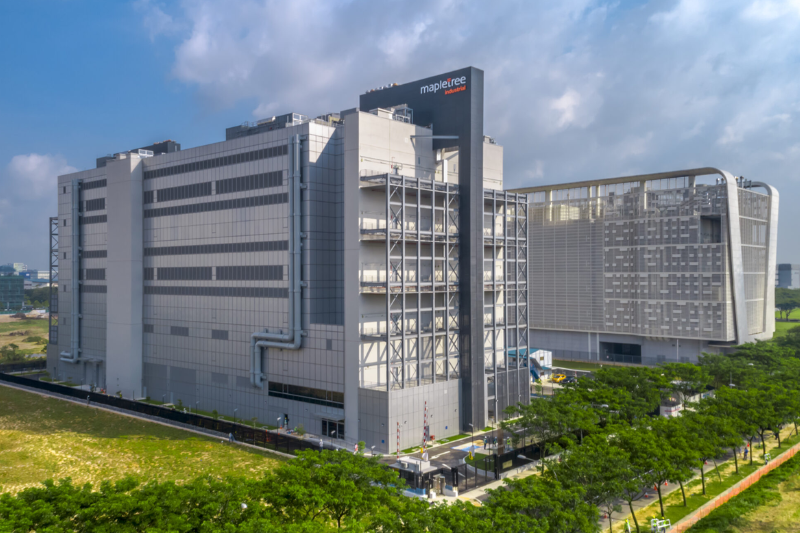
Mapletree Industrial Trust (SGX: ME8U), or MIT – The Industrial Growth Play
MIT owns industrial assets in Singapore and data centres across North America and Japan.
As at 31 March 2026, its portfolio had S$8.3 billion in assets under management.
Its data centre exposure gives MIT a long-term growth angle.
Its North American portfolio had a weighted average lease expiry (WALE) of 6.3 years.
Still, MIT faces near-term pressure, as average overall portfolio occupancy slipped to 91.2% in 4QFY2025/2026.
Singapore performed better, with average occupancy improving to 93.4% and positive rental reversions of about 6.2%.
MIT’s balance sheet remains manageable, with aggregate leverage at 34.0%.
Its interest coverage ratio was 4.0x and borrowing costs fell 19.4% year on year (YoY) to S$84.8 million in FY2025/2026.
FY2025/2026 DPU fell 6.3% YoY to S$0.1271, but excluding divestment gains, the decline was milder at 3.2%.
The manager also plans to divest S$500 million to S$600 million of North American assets.
The proceeds could be redeployed into assets with more sustainable growth.
Lower rates could give MIT more room to refinance debt, recycle capital, and pursue future growth.
Put simply, MIT has growth engines, but it needs better occupancy, cheaper funding, and sharper execution to fire on all cylinders.
Parkway Life REIT (SGX: C2PU) – The Defensive Healthcare REIT
Parkway Life REIT owns healthcare assets in Singapore, Japan, and France.
Its Singapore hospitals are backed by long master leases, giving the REIT stable recurring rental income.
Its balance sheet is also conservative, with aggregate leverage at 33.4% as at 31 December 2025.
Its interest coverage ratio was strong at 8.6x, and its debt is spread across maturities from 2026 to 2032.
This gives Parkway Life REIT room to refinance gradually.
Occupancy is also well-supported, as its Singapore hospitals are leased to Parkway Hospitals Singapore under master leases until 2042.
Full-year DPUs have been steady too, rising from S$0.1408 in 2021 to S$0.1529 in 2025.
Lower rates may not turn Parkway Life REIT into a fast grower, but they could ease refinancing costs and support its steady distribution record.
This healthcare REIT may not race ahead, but it knows how to keep a steady pulse.
Risks to Watch
Lower interest rates give REITs some breathing room, but they aren’t a cure-all.
Rates might stay up longer beyond what anyone expects, and if rentals falter, income drops while empty space piles up.
Discipline matters when REITs go shopping for new properties, too.
Overpaying eats into returns, even if borrowing costs fall.
Macro trends can give a boost, but ultimately, how REITs run their businesses is the key factor.
Get Smart: Falling Rates Create Opportunities, but Quality Still Wins
Lower interest rates could give Singapore REITs a useful boost.
But the real winners will still be REITs with strong balance sheets, quality assets, and disciplined managers.
For income investors, better macro conditions work best when paired with solid fundamentals.
Many Singapore stocks fall behind inflation, which means your money quietly loses strength over time. Dividend stocks have a very different track record. Some continued delivering 6% to 13% every year across the toughest market conditions.
In this FREE report, discover 5 crisis-tested dividend stocks that kept rewarding investors while the market struggled. Download your dividend investing guide now.
Follow us on Facebook, Instagram and Telegram for the latest investing news and analyses!
Disclosure: Joseph G. does not own units in any of the stocks mentioned.