For young professionals, saving your first S$20,000 is no easy feat.
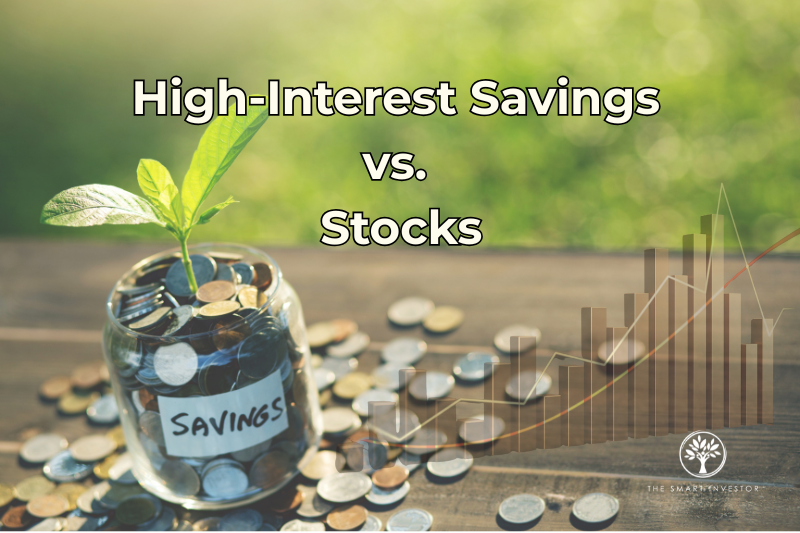
After reaching this milestone, a new question nags: Should you keep this S$20,000 safe or put it to work?
On one hand, high-interest savings are safe and offer certainty.
But, on the other hand, stocks offer potential for higher long-term returns.
Before Investing: Ask Yourself These Three Questions
- Do you have an emergency fund?
Your emergency fund should cover at least three to six months of essential expenses to protect you from having to take on debts or being forced to sell investments at a loss due to a sudden loss of income. These savings should remain easily accessible.
- Do you need the money soon?
Investing means having to stomach market volatility.
If you need that S$20,000 in the near future, whether for further education, a wedding, a home, or other major purchases, investing may not be your best move now.
- What’s your investment time horizon?
The longer your investment horizon, the more suitable stocks generally become as you would have more time to ride out inevitable market downturns.
Option 1: High-Interest Savings Accounts
High-interest savings accounts are designed to preserve your money while earning a predictable return.
Funds can be withdrawn whenever needed without worrying about timing.
These accounts can be used to keep emergency funds or planned expenses within the next few years.
However, their returns may struggle to outpace inflation over extended periods.
Wealth accumulation also tends to be much slower, and interest rates can change over time in response to economic conditions.
For example, the UOB One Account offered an interest rate of up to 4% per annum on balances up to S$150,000, before a series of cuts brought it down to 3.3%, then 2.5%, and to the current 1.9%.
Option 2: Investing in Stocks
Stocks offer the potential for significantly higher long-term returns.
As the profitability of a company grows with its revenue, the value of its stock tends to increase over time.
Dividends also enhance the value of an investment by providing regular income.
For example, UOB (SGX: U11) paid a total dividend of S$1.56 per share for FY2025.
Based on the share price of S$35.06 on 31 December 2025, that is a dividend yield of 4.45%, much higher than the 1.9% interest that UOB One Account offers.
That said, stocks are subject to short-term market volatility.
Prices can rise and fall sharply due to economic conditions, geopolitical events, or investor sentiment.
Selling during bear markets to raise funds can lock in permanent losses.
Stocks also do not provide guaranteed returns, and there is a possibility of losing part, or even all of your investment.
What Could Young Investors Buy?
Young investors with a long investment horizon can look into investing in Singapore blue chips and global Exchange-Traded Funds (ETFs).
Singapore blue chips such as DBS Group (SGX: D05) and Singapore Technologies Engineering (SGX: S63) (STE) offer stability and potential capital appreciation.
DBS is a dependable dividend stock, raising payouts steadily over the years.
For FY2025, the bank paid a total dividend of S$3.06 per share, including S$0.60 in capital return dividends.
Likewise, STE’s share price has risen about 192% over the past five years, from S$3.98 per share to their recent peak of S$11.63 (on 9 April 2026).
Global ETFs like Vanguard Total World Stock ETF (NYSEARCA: VT), offer instant diversification, as it contains nearly 10,000 holdings.
Rather than choosing one or the other, a portfolio combining ETFs and stocks might work in favour of young investors.
Local dividend stocks can take up half of your portfolio, providing income and stability, while global ETFs can make up the rest for growth and diversification.
For young investors, time is your biggest advantage since you have decades for compounding to work.
When dividends are reinvested, they begin generating returns of their own, creating a snowball effect that accelerates portfolio growth.
Furthermore, add to your investments regularly using dollar-cost averaging (DCA).
DCA allows you to invest a fixed amount of money at consistent intervals, regardless of market conditions, reducing market-timing risk.
With time on your side, starting early often matters more than investing larger amounts later.
Common Mistakes Young Professionals Make
Keeping everything in cash forever: Inflation erodes purchasing power. By keeping cash, you buy less with the same amount of money five years down the road.
Investing all their savings immediately: Without any emergency funds, you might end up selling your investments at a bad time to raise cash and lock in permanent losses.
Trying to time the market: Many delay getting started because they want to wait for the “perfect” time. Consistently predicting the best time to invest is impossible. While waiting on the sidelines, you miss growth and compounding opportunities.
Chasing high returns: High yields can hide red flags. New investors who take excessive risks may experience setbacks that discourage them from staying invested.
Who Should Choose Which Option?
High-interest savings accounts might be best suited for investors who are building an emergency fund and need the money within the next one to two years.
Savings accounts are also great for individuals with extremely low risk tolerance as they are capital guaranteed.
Investing in stocks is great for young professionals with stable income, especially those with long-term goals, such as buying a house eight to ten years later.
Those comfortable with short-term market fluctuations are also suited to invest in stocks.
Many investors, however, benefit from a combination of both.
Savings accounts provide flexibility and stability while stock investments provide long-term wealth creation and passive income.
Get Smart: Your First S$20,000 Should Give You Both Security and Growth
There’s no one-size-fits-all answer to whether stocks or savings are better.
Stocks offer the potential to build wealth over the long run while high-interest savings provide security.
For many young professionals, the smartest approach is to use a combination of both to build wealth for long-term financial independence and maintain liquidity for security.
2008. 2020. 2022. Three of the toughest stretches for Singapore markets in a generation. We found 6 SGX companies that paid a dividend every single year through all three. Our free report reveals the six companies and what allowed them to keep paying when others couldn’t. Click here to download now.
Follow us on Facebook, Instagram and Telegram for the latest investing news and analyses!
Disclosure: Wenting A. does not own any stocks mentioned.