Telecom stocks, with their recurring subscription revenue from mobile and broadband, have long been favoured as stable dividend payers.
It comes as no surprise, then, that income-focused investors may have a telecom stock or two in their portfolio.
While most focus on earnings generation to determine dividend sustainability, we think dividend-focused investors should pay more attention to free cash flow (FCF) generation instead.
After all, earnings can be impacted by non-cash items, while FCF is the tangible cash a company has after meeting its obligations.
At the end of the day, the cash dividends you receive are from a company’s FCF.
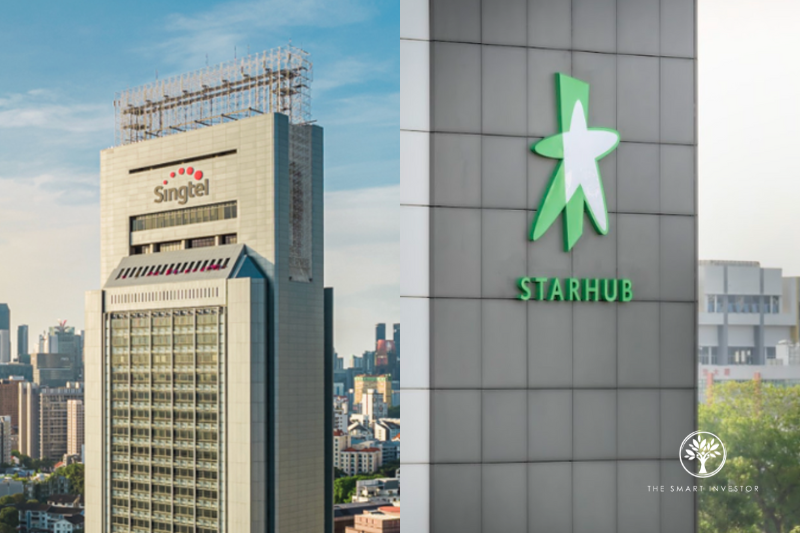
Today, we will compare Singapore Telecommunications Limited (SGX: Z74) and StarHub Ltd (SGX: CC3) to see how these local telecom giants fare in terms of their FCF payout ratios.
Company Overview
Singtel is Singapore’s largest telecommunications company.
Aside from its local telecom operations and its Optus subsidiary in Australia, the group derives a significant portion of its earnings from its associates in regional telcos such as India’s Bharti Airtel and Indonesia’s Telkomsel.
In recent years, Singtel has been making strides in growing its digitalisation offerings through its NCS and Nxera operating segments, providing the necessary infrastructure, such as data centres, to support digitalisation initiatives.
For its latest financial year ended 31 March 2026 (FY2026), Singtel saw stable operating revenue of S$14.3 billion, with underlying net profit up 12% to S$2.8 billion compared to the prior year (on a constant currency basis).
Turning to StarHub, other than providing broadband and mobile services, the group’s top-line profile is increasingly driven by its enterprise cybersecurity and information communication technology (ICT) solutions.
For StarHub’s quarter ended 31 March 2026 (1Q2026), total revenue slipped by around 4% year on year (YoY) to S$507.3 million due to softer pricing seen in its mobile and broadband segments.
Meanwhile, its managed services segment was affected by project recognition timing.
Combined with higher operating costs, StarHub’s net profit slumped by over 81% YoY to S$5.9 million.
Singtel: Is the Dividend Well Supported?
Singtel grew its operating cash flow by 6.7% YoY, coming in at S$4.9 billion for FY2026.
After accounting for a capital expenditure of S$2.5 billion, and dividends received from associates (amounting to S$1.1 billion post-tax), Singtel’s latest annual FCF stood at S$2.4 billion (down roughly 1.5% compared to FY2025).
Against a total annual core dividend paid of roughly S$2.2 billion, the FCF payout ratio stands at roughly 92%.
This figure does not include its value realisation dividend.
Currently, at S$4.41 per share, Singtel offers a trailing dividend yield of roughly 4.2% (including value realisation dividends).
Future core dividend growth is likely to come from increasing FCF generation, alongside the continued recycling of non-core assets (which yielded S$3.9 billion in cash proceeds for FY2026).
Singtel’s balance sheet continues to deleverage, with net debt declining to S$8.7 billion as of 31 March 2026, down from S$9.4 billion a year ago.
StarHub: Does the Cash Flow Tell a Different Story?
Despite the sharp fall in net profits, StarHub still generated S$26.6 million in FCF for 1Q 2026, representing a 17% decline compared to 1Q 2025.
The lower percentage decline in FCF generation compared to net profit highlights the telecom player’s ability to still generate solid cash flows from its earnings.
Looking at its 2025 financials, we find a negative FCF generation of S$24 million against cash dividends paid of S$106.7 million.
Hence, StarHub’s dividend is mainly financed by its cash position (S$867.2 million as of 31 March 2026).
Compared to Singtel, StarHub’s dividend does not appear to be adequately financed by FCF generation, but management is optimistic that its enterprise transformation should result in stronger recurring FCF generation and an eventual normalisation of cash generation following a transitional 2025.
At S$1.02, StarHub offers a higher trailing annual dividend yield of roughly 5.9%.
Beyond Free Cash Flow: Other Factors That Matter
Other than FCF generation, investors will do well to pay attention to other financial metrics.
In particular, focus on balance sheet strength: how does the net debt look?
Can the company service its interest obligations comfortably?
Also, pay attention to the business outlook; can the company’s top line and bottom line continue growing?
Finally, monitor the levels of capital expenditures spent as telecom networks require heavy continuous investments, which could hamper future dividend payments.
Which Company Looks Better for Income Investors?
Investors seeking geographical diversification and a company with a stronger balance sheet can consider owning Singtel.
For those seeking a higher income yield and who are comfortable bearing execution risks, StarHub seems to be a more appropriate choice.
Ultimately, the better-performing company will be the business that can best grow FCF in the next five years.
Common Mistakes Income Investors Make
Do not merely focus on a high dividend yield while ignoring declining business fundamentals such as deteriorating cash generation.
Failing to account for capital expenditure needs could also prove costly for income investors.
Finally, please do not assume that dividends from telecoms are automatically safe; the businesses still have to perform.
Get Smart: Follow the Cash, Not the Yield
In sum, an attractive dividend yield is only as good as the company’s ability to support its payment through FCF generation.
We think that the FCF payout ratio is an underappreciated metric that gives a clear indication of a dividend’s durability.
For income-focused investors, paying close attention to this metric could be hugely rewarding in your income journey.
One of these six companies is the only one legally allowed to operate in Singapore. It has increased its dividend for 16 consecutive years. Discover which one it is in our free report here.
Follow us on Facebook, Instagram and Telegram for the latest investing news and analyses!
Disclosure: Wilson H. does not own shares of any companies mentioned.