The marine and offshore sector has seen a new breath of life recently on the back of strong shipbuilding demand and a revival in energy security concerns, which has facilitated the resurgence of offshore investment.
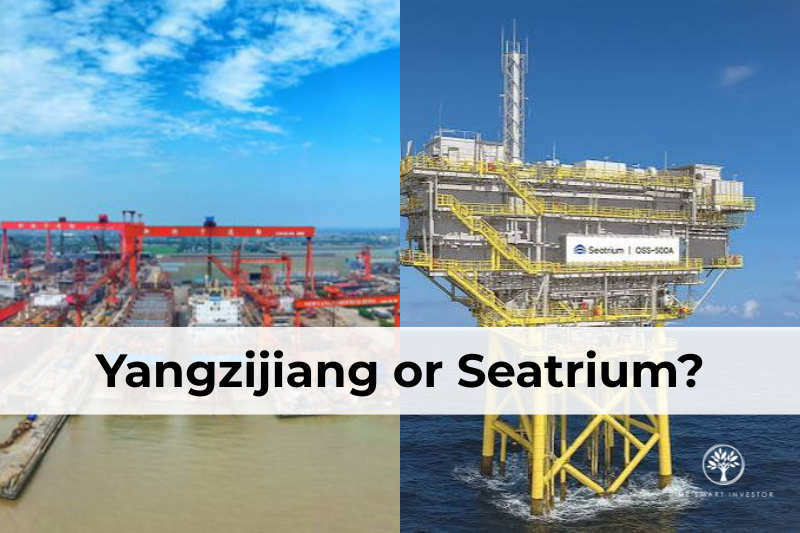
In Singapore, two titans dominate: Yangzijiang Shipbuilding (Holdings) Limited (SGX: BS6), or YZJ, and Seatrium Limited (SGX: 5E2).
The two companies operate in the maritime industry, but they are very different businesses.
Which is a more attractive buy today? Let’s find out.
A Quick Look at the Businesses
YZJ is one of the largest private shipbuilders in China.
The company’s shipbuilding segment focuses mainly on large and medium-sized commercial vessels such as container ships, bulk carriers, and oil tankers.
Its order book value (US$22.3 billion as of 19 May 2026), momentum of new order contracts, and delivery timelines are key metrics for investors to focus on.
Concurrently, YZJ has a ship chartering business where it leases its fleet of vessels to external customers based on spot charter rates.
Meanwhile, Seatrium is more focused on offshore and marine engineering; it is similar to YZJ in that it has a shipbuilding segment as well, but Seatrium mainly produces vessels suitable for offshore energy needs (oil and gas, alongside offshore wind).
The company’s order book is strong, last valued at S$15.5 billion as of 31 March 2026 (1Q2026).
Seatrium also provides services relating to repairs and upgrades, and the conversion of vessels.
In sum, YZJ is more tied to the shipbuilding and chartering cycles, while Seatrium’s performance is more closely linked to energy investment cycles.
The Industry Tailwinds Supporting Both Stocks
Two industrial tailwinds support the operating momentum of the companies.
First, global shipbuilding is seeing strong demand due to the need for ongoing fleet renewal, as a significant portion of the global vessel fleet is ageing and approaching replacement age.
Concurrently, more fuel-efficient vessels are required to comply with stricter environmental regulations.
Then, there’s growing demand for specialised vessels for the transportation of energy fuel.
Second, the ongoing energy transition and the need for more sources of energy have led to a rise in investments in offshore energy infrastructure.
The build-out of offshore energy infrastructure requires specialised engineering expertise and complex marine projects, necessitating the need for specialised vessels.
Why Investors Like Yangzijiang
Since 2021, YZJ’s revenue has risen at a decent 14% compound annual growth rate (CAGR) from US$2.4 billion to US$4.1 billion in 2025.
Growth is likely to continue for the company, given its US$22.3 billion order book already provides roughly five years’ worth of revenue visibility.
From 2021 to 2025, YZJ’s operating margin expanded from 10.9% to 31.3%.
This helped the company deliver an impressive CAGR of 21% for net income, which ended 2025 at US$1.2 billion.
Currently, YZJ boasts a return on equity (ROE) of 29.5% and has a net cash position of US$2 billion as of 31 December 2025.
Finally, YZJ’s trailing dividend yield is attractive at roughly 5.8%.
Why Investors Like Seatrium
On the other hand, Seatrium has largely benefited from the recovery in offshore and marine activity.
The metrics that solidify the company’s performance are its operating margin and net income. Both more than doubled, to 4.1% and S$323.6 million, respectively, in 2025.
ROE is still low at just 4.9%, but it is a step-up from 2024’s 2.25%.
Seatrium’s balance sheet continues to be lightly levered, with a net gearing ratio of 0.1, and the company has S$3.1 billion in available liquidity to tap on if needed.
Finally, the offshore giant increased its annual dividend by 100% in 2025 to S$0.03 per share.
This gives Seatrium a trailing yield of 1.5%.
The Risks Investors Should Consider
The main risks a YZJ investor has to underwrite are its exposure to the Chinese economy and the global shipbuilding cycle.
The latter, in particular, can be highly cyclical.
Meanwhile, Seatrium’s main risks include its ability to execute its projects and possible margin pressure from higher inflationary costs, which could increase the volatility of its earnings.
Valuation: Which Stock Looks More Attractive?
YZJ currently trades at a forward price-to-earnings (P/E) ratio of approximately 7.4x, roughly in line with its five-year historical average.
Should the shipbuilding giant maintain its net income’s CAGR, the current valuation appears undemanding.
Seatrium currently trades at a forward P/E ratio of roughly 14.9x, well below its three-year historical average of 31.9x.
Investors might have priced in Seatrium’s turnaround story with its elevated P/E ratio compared to YZJ; the former has to show serious earnings growth to justify current valuations.
Which Stock Fits Different Investors?
Investors seeking consistent profitability and earnings visibility, alongside steady dividends, can consider YZJ. In our view, it is the stronger business in terms of financials compared to Seatrium.
That said, it does not mean Seatrium is not a buy.
Investors comfortable with higher volatility and turnaround risk, with the potential of increased upside, and who are looking for offshore energy exposure, can consider Seatrium.
Could Investors Own Both?
Or you could always own both: YZJ for exposure to shipbuilding, and Seatrium for exposure to offshore infrastructure.
However, do note that the overarching risk of exposure to the marine sector is exemplified through ownership of both names.
Get Smart: Which Marine Stock Comes Out Ahead?
In sum, while the general industry trends have benefitted both YZJ and Seatrium, each presents a different offering to investors.
YZJ offers stronger profitability, with a more fortified balance sheet and better dividend potential, while Seatrium is a higher-risk but possibly higher-reward turnaround play; the better buy ultimately rests on your risk tolerance and appetite.
If the market falls further, will you be ready… or fully invested?
This is where most investors get it wrong. Our FREE report shows how to stay prepared for what comes next. Get it free here.
Follow us on Facebook, Instagram and Telegram for the latest investing news and analyses!
Disclosure: Wilson.H does not own shares in any of the companies mentioned.