When investors are looking at real estate investment trusts (REITs) for the first time, it’s common to focus on the key metrics such as occupancy rates, distribution yields, or net property income (NPI)
However, not all REITs are the same; there is one underappreciated, yet crucial, factor that investors may not appreciate as much: the sponsor.
A strong sponsor can provide a myriad of benefits: acquisition opportunities, operational expertise, and even financial support – all of which come in handy, especially during tough times.
This is further strengthened if their interests align with those of unitholders (you).
What Makes a REIT High Quality
For a REIT to be of high-quality, other supporting factors come into play, including the presence of a widely diversified property portfolio, underpinned by healthy occupancy rates.
A history of growing rental reversions and distribution per unit (DPU) further strengthens the quality of a REIT.
Add in a solid balance sheet, characterised by a well-staggered debt profile and conservative gearing, and you’ve got a stew going.
Having a strong sponsor helps, but the support works better when paired with a REIT’s solid fundamentals.
CapitaLand Integrated Commercial Trust (SGX: C38U) – The Blue-Chip Commercial REIT
The first REIT on our list should be familiar to many: CapitaLand Integrated Commercial Trust (CICT).
Backed by CapitaLand Investment Limited (SGX: 9CI), or CLI, a leading global real asset manager, CICT is in an enviable position, with ready access to a portfolio of high-quality assets and redevelopment expertise.
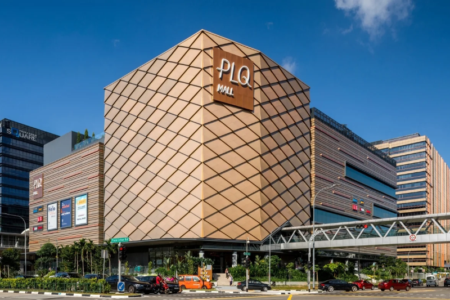
CICT’s portfolio consists of high-quality assets, including Plaza Singapura (slated for asset enhancement), Raffles City, CapitaSpring, and the upcoming acquisition, Paragon.
Having a high-quality portfolio of properties allows CICT to enjoy a strong occupancy rate of 95.2% (as of 31 March 2026).
CICT’s DPU trend has been steadily increasing since 2022 – the REIT paid an annual distribution of S$0.1158 per unit for FY2025.
When backed by a reputable parent company like CLI, a REIT is well-supported to drive asset-enhancement and acquisition initiatives.
Mapletree Logistics Trust (SGX: M44U), or MLT – The Logistics REIT
The sponsor of MLT is none other than Mapletree Investments Pte Ltd.
Other than providing MLT with a healthy pipeline of attractive logistics assets across different geographies, Mapletree Investments also helps manage the REIT’s assets.
Do note that MLT has roughly 78% of its multi-tenanted building leases (by net lettable area) expiring between FY2026/27 and FY2028/29, i.e. by 31 March 2029.
Monitoring the REIT’s progress in announcing new leases to replace these upcoming expiries will be important.
Nonetheless, the REIT’s tenant mix is well-diversified, with the largest tenant only making up 3.7% of the REIT’s gross revenue.
With 175 logistics properties spanning across Asia-Pacific, MLT remains well-positioned to capture the growth of e-commerce.
The key takeaway is that the relevant expertise of a sponsor can help provide a competitive advantage in managing the REIT’s assets.
Keppel DC REIT (SGX: AJBU), or KDCREIT — The Defensive Specialist
KDCREIT’s sponsor, Keppel Ltd (SGX: BN4), certainly knows a thing or two about data centres.
As a global asset manager and operator with strong expertise in infrastructure, real estate and connectivity, Keppel has built deep data centre capabilities – managing assets across Singapore, China, Indonesia, Japan and the Netherlands through its listed REIT and private funds.
This allows the sponsor to provide operational support and a pipeline of opportunities for KDCREIT.
Data centres are the latest multi-year, high-growth industry, given the increasing prevalence of AI, both in Singapore and worldwide.
For its 1Q2026 operational updates, the REIT reported gross revenue up 18.4% year on year (YoY) to S$121.0 million while NPI rose 19.4% to S$105.2 million.
Distributable income increased 20.7% year on year to S$74.6 million, translating to a DPU of S$0.02833, up 13.2% compared to a year ago.
While global uncertainty has increased amid the escalation of the Middle East conflict, structural demand from AI workloads continues to underpin the long-term outlook for data centres.
What Investors Should Still Watch
However, having a strong sponsor is not the be-all-end-all; it merely complements a REIT that already has robust fundamentals.
Risks still exist: poor non-accretive acquisitions, having an overly-leveraged balance sheet, and poor execution can still hamper a REIT’s overall performance.
A robust institutional sponsor provides stability in times of market uncertainty, reinforcing the REIT’s fundamentals and giving investors the confidence to make it a cornerstone of their long-term income portfolio.
Get Smart: Great REITs Rarely Stand Alone
In conclusion, reputable sponsor backing can further elevate a REIT’s status.
Such a sponsor can provide a pipeline of accretive assets, as well as management and operational expertise.
Importantly, they can also provide crucial support for the REIT during market downturns.
Combining a REIT’s already healthy fundamentals with a robust institutional partner can further strengthen the resilience of your income portfolio.
Imagine receiving steady rent increases for more than two decades. It sounds unusual, but one healthcare REIT already has rental escalations locked in until around 2042. Income visibility like this is hard to find today. We break down how this REIT built such dependable cash flow in our FREE dividend report and how it could strengthen a retirement portfolio. Get the free report here.
Follow us on Facebook, Instagram and Telegram for the latest investing news and analyses!
Disclosure: Wilson H. does own shares in any of the companies mentioned.