Your regular cup of Joe just got more costly.
No, I’m not referring to your favourite artisan cafe.
It’s the increasing number of humble neighbourhood coffeeshops raising coffee prices by S$0.10 to S$0.30.
Hikes in coffee prices could be a canary in the coal mine, suggesting a possible shift in the broader food business.
It’s time to stay alert to what it means for other food businesses (even without your caffeine fix).
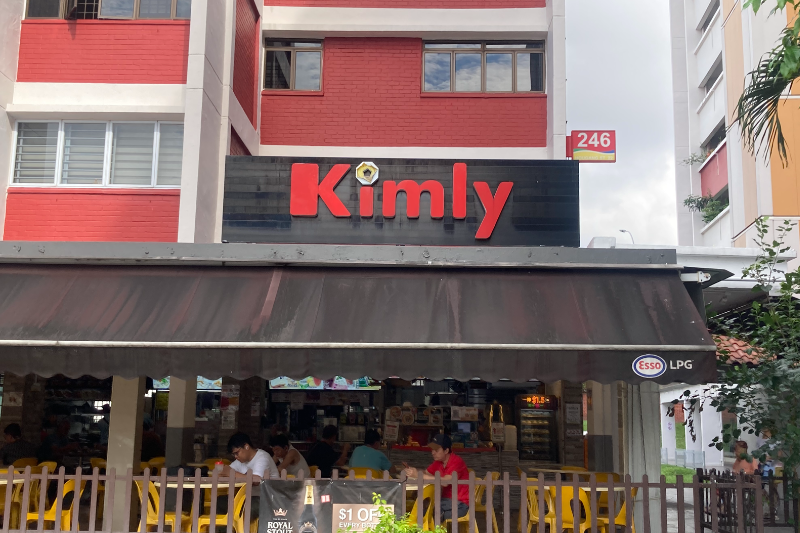
Kimly Limited (SGX: 1D0) – A Pure-Play on Heartland Coffee Shops
One cannot help but wonder when Kimly will join the inflationary trend of raising food prices, with its local footprint comprising 89 food outlets and a total of 195 food retail entities.
It’s a reasonable concern, not just for consumers worried about their wallets, but also for businesses such as Kimly that need to defend their margins against rising costs amid geopolitical tensions.
In its fiscal year ended 30 September 2025 (FY2025), Kimly’s revenue was up marginally by 0.9% to S$322.1 million, while net profit increased modestly by 0.4% to S$33.3 million, reflecting the saturated market of the local food business.
Although growth has been modest, the heartland food anchor has maintained a cash-generative business since 2021.
Crucially, Kimly is pivoting towards acquiring its own coffee shop properties in mature estates, such as Serangoon and Yishun, with strong foot traffic to support long-term scalability of its business.
These strategic moves allow Kimly to maintain a stable business amid volatile leasing costs, and reward shareholders with a total dividend of S$0.02 per share for FY2025, unchanged from a year ago.
Old Chang Kee (SGX: 5ML) – A Play on a Sticky Heritage Brand
When Old Chang Kee, or OCK, opened its first coffee shop selling the humble curry puff in 1956, who would have thought it would go on to clinch the accolade of being one of the world’s 20 best fast-food chains in 2012?
This shows that a business built on local heritage can be sticky, as demonstrated by OCK, having garnered a strong multi-generational following.
For the first half of its fiscal year ending 31 March 2026 (1HFY2026), OCK’s revenue inched up by just 0.2% to S$51.9 million because of inconsistent growth across its outlets.
Notably, OCK operates a high-margin business, with its 1HFY2026 gross margin of 69.3%, although there was a slight 0.1% dip in gross profit to S$36.0 million because of rising food and staff costs.
However, rising operating expenses from asset depreciation and wages caused OCK’s 1HFY2026 net profit to decline 19.3% to S$5.0 million.
Still, OCK ended the first half with a cash balance of S$53.7 million, and minimal debt, providing the financial firepower to reward shareholders with a dividend of S$0.01 per share, unchanged from a year ago.
The company is actively diversifying into non-retail, B2B sectors and scaling its presence in strategic higher-value locations.
For investors, OCK offers a defensive play on a proven multi-generational heritage brand generating steady returns.
Food Empire Holdings (SGX: F03) – Instant Coffee Giant
Food Empire primarily manufactures instant coffee beverages, which are retailed under its award-winning brands of CafePHO and MacCoffee.
Should there be a structural shift in consumer habits from eating hawker food to home cooking, driven by rising food prices that eat into consumers’ wallets, Food Empire is the kind of business that could benefit the most.
In 2025, its revenue surged 21% to US$576.9 million, driving normalised net profit after tax (NPAT) up 37% to US$68.6 million, supported by broad-based growth across all core segments.
Notably, Food Empire’s results were achieved despite having raised prices, demonstrating its pricing power.
Following its enviable performance, Food Empire’s 2025 dividend reached S$0.12 per share, a 50% increase from 2024, and the highest historically.
Food Empire is aggressively expanding its manufacturing capabilities to drive organic growth.
For example, its second spray-dried soluble coffee facility in India, slated for completion in 2027, will increase its output by roughly 60%.
Aside from organic growth, the coffee powerhouse also raised S$41.8 million in cash through share offerings and institutional investments to fund growth opportunities and acquisitions.
Get Smart: One Portfolio, Extra Strong Please
Amid rising food prices exemplified by coffee’s price hikes, Kimly and OCK’s strength lies in their reasonable likelihood of passing on inflationary costs to consumers, benefiting from Singaporeans’ preference to eat out in affordable food outlets.
However, in my opinion, while eating out is culturally sticky for Singaporeans, it’s not functionally indispensable.
Should a new generation of consumers embrace a more functional meal-prep culture, Food Empire’s offerings could become more compelling.
Investors should stay vigilant for potential structural shifts in the heartland economy and prioritise businesses that align with it to build an “extra strong” portfolio – just like your favourite kopi gao.
What if you could collect a steady income from Singapore companies for decades to come? We found one in a near-duopoly with 70%+ market share that’s practically printing money. Our FREE small-cap report uncovers this “hidden monopoly” advantage (plus 4 other dividend powerhouses) that will keep paying no matter what the market does. Click here to grab your copy now.
The world’s gotten unpredictable, but some Singapore companies have quietly kept thriving. You’ve probably seen them in your daily life. And yes, they’ve kept paying dividends through it all. Meet 5 resilient stocks built to navigate global storms. Get the free report here and see how they’ve done it.
Follow us on Facebook, Instagram and Telegram for the latest investing news and analyses!
Disclosure: Larry L. does not own shares in any of the companies mentioned.