When it comes to building an investment portfolio, investors usually assume that they need to choose between income and growth.
High dividend stocks are usually associated with slower growth, while those firms that expand rapidly would rather reinvest their earnings than distribute to shareholders.
But in reality, some businesses manage to deliver both.
1. DBS Group Holdings (SGX: D05)
DBS is a name most Singaporeans are familiar with.
The bank generates income primarily from consumer and corporate banking and wealth management.
In 2025, the bank generated S$22.9 billion in total income, a 3% increase from a year ago. Net profit amounted to S$11.0 billion, which translates to a strong return on equity (ROE) of 16.2%.
In other words, the bank has high profitability.
DBS’s total income growth in 2025 was supported by its consumer banking and wealth management segment, where income rose by 4% to S$10.5 billion.
Meanwhile, institutional banking saw a drop in total income of 3% to S$8.9 billion.
Even as DBS continues to invest in technology and expand its business, it has not forgotten to reward shareholders.
The bank paid a total dividend of S$3.06 per share for 2025, 37.8% higher than 2024’s dividend of S$2.22 per share.
In addition, DBS maintained a fully phased-in CET-1 ratio of 15%, which allows the bank to continue its expansion plans without compromising on its dividends.
2. Singapore Exchange Ltd (SGX: S68)
Singapore Exchange, or SGX, which is behind Singapore’s stock and derivatives market, has also been able to deliver both earnings growth and reliable dividends.
It earns revenue whenever investors trade securities and access financial data, and companies list their shares.
SGX announced operating revenue of S$736.2 million for the first half of FY2026 (1HFY2026) which ended on 31 December 2025, a 7.9% increase year-on-year (YoY).
Its equities (cash) segment is the strongest revenue driver, with a 16.2% YoY jump in revenue to S$226.1 million.
Meanwhile, fixed income, currencies, and commodities grew 14% YoY to S$197.1 million, while equities (derivatives) dipped by 5.2% to S$182.4 million.
Lastly, platform and others contributed S$130.6 million in revenue in 1H FY26, 6.8% more than the year before.
However, SGX’s net profit after tax only inched up by 0.8% YoY to S$342.7 million, mostly because of a sharp drop in non-operating gains and slightly higher tax expenses.
More importantly, SGX continues to generate strong cash flow, with its free cash flow amounting to around S$328.9 million.
For the reporting period, SGX raised its dividends by 20.8% YoY to S$0.2175 per share. The company has projected a total dividend of S$0.445 per share for FY2026, up 18.7% from FY2025’s dividend of S$0.375 per share.
3. CapitaLand Integrated Commercial Trust (SGX: C38U)
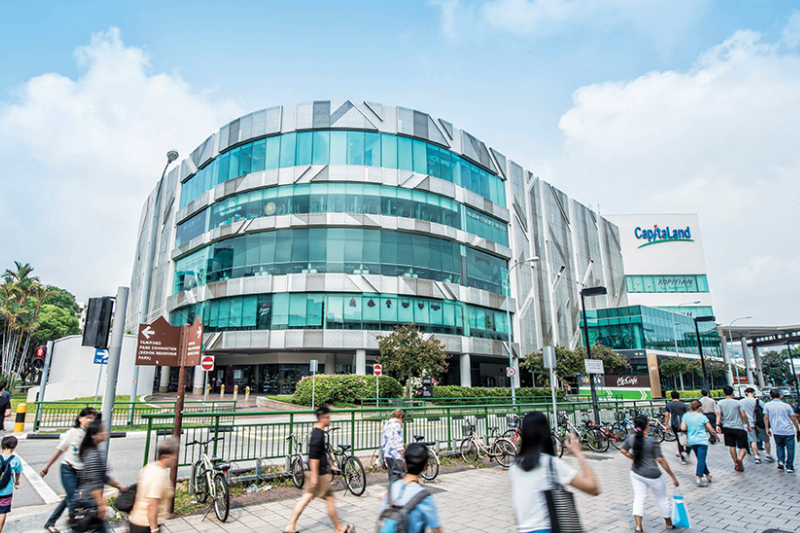
CapitaLand Integrated Commercial Trust, or CICT, is Singapore’s largest listed REIT, with a market capitalisation of around S$17.8 billion currently.
Its properties, which are mostly retail malls and offices, are located in Singapore, Germany, and Australia, and are valued at S$27 billion at the end of 2025.
The REIT’s 2025 revenue grew by 2.1% YoY to S$1.6 billion, while net property income (NPI) rose 3.1% to S$1.2 billion.
CICT’s portfolio committed occupancy remained strong at 96.9% as of 31 December 2025, supported by active asset and portfolio management.
Tenant retention rates in 2025 were at 83.7% for office and 72.7% for retail.
The REIT’s amount available for distribution for 2025 came in at S$870 million, a 14.2% jump from the year before, while the distribution per unit (DPU) increased 6.4% to approximately S$0.1158.
CICT also managed to maintain a healthy aggregate leverage ratio of 38.6% and an acceptable average cost of debt of 3.2%.
In other words, the REIT has the flexibility to pursue acquisition and asset enhancement projects while supporting its distribution.
4. Mapletree Logistics Trust (SGX: M44U)
As at 31 December 2025, Singapore’s first Asia Pacific-focused logistics REIT, Mapletree Logistics Trust (or MLT), owns 174 warehouse and distribution centers across nine key markets.
For the third quarter of FY2025/26 (3QFY25/26), which ended on 31 December 2025, MLT’s gross revenue fell by 3.1% YoY to S$176.8 million. Similarly, NPI slipped 3.3% YoY to S$152.0 million.
But the softer performance was not because of operational inefficiencies. Instead, currency headwinds and loss of rental income from divested properties were the culprits.
Nonetheless, MLT’s lower NPI impacted its distributions, resulting in a 9.3% YoY drop in DPU from S$0.2003 to S$0.1816.
Stronger leasing demands in Singapore, Japan, and South Korea boosted MLT’s overall portfolio occupancy to 96.4%, offsetting weaker contributions from China. The portfolio occupancy of 96.4% is slightly better than the previous quarter’s 96.1%, and the year-ago quarter’s 96.3%.
MLT also managed to achieve a rental reversion of 1.7%, excluding China, where the rental reversion improved sequentially from -3.0% to -2.2%, suggesting early signs of stabilisation.
Even with the near-term headwinds, the REIT maintains a decent 40.7% aggregate leverage ratio and has an interest cover ratio of 2.9.
Although MLT’s short-term performance has been affected by macro factors, its stable occupancy and capital management positions it to balance both growth and consistent dividends.
Get Smart: Growth and Income Can Coexist
The most resilient companies do not need to choose between growth and dividends.
Instead, they balance both – with disciplined capital allocation of course.
But as usual, these companies also come with risks of their own.
For banks and REITs in particular, external factors like currency movements or interest rates can affect earnings.
Take a look at the company’s cash flow and long-term growth strategies instead of just headline dividend yields.
Over time, these resilient businesses can help investors build a portfolio with stable income and long-term capital appreciation.
Some companies cut dividends in a downturn. These 5 didn’t.
Find out which Singapore blue chips have weathered past chaos…and why they could be your portfolio’s anchors in the next wave of downturn. Download the report free.
Follow us on Facebook, Instagram and Telegram for the latest investing news and analyses!
Disclaimer: Charlyn T. owns shares in DBS and SGX.