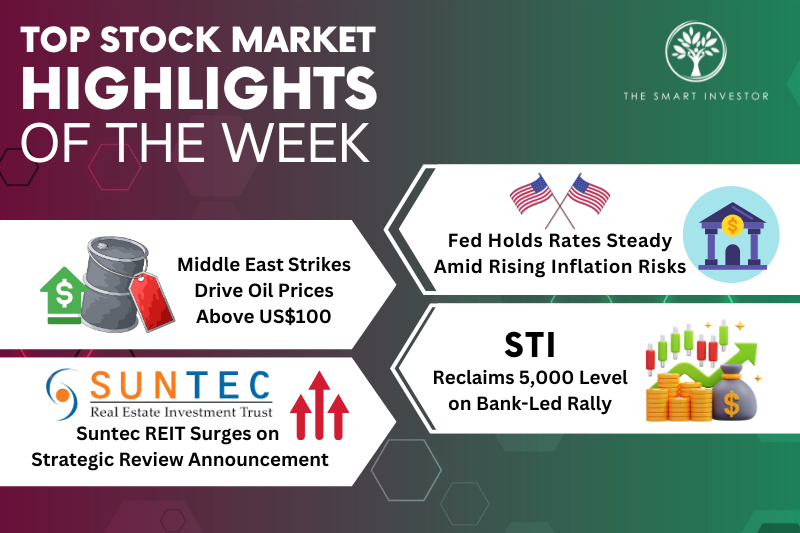
Geopolitics took center stage this week as strikes on Qatar’s energy infrastructure sent oil prices north of US$100, complicating the inflation outlook just as the Fed held rates steady.
But it wasn’t all red screens; the STI reclaimed its 5,000-point crown, proving once again why Singapore’s “Big Three” banks are the bedrock of local portfolios.
Meanwhile, a surprise strategic review sent Suntec REIT (SGX: T82U) units soaring on record volume.
Here is what you need to know about the Fed, the energy surge, the STI’s milestone, and the shakeup at Suntec.
Fed Holds Steady as Inflation Risks Mount
The US Federal Reserve maintained interest rates at 3.5% to 3.75% following its 18 March meeting.
While the “hold” was expected, the updated “dot plot” and inflation forecasts stole the show.
Officials now project PCE inflation to hit 2.7% by year-end, up from previous 2.4% estimates.
Fed Chair Jerome Powell explicitly flagged the Iran-Israel conflict as a primary inflation risk, noting that surging energy costs could hamper progress.
For Singaporean investors, particularly those in yield-sensitive REITs, this “higher-for-longer” caution suggests that the road to rate cuts remains bumpy and data-dependent.
With GDP growth nudged up to 2.4%, the US economy remains resilient, but the Fed is clearly not ready to declare victory over inflation just yet.
Iran Strikes Qatar’s LNG Hub, Sending Energy Prices Higher
Global markets were jolted after missile attacks on Qatar’s Ras Laffan Industrial City caused “extensive damage” to the world’s premier LNG export facility.
This escalation in the Middle East saw Brent crude settle at US$107.38 per barrel on 18 March, with some intraday spikes clearing the US$111 mark.
With the Strait of Hormuz—a transit point for 20% of global seaborne oil—facing severe constraints, analysts warn that US$130 oil could be on the horizon.
As a net energy importer, Singapore faces immediate inflationary pressure.
Investors should keep a close eye on transport and utility costs, as prolonged energy volatility could weigh on corporate margins across the STI.
STI Closes Above 5,000 for First Time in Three Weeks
The Straits Times Index (SGX: ^STI) demonstrated remarkable resilience this week, reclaiming the psychologically vital 5,000-point level.
After hitting a historic high of 5,041 in February, the index had dipped amid the initial “Hormuz Shock”.
However, a robust recovery led by the “Big Three” local banks – DBS Group Holdings Ltd (SGX: D05), Oversea-Chinese Banking Corp Ltd (SGX: O39), and United Overseas Bank Ltd (SGX: U96) – pushed the benchmark back into the green.
The STI is currently up approximately 28% year on year, outperforming many regional peers.
This strength is underpinned by Singapore’s solid 4.8% GDP growth in 2025 and a tight labor market.
While geopolitical risks remain the primary wildcard, the index’s ability to stabilize above 5,000 suggests strong underlying confidence in Singapore’s blue-chip fundamentals.
Suntec REIT Surges on Strategic Review News
Suntec REIT became the talk of the town this week, with its units climbing 4.3% to close at S$1.41 on heavy trading volume.
The surge followed an announcement from its new sponsor, Tang Organization, which plans to undertake a comprehensive strategic review of the REIT’s portfolio.
The market responded with significant enthusiasm, as S$577.7 million worth of units changed hands, making it the most actively traded stock by both volume and value on the Singapore Exchange (SGX: S68) that day.
The review aims to “strengthen portfolio performance and enhance capital efficiency,” exploring disciplined approaches to asset optimization and recycling.
Analysts suggest this could involve asset enhancement initiatives at Suntec City Mall or even divesting non-core assets in Australia to improve portfolio quality.
For investors, the big draw is the potential to narrow the REIT’s significant trading discount – which sits at 20% to 30% of its net asset value – and support higher distributions in the coming years.
While the shift in ownership has already seen leadership changes, the primary focus remains on long-term balance sheet strength.
What if every stock trade in Singapore puts money in your pocket? One company earns whenever the market moves. Its free cash flow has grown close to 10% a year, and dividends are set to rise 40% over the next three years. Our free 2026 Dividend Playbook reveals this legal monopoly. Download it for free now.
Follow us on Facebook, Instagram and Telegram for the latest investing news and analyses!