The demand for data centers has been skyrocketing in recent years as the world embraces AI and increasing digitalisation.
With legs to go for these trends, investors may be wondering if there’s a way to get exposure.
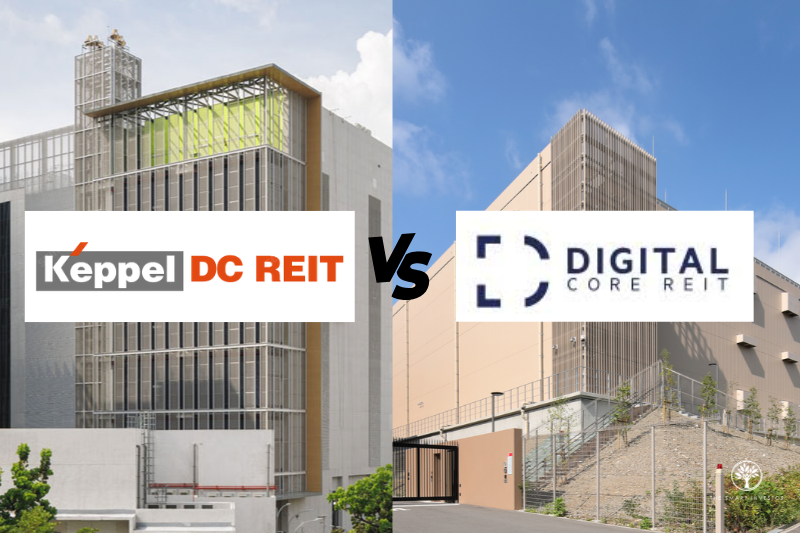
Listed on the local exchange are two names that investors often compare: Keppel DC REIT (SGX: AJBU) and Digital Core REIT (SGX: DCRU).
In this article, we examine which of the two presents a stronger buy.
Business Overview
Although both REITs are in the business of owning and operating data centers, there are some key differences between them.
Keppel DC REIT is the oldest data center REIT listed in Singapore, with its IPO held a dozen years ago in 2014. Its portfolio is mainly in Asia-Pacific (84.5% of assets under management), with the remaining (15.5% of assets) in Europe.
As of 31 December 2025, Keppel DC REIT’s portfolio of data centers is valued at S$6.3 billion.
Keppel DC REIT also has strong sponsor backing from Keppel Limited (SGX: BN4).
On the other hand, Digital Core REIT’s IPO was more recent, in 2021.
With assets valued at roughly S$2.3 billion as of 31 December 2025, Digital Core REIT’s portfolio is spread across North America (accounting for 52% of annualised rent), Europe (28%), Asia Pacific (10%), Latin America (5%), and Africa (5%).
Similarly to Keppel DC REIT, Digital Core REIT has strong sponsor support too; Digital Core REIT’s sponsor is Digital Realty (NYSE: DLR), which is the largest global provider of data center services.
Portfolio Comparison
Taking a deeper look at each REIT’s assets, we find that Keppel DC REIT has 25 properties, which is significantly higher than Digital Core REIT’s 11.
The tenant quality of both REITs is high, with them counting global hyperscalers and top cloud companies among their top 10 clients.
These tenants have strong balance sheets and free cash flow generation abilities.
But there is customer-concentration.
The clients from the two categories account for 60% or more of rental income for both REITs.
Overall occupancies are also robust: Keppel DC REIT’s came in at 95.8% as of 31 December 2025, while Digital Core REIT’s was 97%.
Both REITs ended FY2025 with long lease expiries: Keppel DC REIT and Digital Core REIT reported weighted average lease expiries (WALEs) of 6.7 years and 4.6 years, respectively.
With the long WALEs giving decent rental visibility over the next few years, coupled with a high-quality tenant base, both REITs’ future earnings seem secure and stable.
Financial Snapshot
Now let’s look at the REITs’ financials.
Digital Core REIT’s unit price of US$0.49 is near a 52-week low and gives it a market capitalisation of US$646.7 million.
The REIT’s distribution per unit (DPU) of US$0.036 for FY2025 gives it a trailing yield of roughly 7.3%.
Although Digital Core REIT’s net property income (NPI) had strong growth of 43.5% in FY2025, its DPU was flat.
Digital Core REIT operates with a lean balance sheet, with an aggregate leverage ratio of 37.1%.
The cost of debt is also manageable at 3.5%, with little refinancing pressure until 2029 (when US$162 million, or 24% of total debt, comes due).
Interest coverage for the REIT is also decent at 3.5 times.
Coming to Keppel DC REIT, we see the following: Its unit price is near a 52-week high of S$2.30, which gives it a market capitalisation of S$5.6 billion.
Unlike Digital Core REIT, Keppel DC REIT’s NPI and DPU have been increasing over the past two years.
With its DPU of S$0.10381 for FY2025, Keppel DC offers a trailing yield of 4.5%.
Keppel DC REIT has an aggregate leverage ratio of 35.3%, with an interest coverage ratio of 7.5 times.
Cost of debt is low at 2.8%, and the debt-maturity wall happens only in 2029 and 2030.
Growth Drivers & Key Risks
Growth can come in different ways for both Digital Core REIT and Keppel DC REIT, including third-party acquisitions, acquisitions from sponsor pipelines, and increased rental for its data centers from the secular growth trends of digitalisation.
But higher interest rates can pressure both REITs’ DPU.
Furthermore, unique to both REITs, there is a risk of technological obsolescence as data centers increasingly grow in sophistication, which might require upgrading for these REITs.
Should the excitement surrounding AI recede, the valuations of their data center assets could also come under pressure.
Valuation Comparison
With a price-to-book (P/B) ratio of 1.35, Keppel DC REIT is trading at a premium compared to Digital Core REIT with its estimated P/B ratio of 0.6.
As mentioned earlier, Keppel DC REIT also has a materially lower dividend yield compared to Digital Core REIT.
Meanwhile, the broader S-REIT universe offers an average yield of around 5.7% and an average P/B of 1.
Compared to the averages, Digital Core REIT appears to be more of a bargain than Keppel DC REIT.
Which REIT Fits Which Investor?
One key difference between the REITs is their geographical exposure, mainly North America for Digital Core REIT and Asia-Pacific for Keppel DC REIT.
Keppel DC REIT might appeal to investors looking for a more stable name (given its larger size) and a longer operating record.
For investors fine with taking slightly higher risk in exchange for possibly stronger growth, Digital Core REIT might be more suitable.
Get Smart: The REIT to Choose Depends On Your Risk Appetite
In summary, we covered two data center names in this article (Digital Core REIT and Keppel DC REIT), which are primary beneficiaries of the AI and digitalisation growth trends.
The choice between each name to include in your portfolio depends on whether you’re looking for something more stable and exposed to Asia-Pacific, or something that has stronger growth and is more exposed to North America.
For the former, Keppel DC REIT is more suitable, while the latter is ideal for Digital Core REIT.
What are the stock secrets to Singapore’s “quiet millionaires?” Chances are, you’ll find at least one of their favourites in this free report. Download it now and see how these stocks could power your portfolio!
Follow us on Facebook, Instagram and Telegram for the latest investing news and analyses!
Disclosure: Wilson.H does not own shares in any of the companies mentioned.