Investors often fixate on the flashing red and green of the Straits Times Index (SGX: ^STI), but when global energy arteries like the Strait of Hormuz face renewed tension, those flashing lights often turn into a warning.
In such uncertain times, the psychological comfort of steady dividends provides more than just income – it offers the patience to stay invested for the long haul.
True defensive strength isn’t found in optimistic earnings projections or growth stories, but in the cold, hard reality of free cash flow and a fortress-like balance sheet that remains unmoved by geopolitical tremors.
Here are three SGX-listed companies that meet those criteria.
VICOM (SGX: WJP)
VICOM stands as a prime example of a business with a wide, defensive moat.
As Singapore’s dominant vehicle inspection operator, it commands a staggering 73% market share, a position that makes it more of a utility than a discretionary service.
For the full year ended 31 December 2025 (FY2025), the company delivered a headline performance, with revenue surging 40.1% year on year (YoY) to S$167.4 million and profit attributable to shareholders jumping 45.1% to S$42.5 million.
These numbers were largely fuelled by the massive On-Board Unit (OBU) installation project for ERP 2.0.
While this project is now substantially completed, it has left VICOM with a formidable treasure chest.
The true story, however, lies in the cash flow.
Capital expenditure rose to S$39.0 million for the year, causing free cash flow to dip 16.8% to S$19.2 million.
This dip needs some context.
The core business did not weaken; instead, management was pouring resources into a defined infrastructure project with a finite timeline.
As at 31 December 2025, VICOM held S$57.9 million in cash with no debt on its books — meaning it funded the entire investment from its own resources without touching a credit line.
This financial fortitude allowed management to reward shareholders with a total payout of S$0.084 per share, representing a 44.8% increase from the previous year and a yield of 4.8% at a share price of S$1.74.
As capital expenditure normalises and the new integrated testing hub at Jalan Papan goes live in late 2026, VICOM is positioned to turn that accounting noise into consistent, crunchy cash flow once again.
Old Chang Kee (SGX: 5ML)
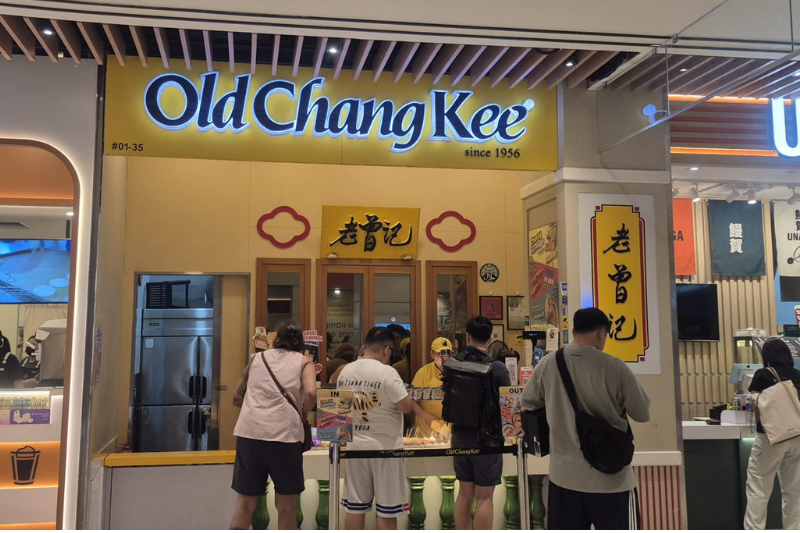
Singaporeans are probably familiar with this household name, but not many know that it has mastered the art of turning a simple curry puff into a cash-generating machine.
Yet, even local favourites aren’t immune to the current inflationary environment.
For the six months ended 30 September 2025 (1HFY2026), Old Chang Kee (OCK) reported a mixed bag: revenue edged up 0.2% to S$51.9 million, but net profit slid 19.3% to S$5.0 million.
The culprit came in the form of a “triple threat”: rising food costs, wage increases tied to Singapore’s progressive wage model, and higher depreciation from new outlet investments.
Gross margins were squeezed down to 69.3%, and free cash flow followed suit, falling 20% to S$8.8 million.
While these headwinds might make some investors nervous, OCK’s balance sheet is as stuffed as its signature Curry’O.
The company held S$57.3 million in cash against a tiny S$1.0 million in debt as of September 2025.
This net cash position of S$56.3 million is extraordinary for a business of its size, providing a massive safety net that can absorb structural cost increases without threatening the dividend.
At a share price of S$1.15, the trailing yield of 1.7% might seem modest compared to high-yield REITs, but the security of the payout is unparalleled.
Management has explicitly flagged that this cash pile gives OCK the optionality to hunt for acquisitions.
For investors, this means OCK isn’t just a defensive play; it’s a coiled spring waiting for the right moment to expand, all while keeping the interim dividend of S$0.01 per share firmly intact.
QAF Limited (SGX: Q01)
QAF Limited, the name behind the ubiquitous Gardenia bread, recently gave investors a masterclass in why you should never judge a book – or a stock – solely by its cover.
For the first half of 2025 (1H2025), QAF reported a shocking 69% drop in profit to S$3.9 million.
However, a closer look at the cash flow statement revealed a different reality: free cash flow actually improved by 13% YoY to S$11.5 million.
The “loss” was almost entirely driven by non-cash accounting items, including S$3.0 million in foreign currency translation losses from a fluctuating Australian dollar and various impairments on its Malaysian joint venture.
Crucially, these impairments didn’t take a single cent out of QAF’s bank account.
As of 30 June 2025, the company sat on a mountain of cash totalling S$188.6 million, offset by a measly S$6.9 million in debt.
This gives QAF a net cash position of S$162.4 million – a figure so large it represents a significant portion of its total market capitalisation.
This cash fortress allowed management to maintain an interim dividend of S$0.01 per share, translating to a trailing yield of 5.1% at a share price of S$0.99.
While the company faces a challenging consumer environment, its ability to generate cash while its accounting profits are bogged down by currency shifts makes it a quintessential defensive pick.
QAF is the financial equivalent of a sturdy loaf: it may face some external pressure, but its core remains solid, resilient, and ready to feed your portfolio’s income needs.
Get Smart: Cash Flow Is the Ultimate Anchor
Profit is an opinion, but cash is a fact.
Think of a company’s reported earnings like a flashy social media profile – it’s easy to apply “filters” through accounting adjustments and non-cash impairments that mask the true story.
But focus on free cash flow and net cash positions, and you can find businesses capable of sustaining their payouts to shareholders.
A robust balance sheet is the ultimate insurance policy, ensuring your retirement goals remain on track regardless of temporary tremors in global maritime corridors or the resulting market jitters.
You walk past million-dollar opportunities every single day. Your coffee shop. Your commute. Your grocery run. But these “boring” Singapore companies are quietly building fortunes while everyone chases crypto and overpriced tech stocks. Our latest report reveals 5 small-cap goldmines hiding in plain sight. Click here to download for free now before prices catch up.
Follow us on Facebook, Instagram and Telegram for the latest investing news and analyses!
Disclosure: Calvina L. does not own any of the stocks mentioned. Chin Hui Leong contributed to the article and owns shares of VICOM.