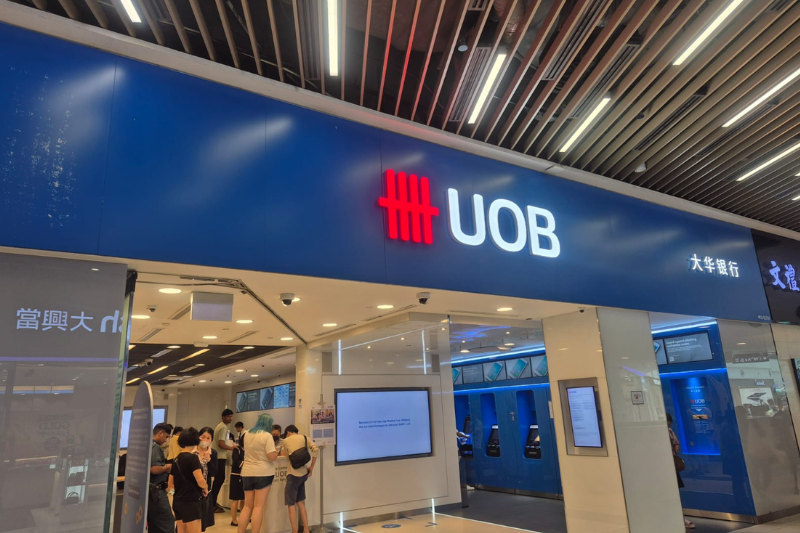
As the “higher-for-longer” interest rate environment of the past few years began to plateau in 2025, Singapore’s banking giants faced a critical test of their business models.
The shift toward lower benchmark rates and competitive pricing has placed pressure on traditional lending margins.
However, the latest fiscal year results from United Overseas Bank Ltd (SGX: U11) and OCBC Ltd (SGX: O39) suggest that these institutions are successfully pivoting toward fee-based income and wealth management to sustain their growth trajectories.
UOB: Fortifying the Foundation
United Overseas Bank (UOB) navigated a complex FY2025 by prioritizing balance sheet strength.
The bank reported a total income of S$13.8 billion, a 3% decline from the previous year.
This was largely driven by a 3% dip in net interest income (NII) to S$9.4 billion as its net interest margin (NIM) narrowed by 14 basis points to 1.89%.
Despite this margin compression, UOB demonstrated the resilience of its regional franchise, with gross customer loans growing 4% to S$352.2 billion.
The standout performer for UOB was its net fee and commission income, which reached a record S$2.6 billion, up 7%.
This growth was fueled by an 18% surge in wealth management fees and a 13% rise in loan-related fees.
However, a 15% drop in other non-interest income – reflecting a normalization of trading and investment gains – led to a 4% ease in operating profit before allowances.
Most notably, UOB’s net profit fell 23% to S$4.7 billion.
This sharp decline was a deliberate strategic move, as the bank set aside S$2.0 billion in total allowances.
These pre-emptive provisions were made to strengthen the balance sheet against macroeconomic uncertainties, even as the non-performing loan (NPL) ratio remained steady at 1.5%.
Shareholders will receive a total dividend of S$1.56 per share for the year, compared to S$1.80 in FY2024.
OCBC: Record Breaking Diversification
OCBC delivered a record-breaking performance in FY2025, proving the efficacy of its diversified financial services model.
The group reported a record total income of S$14.6 billion, a 1% increase year on year.
While its NII fell 6% to S$9.2 billion due to a 29-basis-point compression in NIM to 1.91%, the bank successfully cushioned this with a robust 9% growth in constant-currency customer loans, totaling S$341.1 billion.
The bank’s non-interest income engine was the primary growth driver, surging 16% to S$5.5 billion.
Record performances were seen across the board: net fee income climbed 22% to S$2.4 billion (led by a massive 34% jump in wealth fees) while insurance income from Great Eastern Holdings grew 17% to S$1.1 billion.
OCBC’s asset quality remained exceptionally high, with an NPL ratio of just 0.9% for seven consecutive quarters.
Despite a 2% dip in net profit to S$7.4 billion, primarily due to higher tax expenses from global minimum tax rules, OCBC maintained strong capital returns.
The Board proposed total dividends of S$0.99 per share for FY2025, including a S$0.16 special dividend.
This represents a 60% payout ratio, complemented by a S$2.5 billion capital return plan targeted for completion by 2026.
Get Smart: The Bottom Line
The transition to a lower-rate environment is here, but Singapore’s banks are far from vulnerable.
OCBC’s record non-interest income growth proves that its “One Group” strategy is paying off, with wealth management now contributing 38% of its total income.
Meanwhile, UOB is playing a prudent long game, using record fee income to fund massive pre-emptive provisions that shield it from future volatility.
For investors, the focus shifts from margin expansion to how well these lenders can capture rising Asian wealth flows – a race that both banks appear well-positioned to win.
Many Singapore stocks fall behind inflation, which means your money quietly loses strength over time. Dividend stocks have a very different track record. Some continued delivering 6% to 13% every year across the toughest market conditions.
In this FREE report, discover 5 crisis-tested dividend stocks that kept rewarding investors while the market struggled. Download your dividend investing guide now.
Follow us on Facebook, Instagram and Telegram for the latest investing news and analyses!
Disclosure: The Smart Investor owns shares of OCBC.