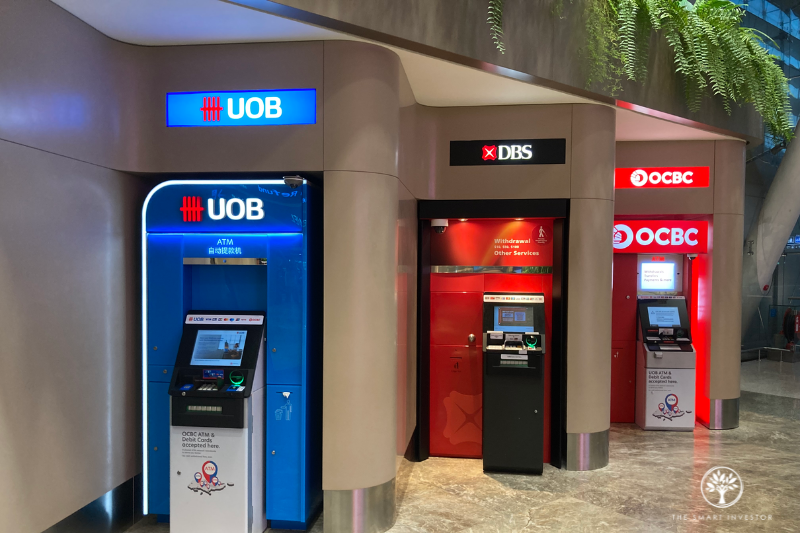
Singapore’s big three banks are trading near record levels, leaving dividend investors with a familiar dilemma: buy now or wait for a pullback?
As of last Friday, shares of DBS Group (SGX: D05) and Oversea-Chinese Banking Corporation (SGX: O39) were within touching distance of their all-time highs.
United Overseas Bank (SGX: U11) trails slightly further but remains within 6.2% of its peak.
Measured by price-to-book (P/B) ratio, all three banks are trading above their historical averages.
DBS currently commands a P/B of about 2.4 against its long-term average of 1.45. OCBC trades at around 1.6 versus an average of 1.1, while UOB fetches a ratio of about 1.3 compared to its historical norm of 1.1.
At these valuations, can Singapore banks still deliver for income-focused investors?
The Earnings Picture is Shifting
Banks generate revenue from two main sources: net interest income (NII) from lending, and non-interest income from activities such as wealth management, card fees, and remittances.
The outlook for NII is becoming more challenging.
Net interest margins are compressing as interest rates ease, which means banks earn less on each loan.
While cheaper borrowing costs should eventually spur loan growth, this offset takes time to materialise.
OCBC has guided for NII to fall by mid-to-high single digits in 2025 — we’ll get the confirmation once the bank reports its earnings.
DBS expects its NII to dip slightly in 2026.
The silver lining is that non-interest income is helping cushion the decline.
Wealth management and fee-based businesses are picking up the slack, providing diversification that matters during this transition period.
Dividends Remain Attractive
Despite the valuation concerns, the trailing dividend yields tell a compelling story.
DBS and OCBC both offer yields of around 4.9%, while UOB leads the pack at 5.6%.
However, investors should note these figures include special dividends and capital return components funded by excess profits accumulated over the past two to three years.
As banks navigate the NII transition, dividend sustainability will hinge on how effectively their non-interest businesses can offset lending headwinds.
We have already seen UOB and OCBC trim their interim dividends.
DBS, meanwhile, has weathered the interest rate decline better and may even increase its payout.
That said, DBS also trades at a significantly higher multiple than its peers.
The Waiting Game has Costs Too
For those contemplating whether to buy now or hold off, consider the trade-offs involved.
If you buy today, you collect dividends immediately but accept the risk of share prices falling.
If you wait, you might secure a better entry point, but nobody knows when that opportunity will arrive.
In the meantime, you forgo income while sitting on the sidelines.
Here is a useful perspective: you do not have to choose one or the other.
You can buy a little today and add more if prices decline.
No one is rushing you, and your success as an investor does not hinge on a single decision made today.
Some may look back at 2020 when DBS traded between S$18 and S$19 and call it a golden buying opportunity.
But remember the uncertainty at that time: MAS instructed banks to slash dividends by 60%, and vaccines were merely a hope on the horizon.
As bestselling author Morgan Housel aptly puts it: Every past market decline looks like an opportunity. Every future decline looks like a risk.
Get Smart: Have the Right Expectations
If you are waiting for Singapore bank stocks to trade at book value before buying, understand what that implies.
DBS’s current net book value stands at S$24.28.
The last three occasions when DBS traded at book value were during the 2008 Global Financial Crisis, the 2014 oil price collapse, and the 2020 pandemic.
If you find yourself fearful about buying today, you may not summon the courage to act when prices genuinely tumble.
The key is to enter with the right expectations.
Focus on what you can control: your allocation, your time horizon, and your commitment to owning quality businesses for the long term.
We’ve found 5 SGX-listed dividend stocks with strong track records in turbulent markets. If you want consistency in an uncertain world, start here.
Follow us on Facebook, Instagram and Telegram for the latest investing news and analyses!
Disclosure: Chin Hui Leong owns shares of DBS Group, OCBC, and UOB.