Long-term financial planning often feels like juggling responsibilities while securing your future.
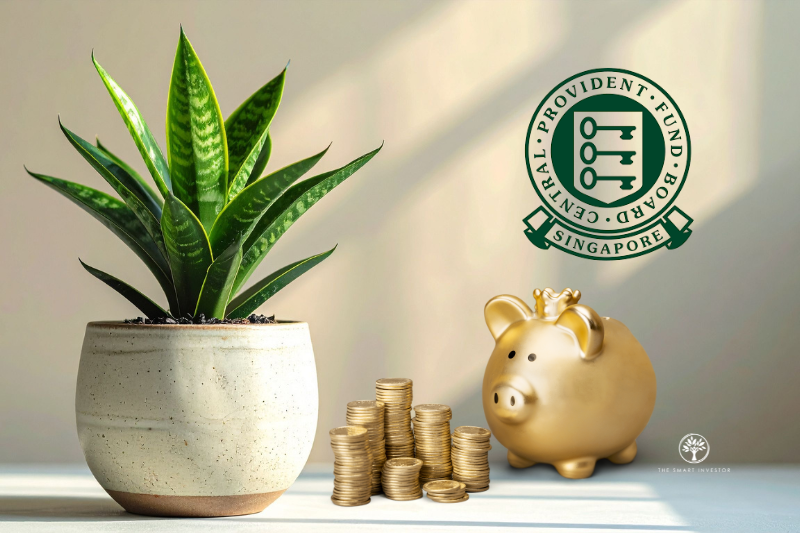
Most Singaporeans rely on CPF savings for retirement as it offers guaranteed, risk-free growth.
However, CPF does not provide the same wealth-building potential that stock investing offers, though stocks carry market-related risks.
The real challenge is not just relying on one, but how to skillfully combine both strategies to build a solid portfolio for steady and sustainable wealth.
Understanding the Basics: CPF vs. Stock Investing
Set by the Singapore Government, CPF savings earn guaranteed interest from 2.5% to 4% annually.
Safe and low-risk, CPF provides stable returns but can be limited when it comes to long-term wealth accumulation.
While you can use CPF savings to pay for housing and healthcare, you can only liquidate these funds for cash after you turn 55.
In contrast, equity returns are variable and dependent on various factors such as investors’ understanding of the stocks and market cycles, consistent investment strategy, risk tolerance, and investment horizon.
Stocks offer potential capital appreciation and dividends that can outpace inflation over time, but market volatility can also cause investors to lose their investments.
CPF gives security and stability, while stocks offer growth and flexibility.
The Secret Formula: CPF + Stocks = Balanced Long-Term Growth
When it comes to investing for the long term, CPF and stocks are not an either/or strategy.
The secret formula for a balanced long-term growth lies in using CPF as a safety net and stocks as a growth engine.
Stability from CPF savings allows investors to take calculated risks through stock investing, which can potentially accelerate wealth accumulation.
Here are three steps to balance long-term growth with CPF and stocks.
Step 1: Maximise CPF Contributions First
CPF currently offers floor interest rates of a minimum of 2.5% interest p.a. for Ordinary Account (OA), and 4% interest for Special Account (SA) and Retirement Account (RA).
By fully optimising your CPF savings, you secure a base of guaranteed, low-risk retirement savings.
Leverage tax-deductible top-ups to your SA or RA (noting these are one-way transfers) to maximise compounding.
CPF’s guaranteed returns eliminate market risks, which can be especially appealing for conservative investors who prioritise capital preservation.
When you have a solid CPF foundation, there is less pressure on your equity portfolio during volatile periods.
Step 2: Allocate Extra Funds to Stocks
Beyond using cash, you may also utilize the CPF Investment Scheme (CPFIS) to invest OA savings exceeding $20,000 and SA savings exceeding $40,000.
Surplus cash after maximising CPF can be channelled into equities for higher returns.
Look into companies with sound finances and reliable dividend records to invest in for retirement.
Quality companies include DBS Group Holdings (SGX: D05), Singapore’s largest bank; Parkway Life REIT (SGX: C2PU), a healthcare REIT with long-term leases; and SBS Transit (SGX: S61), Singapore’s largest public bus operator.
Step 3: Ensure Liquidity & Diversification
While CPF funds are reserved for retirement and have limited access before age 55, you can always adjust stocks to fit your needs.
Investors can cut risks by investing in different sectors and countries, and by spreading their investments in a collection of blue-chip stocks, REITs, and ETFs.
Combine dividend stocks, which provide a steady source of cash, and growth stocks, which help in capital appreciation, in your portfolio.
A diversified portfolio protects you from panic-selling during market downturns and keeps your long-term investment strategy intact.
Managing Risk: Why Diversification and Consistency Matter
In investment, there is always risk.
However, you can manage the risks through diversification and consistency.
While building your investment portfolio, pick both local and international stocks that have a solid financial history and competent management.
By diversifying your investment, you minimise over-exposure and over-reliance on a single company, sector, or geography.
A mixture of long-term growth sector stocks, which include healthcare, technology, and green energy, along with REITs and ETFs, is ideal.
Strategic consistency, achieved through Dollar-Cost Averaging (DCA), helps smooth out market volatility.
With DCA, you become disciplined in your investment and can focus on your investment objectives for the long term.
How to Fine-Tune Your Portfolio as You Approach Retirement
As you near retirement, capital preservation becomes more important than chasing high returns.
Begin by cutting back on the riskier portion of your portfolio and reallocating towards more income-generating and defensive assets.
Allocate more towards strong dividend stocks such as DBS and Singapore Exchange (SGX: S68), or bonds and Treasury Bills (T-Bills).
Use tax-efficient schemes, such as the Supplementary Retirement Scheme (SRS), to maximise returns while minimising tax liabilities.
Review your portfolio annually and ensure your investments still match your investment horizon, lifestyle needs, and risk exposure.
The goal is to reach retirement with a solid CPF savings base and a well-managed investment portfolio that can support your golden years and legacy plans.
Get Smart: Maximise and Diversify
Balancing CPF and stocks is not a binary choice; it is a pursuit of synergy.
Understanding the unique benefits of each and integrating the two is what matters.
The secret formula is to maximise your CPF savings, then use the extra funds to build a strategic stock portfolio for long-term wealth accumulation.
Through both, you are likely to achieve your desired financial independence with a portfolio that stays robust as you navigate through the different stages in life.
Remember, diversification, consistency, and risk management are the pillars of a successful strategy.
Don’t let market uncertainty hijack your financial dreams. While headlines scream gloom, 5 Singapore companies have been quietly building wealth and paying reliable dividends. You’re probably overlooking them. Discover these resilient giants and their secrets to sustained income, even through global storms.
Click here to download your free report now and secure your financial future!
Follow us on Facebook, Instagram and Telegram for the latest investing news and analyses!
Disclosure: Wenting does not own shares in any of the companies mentioned.