Warren Buffett probably has the most concise yet the best explanation of how to value a stock. He said: “Intrinsic value can be defined simply: it is the discounted value of the cash that can be taken out of a business during its remaining life.”
This is how all stocks should theoretically be valued. In a perfect market where cash flows are certain and discount rates remain constant, all stocks should provide the same rate of return.
But this is not the case in the real world. Stocks produce varying returns, allowing investors to earn above-average returns.
Active stock pickers have developed multiple techniques to try to obtain these above-average returns to beat the indexes. In this article, I’ll go through some investing styles, why they can produce above-average returns, and the pros and cons of each style.
Long-term growth investing
One of the more common approaches today is long-term growth investing. But why does long-term investing outperform the market?
The market underestimates the growth potential
One reason is that market participants may underestimate the pace or durability of the growth of a company.
Investors may not be comfortable projecting that far in the future and often are only willing to underwrite growth over the next few years and may assume high growth fades away beyond a few years.
While true for most companies, there are high-quality companies that are exceptions. if investors can find these companies that beat the market’s expectations, they can achieve better-than-average returns when the growth materialises. The chart below illustrates how investors can potentially make market-beating returns.
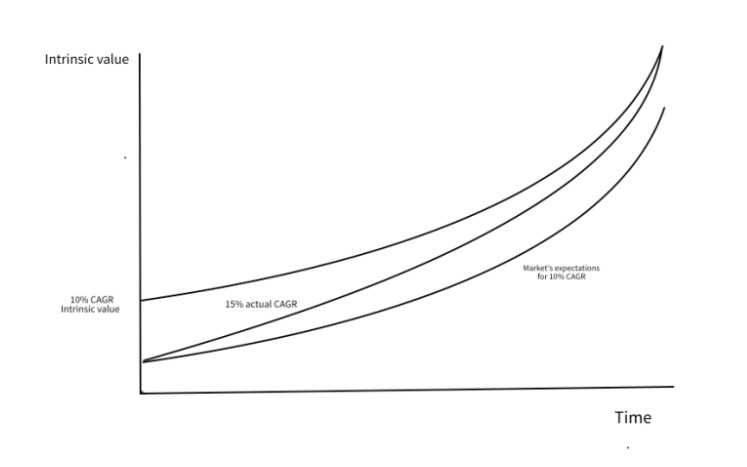
Let’s say the average market’s required rate of return is 10%. The line at the bottom is what the market thinks the intrinsic value is based on a 10% required return. But the company exceeds the market’s expectations, resulting in the stock price following the middle line instead and a 15% annual return.
The market underwrites a larger discount rate
Even if the market has high expectations for a company’s growth, the market may want a higher rate of return as the market is uncertain of the growth playing out. The market is only willing to pay a lower price for the business, thus creating an opportunity to earn higher returns.
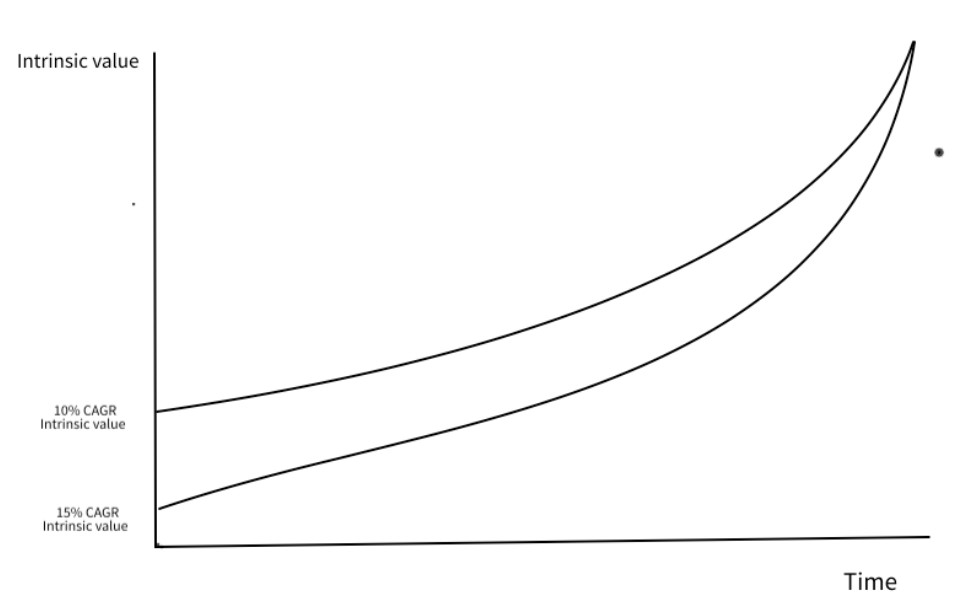
The line below is what investors can earn which is more than the 10% return if the market was more confident about the company.
Deep value stocks
Alternatively, another group of investors may prefer to invest in companies whose share prices are below their intrinsic values now.
Rather than looking at future intrinsic values and waiting for the growth to play out, some investors simply opt to buy stocks trading below their intrinsic values and hoping that the company’s stock closes the gap. The chart below illustrates how this will work.
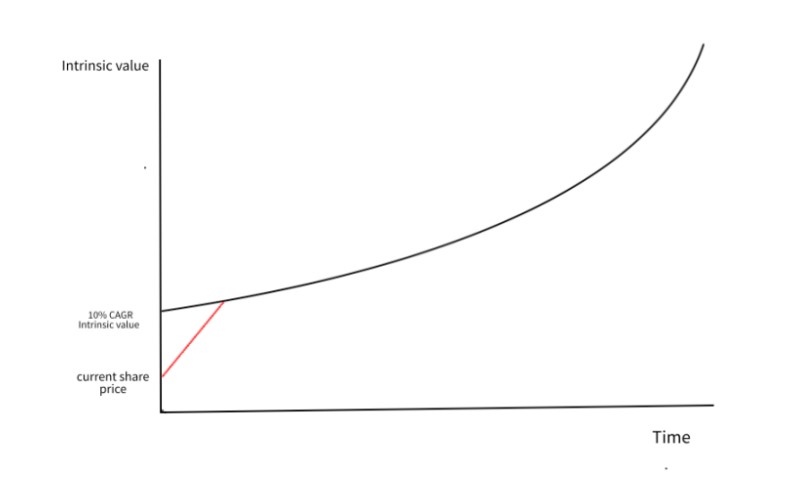
The black line is the intrinsic value of the company based on a 10% required return. The beginning of the red line is where the stock price is at. The red line is what investors hope will happen over time as the stock price closes the gap with its intrinsic value. Once the gap closes, investors then exit the position and hop on the next opportunity to repeat the process.
Pros and cons
All investing styles have their own pros and cons.
- Underappreciated growth
For long-term investing in companies with underappreciated growth prospects, investors need to be right about the future growth of the company. To do so, investors must have a keen understanding of the business background, growth potential, competition, potential that the growth plays out and why the market may be underestimating the growth of the company.
This requires in-depth knowledge of the company and requires conviction in the management team being able to execute better than the market expects of them.
- Underwriting larger discount rates
For companies that the market has high hopes for but is only willing to underwrite a larger discount rate due to the uncertainty around the business, investors need to also have in-depth knowledge of the company and have more certainty than the market that the growth will eventually play out.
Again, this may require a good grasp of the business fundamentals and the probability of the growth playing out. - Undervalued companies
Thirdly, investors who invest in companies based on valuations being too low now, also need a keen understanding of the business. Opportunities can arise due to short-term misconceptions of a company but investors must have a differentiated view of the company from the rest of the market.
A near-term catalyst is often required for the market to realise the discrepancy. A catalyst can be in the form of dividend increases or management unlocking shareholder value through spin-offs etc. This style of investing often requires more hard work as investors need to identify where the catalyst will come from. Absent a catalyst, the stock may remain undervalued for long periods, resulting in less-than-optimal returns. In addition, new opportunities need to be found after each exit.
What’s your edge?
Active fundamental investors who want to beat the market can use many different styles to beat the market. While each style has its own limitations, if done correctly, all of these techniques can achieve market-beating returns over time.
Note: An earlier version of this article was published at The Good Investors, a personal blog run by our friends.
The future of Artificial Intelligence (AI) is upon us, and it has never been more important to understand its progress. We’ve just released an urgent Special Free Report that explores all the opportunities and dangers of AI. Discover the steps you must take to prepare your portfolio for the inevitable AI boom. Click here to download the complimentary report now.
Follow us on Facebook and Telegram for the latest investing news and analyses!
Disclosure: Jeremy Chia does not own shares in any of the companies mentioned.